
 kevin@skalia.ca


AI Customer Service Agents: Where to Draw the Line Between Bot and Human
An AI agent can respond 24/7 and handle the FAQ, but it misses the emotional cues and disputes. Here's where to draw the line between bot and human, case by case, so you save time without damaging your brand.
- An AI customer service agent excels at FAQs, qualification, and 24/7 availability.
- It handles emotion, complex cases, and disputes poorly: plan a clear escalation path to a human.
- The real risk isn't the AI — it's an AI that refuses to hand off.
- Skalia's position: AI filters, humans handle what matters.
What does an AI customer service agent do well?
An AI customer service agent handles anything repetitive, factual, and free of emotional weight very well. Concretely: answering frequently asked questions, qualifying an incoming request, giving an order status, routing to the right department. On these tasks, it never gets tired and responds within seconds.
The biggest win is availability. An AI agent responds at 3 a.m., on a Sunday, during peak periods. It absorbs the volume your team can't handle without hiring. For a small or medium business, that means no longer losing requests that come in outside office hours.
It's also very good ahead of the sale. Asking three qualifying questions, capturing a need, a budget, a timeline: this is structured work, perfect for AI. That's exactly the logic behind an AI SDR that sorts contacts before handing them to a human sales rep.
Finally, it frees up mental bandwidth. Your teams stop repeating the same answers ten times a day. They focus on the exchanges where their presence truly makes a difference.
What does an AI agent handle poorly?
An AI agent handles anything involving emotion, ambiguity, and high stakes poorly. An angry customer, a dispute, a refund request, a case outside the standard process: here, an automated reply annoys more than it helps. The customer feels the wall going up and gets defensive.
Emotion is the first blind spot. AI can detect a negative tone, but it doesn't truly reassure a disappointed customer. The right sentence, said at the right moment by a human, defuses a situation that ten automated messages would make worse.
Complex cases are the second blind spot. As soon as a request falls outside the script, mixes several issues, or requires a judgment call, the AI improvises. And an AI improvising on a sensitive topic is a risk of factual error or a promise you can't keep.
The third blind spot is high-stakes decisions: a goodwill gesture, an exception, a contractual commitment. These choices bind your company. They should stay in the hands of a human who can own the outcome and adapt.
Where should you draw the line between bot and human?
The line is drawn request by request, not customer by customer: AI takes the first contact and the simple cases, humans handle anything with emotional or financial stakes. It's not “AI or human” — it's “AI first, human when it matters.”
The principle is simple: AI filters, humans handle. The majority of requests are repetitive and AI absorbs them. The minority that really matter, for satisfaction as much as for revenue, get escalated to a person. You're not diluting your customer relationship — you're refocusing it.
Here's how to split the most common cases.
| Customer case | AI alone | Human required |
|---|---|---|
| Question about hours, price, stock | Yes | No |
| Order or delivery tracking | Yes | No |
| Qualifying an inbound prospect | Yes | No |
| Complaint from an unhappy customer | No | Yes |
| Refund request or dispute | No | Yes |
| Negotiation, goodwill gesture | No | Yes |
| Complex technical case outside the FAQ | No | Yes |
Set the line by observing your real conversations. Identify the 20% of requests that keep coming back: hand them to the AI. Keep the rest for your teams. It's the same logic as choosing which marketing tasks to automate: you automate the repetitive, not the strategic.
How do you get escalation to a human right?
A good escalation triggers quickly, without making the customer repeat themselves and without lying to them about who they're talking to. This is the point that makes or breaks an AI customer service agent. An AI that traps a frustrated customer in a loop is worse than no AI at all.
Three rules make escalation smooth. First, a clear trigger: words signaling dissatisfaction, an explicit request for a human, or simply the AI hitting a wall twice. Second, context handoff: the human receives the history, the customer doesn't start from scratch. Third, transparency: you disclose that it's an AI, and you announce the handoff to a person.
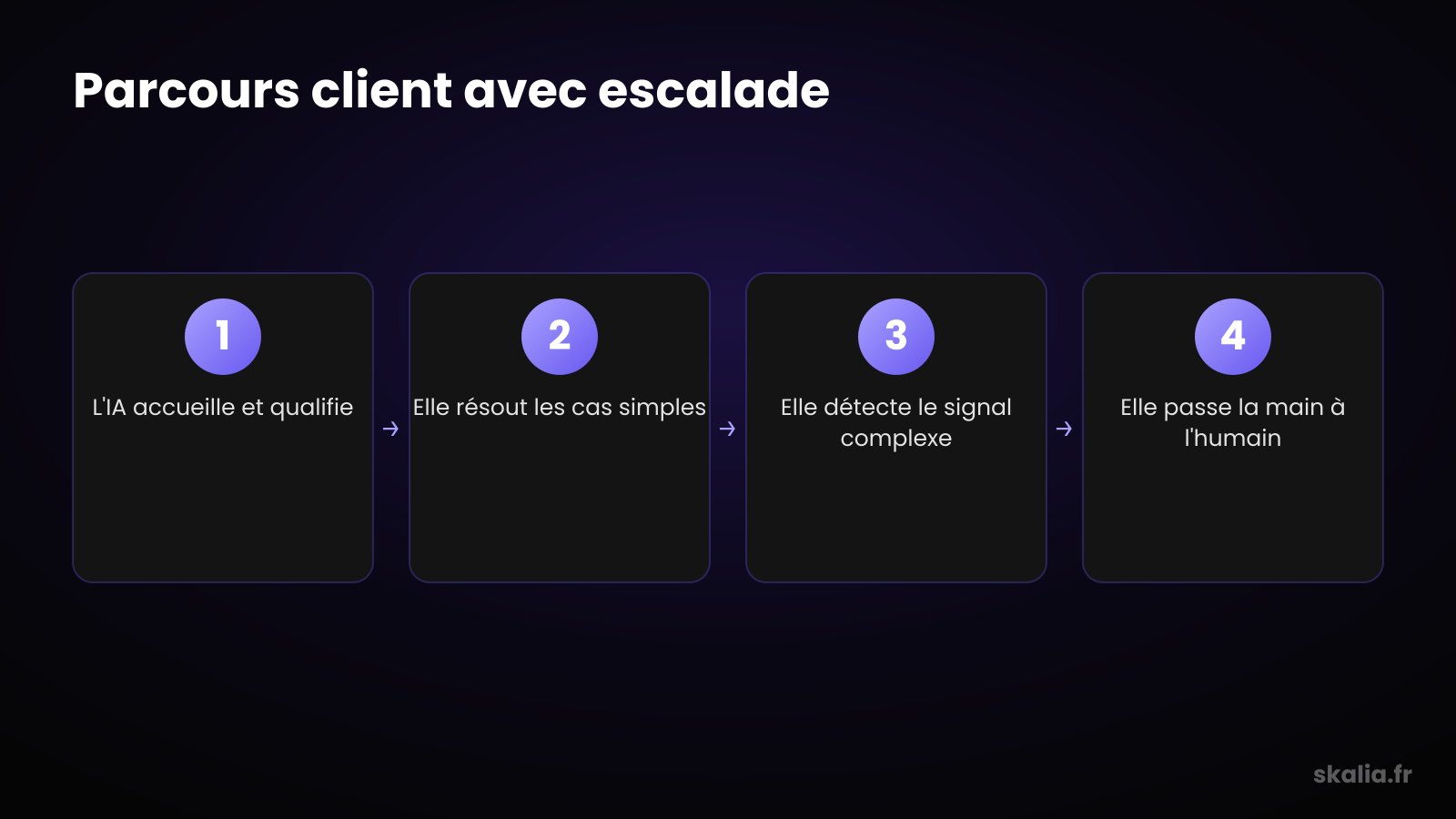
The ideal journey looks like this.
- The AI welcomes the customer, identifies the need, and qualifies it.
- It resolves simple, frequent requests on its own.
- It detects a complex signal: emotion, dispute, off-script.
- It hands off to a human with full context.
This signal detection is the same intelligence behind signal-based selling applied to support: reacting at the right moment, on the right cue. An AI agent that knows how to say “let me hand this over” is worth a thousand times more than an agent that pretends to know everything.
What are the risks of a poorly scoped AI agent?
The first risk of a poorly scoped AI agent is customer frustration, and it's costly: a customer stuck in an automated loop keeps a negative memory that no fast response can offset. Speed is worthless if it leads nowhere.
The second risk affects your brand image. An AI that answers off-topic, invents information, or refuses to hand off gives the impression of a company hiding behind a robot. On a public dispute, an online review, or social media, the effect is immediate and lasting.
The third risk is legal and commercial. An AI that promises a refund, a deadline, or a discount it shouldn't makes a commitment on your behalf. Hence the rule: never a high-stakes decision without human validation.
These risks don't condemn AI. They simply require scoping it properly: a clear perimeter, fast escalation, transparency. Set up well, a support AI improves satisfaction. Set up poorly, it damages it.
How do you deploy an AI customer service agent without breaking things?
You deploy an AI customer service agent in stages, on a narrow scope first, never as a brutal replacement for your team. Start with the 5 to 10 most frequent questions, measure, then expand only what works.
A few concrete best practices. First, write your reference answers: an AI is only as good as its knowledge base. Set clear boundaries on its scope: it answers what it knows and escalates the rest. Test with real conversations before going live publicly. And monitor exchanges every week to fix any missteps.
Always keep a visible exit door to a human. A button, a phrase, a channel: the customer should never feel trapped. This safety net reassures and, paradoxically, reduces the number of escalations, because the customer tries the AI first knowing they can switch over.
If you're starting from scratch with AI, don't begin with customer support. It's a high-emotion area. Our advice on getting started with AI marketing recommends internal, low-risk tasks before touching the customer-facing side.
FAQ: AI agents and customer service
Can an AI agent completely replace human support?
No, and that's not the goal. AI absorbs repetitive volume and provides 24/7 availability, but emotion, disputes, and high-stakes decisions remain human. The right model is hybrid: AI filters, humans handle what truly matters.
How do you avoid frustrating a customer with an AI?
Plan a fast, visible escalation path to a human, never make the customer repeat themselves, and be transparent about the fact that they're talking to an AI. Frustration almost always comes from a dead-end loop, not from the AI itself.
Can an AI agent handle phone prospecting?
Partly. An AI can call, qualify, and book simple appointments, as shown by AI-driven phone prospecting. But as soon as an exchange requires negotiation or nuance, a human sales rep remains essential to close the deal.
How long does it take to deploy an AI customer service agent?
Expect a few days for a narrow scope, a few weeks for a solid rollout. Most of the work isn't technical: it's preparing the knowledge base and defining the escalation rules.
Taking action with a well-calibrated AI agent
A successful AI customer service agent doesn't try to do everything: it handles the repetitive well and leaves the human in charge of what has real stakes. The ideal line, AI filters, human handles what matters, is set by observing your real conversations, not by copying a competitor.
At Skalia, we set this line with you: scope, escalation, knowledge base, measurement. We automate what should be automated and protect what makes your customer relationship valuable. If you want to know where to start without taking any risks, our approach to getting started with AI marketing lays the groundwork. Let's talk about it.