
 kevin@skalia.ca


Getting Google Reviews in 2026: Method and Pitfalls to Avoid

Google reviews carry serious weight for your local visibility and contact rate. Here's a simple method to get more of them, without falling into prohibited practices that can get your listing removed.
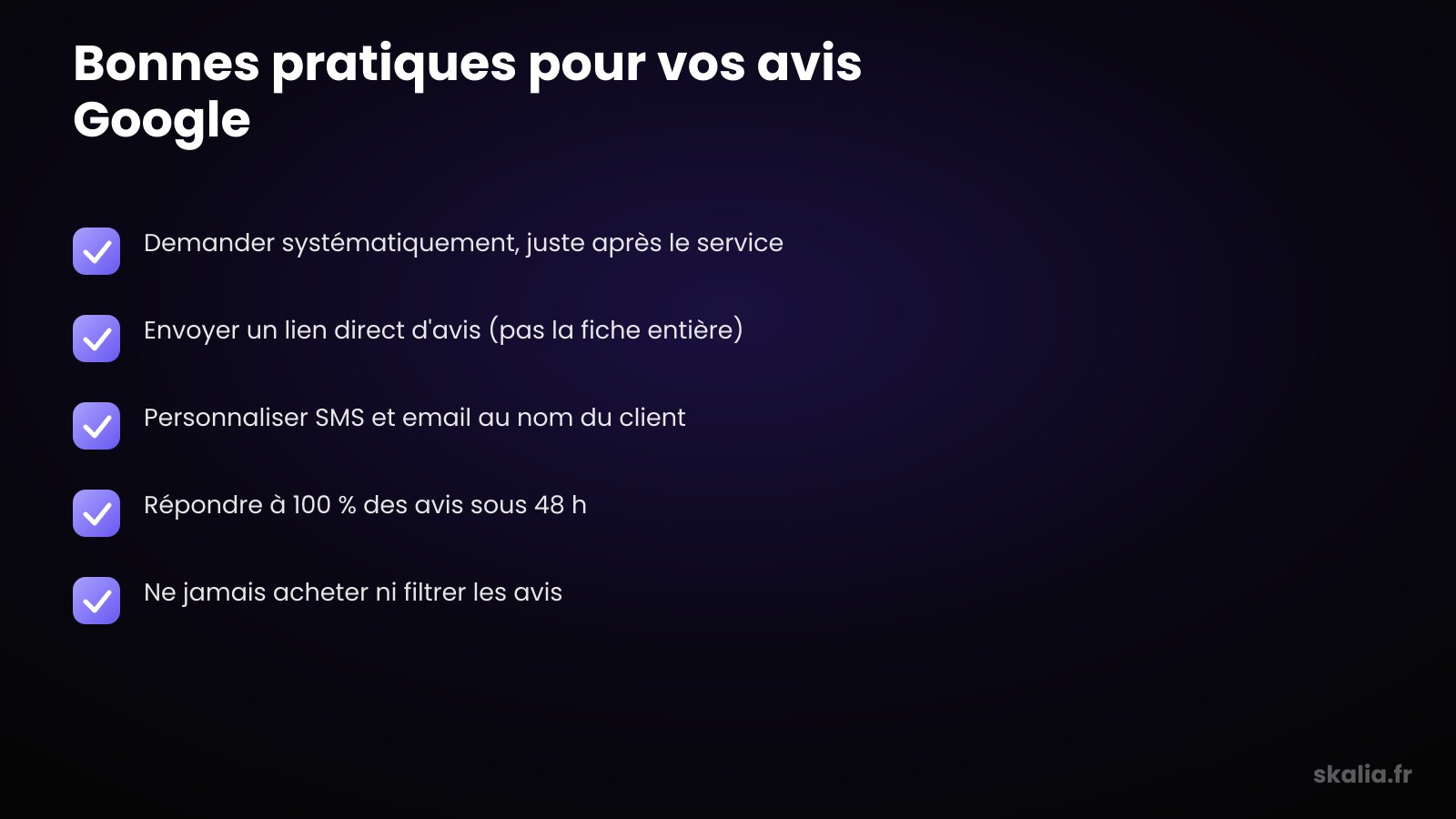
- Ask for a review systematically, right after a successful service.
- Make it as easy as possible with a direct review link (text, email, or QR code).
- Respond to 100% of reviews, positive and negative alike, within 48 hours.
- Never buy reviews and never filter customers: Google removes the listings involved.
How Do You Get More Google Reviews in 2026?
To get more Google reviews, ask systematically at the right moment, make the process as frictionless as possible, and respond to every review. These three habits form a loop. The vast majority of satisfied customers will leave a review if you simply ask and hand them a direct link.
Most businesses wait for reviews to show up on their own. That's a mistake. A happy customer rarely thinks to rate you unprompted. But they'll say yes almost every time if you ask at the right moment, right after a successful experience.
The goal isn't to rack up hundreds of reviews all at once. A steady stream of new reviews matters more than a big spike followed by six months of silence. Google and prospective customers both pay attention to freshness as much as volume.
Why Are Google Reviews So Decisive for a Small Business?
Google reviews act on two levers at once: your local search ranking and your contact rate. They're among the signals people look at most before choosing a nearby business, and they're also factored into local pack ranking.
For SEO, your average rating, review count, freshness, and your responses are all signals Google uses. An active listing with recent reviews and replies sends a message of reliability. For more on this, see our article on the Google local pack and local SEO.
For conversion, the effect is direct. Between two tradespeople with the same rating, a prospect will almost always choose the one with more recent reviews who actually responds. Reviews build trust before the first call even happens. They do part of the selling for you.
A rating that's too perfect can even raise suspicion. A few well-handled mixed reviews, with a measured response from you, often inspire more confidence than a suspiciously flawless record.
When Should You Ask for a Google Review?
The best time to ask for a review is right after a successful service, when satisfaction is at its peak. Response rates drop fast over time: a request sent the same day converts far better than a reminder a week later.
Identify your moment of peak satisfaction. For a restaurant, it's at the end of the meal. For a tradesperson, at handover of keys or project completion. For a service business, at delivery, or the moment the client thanks you. That's when to ask.
Ask out loud first, then follow up in writing. A "would you mind leaving us a Google review?" at the end of a job sets the stage. The text or email that follows just makes the action easier. You can also schedule a single reminder 48 hours later for those who haven't responded, without ever nagging.
How Do You Make Leaving a Review as Easy as Possible?
Make it easy by sending a direct review link — the one that opens the rating form in a single click, not the full listing page. Every step you remove increases the response rate. A direct link, a QR code, and a pre-written message are enough to remove the friction.
Grab your direct review link from your Google Business Profile listing, in the "Ask for reviews" section. Shorten it if needed and keep it handy. Our Google Business Profile guide explains where to find it and how to optimize your listing.
Then, multiply your touchpoints depending on your business:
- A QR code on the receipt, counter, business card, or quote
- A link in your email signature
- A text message sent right after the service
- A follow-up email with the link clearly visible
- A card handed over in person with the QR code
Always personalize the message with the customer's name. A "Hi Mark, thanks for trusting us — your review would help us a lot" converts better than a generic, cold blast.
Which Channel Should You Choose to Ask for a Google Review?
Text messages remain the most effective channel for requesting reviews, with the best response rate, followed by email and on-site QR codes. The right choice depends on your business and the moment of contact. Here are the benchmarks to weigh the main request channels.
| Channel | Indicative Response Rate | When to Use It |
|---|---|---|
| Text with direct link | 15-25% | Service with known mobile number, same-day while it's fresh |
| Follow-up email | 5-12% | Online sales, B2B, when you have the email but not the mobile number |
| On-site QR code | Variable, depends on foot traffic | Retail, restaurant, waiting room, quote handover |
| Verbal request + card | 10-20% | Tradesperson, in-home service, face-to-face contact |
| Link in email signature | Low but continuous | Everyday exchanges, cumulative effect |
These ranges are rough benchmarks: they vary by sector, the quality of your customer relationship, and how much care goes into the message. Text almost always wins when you have the customer's mobile number. Combine several channels rather than relying on just one.
What's Prohibited When It Comes to Getting Reviews?
Buying reviews, posting fake ones, and filtering customers to only ask the satisfied ones are all explicitly prohibited by Google. These practices violate platform rules and can lead to reviews being removed, or even the whole listing. Legal risk exists in France too.
In concrete terms, these are the red lines you don't cross:
- Buying reviews or packages of fake reviews, even "realistic" ones
- Writing your own reviews or having friends and family write them
- Offering a discount or gift in exchange for a positive review
- Gating: only asking satisfied customers for a Google review and diverting unhappy ones elsewhere
- Threatening or paying a customer to remove a negative review
Gating is the most common trap, because it seems clever. It's prohibited: you must ask every customer for a review, without filtering. In practice, if your service is genuinely good, your average holds up on its own. A rating that's honest and durable beats a perfect listing that gets wiped out overnight.
How Should You Respond to Reviews, Positive and Negative?
Respond to 100% of reviews, ideally within 48 hours, since a response is a reliability signal for both Google and future customers reading it. A short, personalized, calm reply is enough. A business's response rate is publicly visible and factors into the decision.
For a positive review, thank the customer by name and add a concrete detail. "Thanks Sophie, so glad you love your new hardwood floor, see you soon" beats an automatic "Thanks!" You can naturally mention your service or city, without forcing it.
For a negative review, stay calm. Thank them for the feedback, acknowledge how they feel, offer to resolve the issue offline (phone, email). Don't over-justify yourself and don't get drawn into a public dispute. Prospects mostly read your attitude, not just the complaint. A composed reply to a mixed review often reassures more than a wall of five-star ratings.
A fake or defamatory review can be reported to Google for removal. Processing takes time and doesn't always succeed, so treat every review first as an opportunity to show your professionalism.
FAQ
How Many Google Reviews Do You Need to Be Credible?
There's no magic threshold, but crossing about twenty reviews with a rating above 4 out of 5 reassures most prospects. What matters as much as the total is consistency: a few recent reviews each month beat a large batch that's old and frozen in time.
Can You Offer a Discount in Exchange for a Google Review?
No. Rewarding a review, even without requiring it to be positive, violates Google's rules and can get your reviews removed. You can thank customers warmly, but never pay for a review with a discount, a gift, or a prize draw.
Does a Negative Review Really Hurt My Ranking?
Not directly, if it stays isolated and is well handled. A composed reply to a negative review can even send a positive signal. What actually hurts is an accumulation of unanswered complaints, or an overall rating that drops sharply. See our 2026 SEO fundamentals to place reviews in the bigger picture.
How Do I Get My Direct Google Review Link?
From your Google Business Profile listing, open the reviews management section and click "Ask for reviews": you'll get a short link to share. It opens the rating form directly. Copy it once and reuse it across all your texts, emails, and QR codes.
Move to a Steady Habit of Collecting Reviews
Getting Google reviews isn't rocket science: it's a simple routine — ask, make it easy, respond — repeated after every customer. The real work is consistency, not a one-off push. Within a few months, a listing that's actively maintained clearly stands out from local competitors.
If you want to structure this collection process and tie it into the rest of your visibility strategy, our team supports small and mid-sized businesses in the region on exactly this, as detailed on our local SEO agency in Toulouse page. Let's talk: a quick audit of your listing is often enough to spot the first quick wins.