
 kevin@skalia.ca


Minimum Google Ads Budget in 2026: How Much Should You Plan For?

How much do you really need to put into Google Ads for it to work? Here's the realistic floor, the CPC × clicks × conversion calculation logic, and a table of recommended budgets by industry.
- Budget a realistic floor of €500 to €1,000/month in ad spend, comfortable from €1,500 to €2,000/month.
- The minimum budget depends on your industry's CPC: local is cheap, legal and insurance are very expensive.
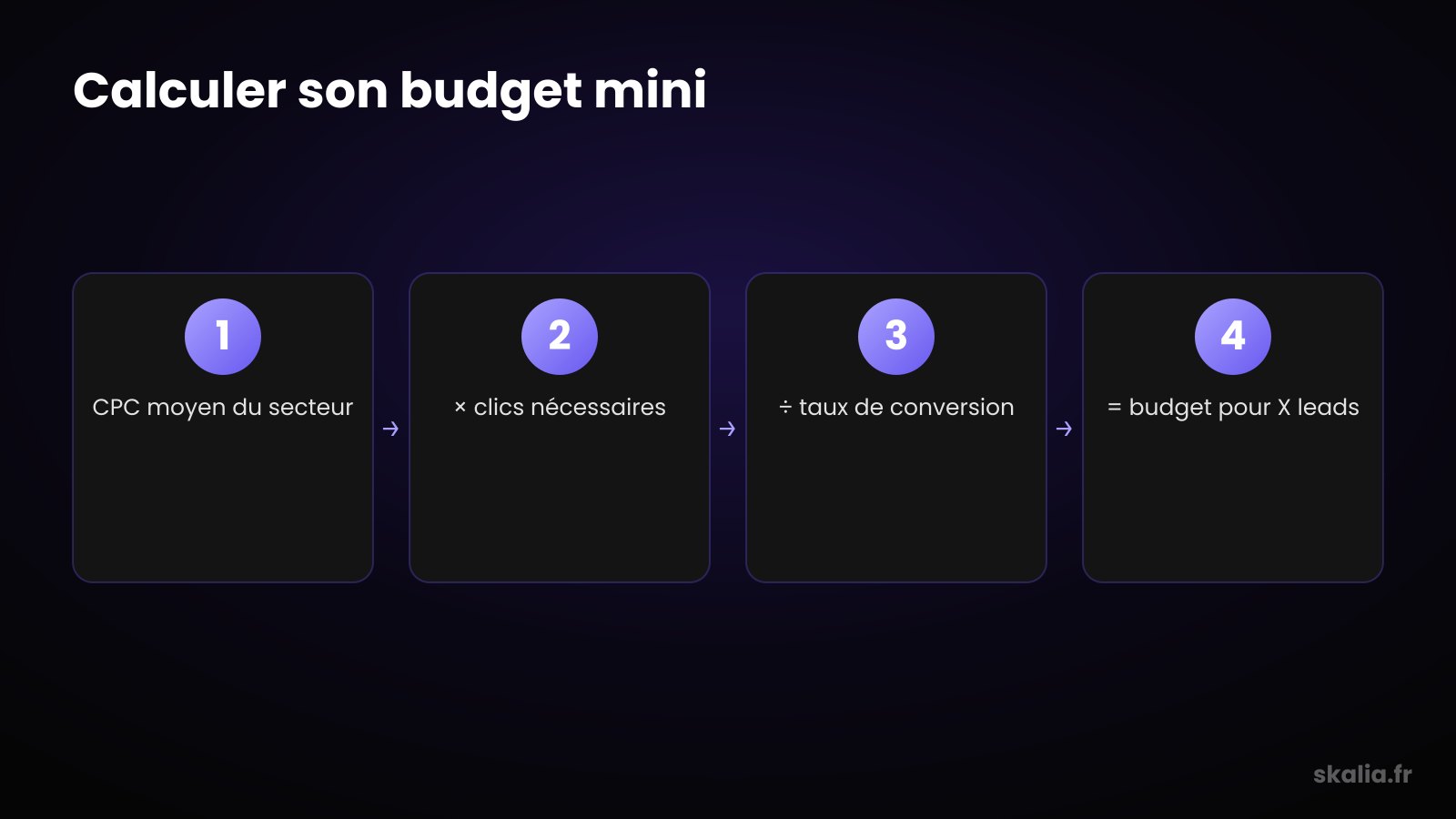
- Calculation logic: average CPC × clicks needed ÷ target conversion rate.
- A budget that's too small fails: the algorithm lacks the data to optimize.
- Better to concentrate a small budget on few keywords than spread it thin everywhere.
What is the minimum budget for Google Ads in 2026?
The realistic minimum budget for Google Ads in 2026 sits between €500 and €1,000/month in ad spend, becoming comfortable from €1,500 to €2,000/month. This floor varies by industry and by your keywords' cost per click (CPC). Below €500, campaigns struggle to collect enough data to optimize.
This budget covers only the money paid to Google, not management fees. A local tradesperson in a low-competition area can usefully start with €500/month. A law firm or insurance broker, bidding on keywords at €8 or €15 per click, will need €2,000 to €3,000/month to generate a workable volume.
The classic mistake is launching a campaign at €150 or €200/month "to test it out." At that level, you're buying too few clicks to draw a reliable conclusion. The test costs you time and produces unrepresentative numbers.
Why does too small a budget make a campaign fail?
A budget that's too small fails because Google's algorithm lacks the data to exit the learning phase. Google recommends roughly 30 to 50 conversions per month per campaign for automated bidding to optimize properly. With just a few clicks a day, the system never gathers enough signal to learn.
In practice, a campaign goes through a 7- to 14-day learning phase after every major change. During this period, Google explores different combinations of audiences, schedules, and devices. If your budget only funds 3 or 4 clicks a day, that exploration goes nowhere. Performance stays unstable and often disappointing.
There's also a dilution effect. With a small budget spread across too many keywords, each term gets only a handful of impressions. None accumulates enough history for Google to identify what converts. The result: a high cost per acquisition and the impression that "Google Ads doesn't work."
How many conversions should you aim for per month?
Aim for at least 15 to 30 conversions per month per campaign to cleanly exit the learning phase. Below that, stick with manual bidding or maximum CPC, which is less data-hungry. Moving to automated bidding (maximize conversions, target CPA) requires this baseline of regular conversions.
How do you calculate your minimum Google Ads budget?
Calculating your minimum Google Ads budget relies on three variables: your industry's average CPC, the number of clicks needed, and your conversion rate. The base formula is: average CPC × target number of clicks = ad spend. To think in terms of leads, divide the number of leads you want by your conversion rate to get the clicks you need to buy.
Take a concrete example. You want 10 leads a month. Your landing page converts at 5%. You need 200 clicks (10 ÷ 0.05). If your average CPC is €3, your minimum ad spend is €600/month (200 × 3). Change one variable and everything shifts: at €8 per click, that same goal requires €1,600/month.
This reasoning shows why there's no universal minimum budget. A high CPC, a low conversion rate, or an ambitious volume target all push the budget up. Before setting an amount, quantify your goal in leads, then work backward through the chain.
To fine-tune these settings once your campaign is live, how you allocate the daily budget matters as much as the total amount. We cover this in our 6 Google Ads settings to check.
What's the minimum ad spend by industry?
The recommended minimum ad spend ranges from €500/month for a low-competition local business to €2,500/month for high-CPC industries like legal or insurance. The deciding factor remains cost per click, which is directly driven by keyword competition. The more contested an industry, the higher the bid climbs.
Here are realistic benchmarks for the French market in 2026. The CPC figures shown are orders of magnitude: your actual numbers depend on your area, your Quality Score, and seasonality.
| Business type | Indicative CPC | Recommended minimum ad spend |
|---|---|---|
| Low-competition local (tradesperson, restaurant) | €0.80 to €2 | €500/month |
| Consumer services (coach, beauty) | €2 to €4 | €700 to €1,000/month |
| General e-commerce | €0.50 to €3 | €1,000/month |
| Construction, renovation, specialized trades | €4 to €8 | €1,500/month |
| B2B, software, training | €5 to €12 | €1,800 to €2,500/month |
| Legal, insurance, healthcare | €8 to €20 | €2,500/month |
A low CPC doesn't guarantee a small budget: you still need a good conversion rate. Conversely, an expensive industry can stay profitable if customer lifetime value is high. Your Quality Score also directly influences actual CPC: a well-aligned ad and landing page lower the cost per click.
Ad spend vs. management fees: what's the difference?
Ad spend is the money paid directly to Google to display your ads, while management fees pay the agency or freelancer running the campaigns. These are two distinct line items. Confusing them skews any profitability calculation and gives a distorted picture of the real cost.
Ad spend funds the clicks. It goes up or down based on your goals and is set within your Google Ads account. Fees, on the other hand, cover strategy, ad creation, ongoing optimization, and reporting. In France, they typically take the form of a flat fee, a percentage of spend (often 10 to 20%), or a hybrid model.
For a small or mid-sized business, plan for two separate budgets. Example: €1,000/month in ad spend plus €400 to €800/month in fees. We break down the models and ranges in our article on Google Ads agency pricing. Remember the principle: ad spend never includes management.
Small budget: should you concentrate or spread it out?
With a small budget, you should always concentrate rather than spread out. A €500/month budget placed on 3 to 5 highly targeted, high-intent keywords consistently outperforms the same budget spread across 40 vague keywords. Concentration gives each term enough impressions to build a usable history.
The logic is simple. Google optimizes better where it has data. By focusing your euros on high purchase-intent queries — think "emergency plumber Toulouse" rather than "plumbing" — you capture qualified clicks and limit waste. Broad keywords burn through budget without converting.
This approach also applies to geographic targeting. A tradesperson benefits from restricting their ads to their actual service area. Broadcasting across an entire region dilutes the budget on unreachable searches. Tight targeting turns a small budget into a local lead-generating machine, provided you choose the right platform: our comparison Google Ads or Meta Ads helps you decide.
FAQ
Can you run Google Ads with €200 a month?
Technically yes, but it's rarely worthwhile. At €200/month, you're buying too few clicks for the algorithm to optimize or for you to draw reliable conclusions. This budget might suit an ultra-local business with a very low CPC, on just one or two keywords. Beyond that, aim for €500/month minimum.
Does the minimum budget include agency fees?
No. The minimum budget discussed here refers only to the ad spend paid to Google. Management fees for an agency or freelancer are a separate line item, generally between €400 and €1,500/month depending on the model. Always plan for both budgets in your profitability calculation.
How long before you see results?
Plan on 2 to 4 weeks to get past the learning phase and obtain stable data. First clicks arrive within hours, but reliable insights require accumulating enough conversions. With too small a budget, this phase drags on indefinitely because the signals stay insufficient.
Should you increase your budget gradually?
Yes, increase in increments of 20 to 30% maximum at a time. A sudden jump restarts the learning phase and destabilizes performance. Start at your industry's realistic floor, let campaigns stabilize, then raise the budget once cost per lead is under control and profitable.
Setting the right budget with Skalia
The minimum Google Ads budget isn't a magic number: it's the result of your CPC, your goals, and your conversion rate. A floor of €500 to €1,000/month is enough to start cleanly in most industries, provided you concentrate your euros on the right keywords and clearly separate ad spend from management fees.
At Skalia, we calculate your minimum budget based on your actual lead targets, industry by industry, before launching anything. To go further, discover our focused acquisition strategy approach. Unsure how much to invest? Let's talk — we'll give you a realistic floor, no jargon.