
 kevin@skalia.ca


Google Ads or Meta Ads: Which One to Choose for Your Business
Should you invest in Google Ads or Meta Ads? There's no one-size-fits-all answer: it all depends on how your customers buy. Here's how to decide quickly, based on your type of business, your sales cycle, and your starting budget.
- Google Ads captures demand that already exists, Meta Ads creates desire among people who weren't looking for you.
- Choose Google if people search for your service (plumber, lawyer, emergency, B2B) and Meta if your product is visual or impulse-driven.
- Short sales cycle + high order value lean toward Google; discovery + emotional purchase lean toward Meta.
- Plan for €800 to €1,000/month in media budget to seriously test a channel before judging it.
Google Ads or Meta Ads: what's the real difference?
The difference boils down to one sentence: Google Ads captures demand that already exists, Meta Ads creates that demand. On Google, someone types “emergency locksmith Toulouse”: they want to buy right now. On Meta (Facebook and Instagram), nobody is searching for your offer: they're scrolling, and it's your ad that sparks the desire.
This isn't a technical nuance, it's the starting point for your entire strategy. On Google, you respond to an intent. On Meta, you create an intent. The same euro invested doesn't work the same way depending on the channel.
In practice, this changes everything: the message, the visual, the moment the searcher buys, and above all the cost per result. An urgent service sells much better on Google. A desirable product sells better on Meta. The rest of this article helps you decide for your business.
When should you prioritize Google Ads?
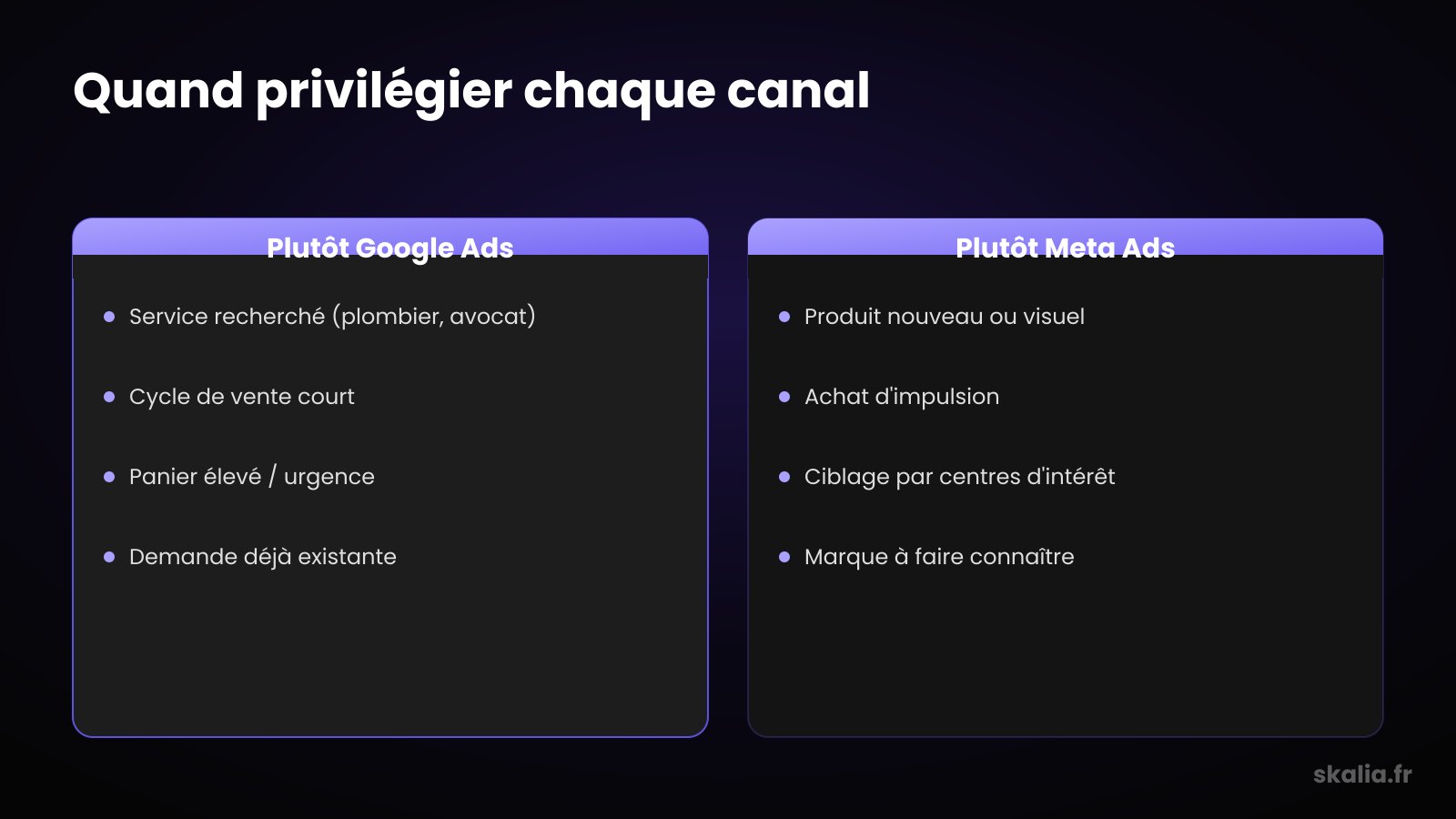
Prioritize Google Ads when your customers are actively searching for what you sell. If your service gets typed into a search bar (“plumber,” “divorce lawyer,” “invoicing software”), the demand already exists and all you need to do is show up at the right moment. It's the channel of intent.
Google Ads is particularly effective in four cases:
- **Urgency**: emergency repairs, locksmiths, plumbers, IT support. The need is immediate, the click is expensive but converts fast.
- **B2B** and professional services: firms, consultants, tradespeople, service providers. The prospect qualifies their own need by typing the query.
- **High order value**: a €3,000 quote justifies a cost per click of €4 or €5.
- **Short sales cycle**: people search, compare, and get in touch the same day.
The downside is the price of the click. In competitive industries, a click can exceed €5 to €8, and a poorly configured campaign burns through the budget fast. That's where Google Ads Quality Score makes the difference: the more relevant your ad, the less you pay per click. Before you dive in, also check the realistic minimum budget for Google Ads for your sector.
When should you prioritize Meta Ads?
Prioritize Meta Ads when your offer sells through image and emotion, not through search. On Facebook and Instagram, nobody is searching for your product: you have to capture the attention of a user who's scrolling. It's the ideal channel to create demand where it doesn't yet exist.
Meta Ads shines especially in these situations:
- **Visual products**: fashion, home decor, cosmetics, food, crafts. A beautiful photo or a short video sells better than text.
- **Impulse buying** and lower order values: people discover, desire, and buy on the spot.
- **Interest-based targeting**: you reach a precise audience (young parents, athletes, decision-makers in a given industry) even if they don't yet know you.
- **Brand awareness**: introducing a brand, a launch, a seasonal offer.
Meta's advantage is a cost per click that's often lower than Google's, plus very fine-grained targeting. In exchange, demand isn't “warm”: you need a good visual, a clear offer, and often several touchpoints before the purchase. Solid structuring of your Meta Ads campaigns prevents you from wasting your budget on disorganized tests.
Google Ads vs Meta Ads: the comparison table
Here's the essence of both channels summarized across the four criteria that matter: intent, cost, sales cycle, and ideal business type. This table gives you a first direction in ten seconds, before you refine it for your specific case.
| Criterion | Google Ads | Meta Ads |
|---|---|---|
| Intent | Captures existing demand | Creates demand |
| Mindset | The searcher is looking and ready to buy | The user is scrolling and discovering |
| Cost per click | Often higher (competitive industries) | Often lower |
| Sales cycle | Short, fast purchase | Longer, multiple touchpoints |
| Best for | Services, urgency, B2B, high order value | Visual products, e-commerce, impulse buys, awareness |
| Key message | Precise answer to a need | Hook, desire, emotional benefit |
Remember the underlying logic: Google to capture, Meta to create. The right decision criterion is always the same: cost per result, not the displayed cost per click.
Should you really choose one, or combine both?
Ideally, you don't choose: you combine, because the two channels reinforce each other. Meta builds awareness of your brand and plants the seed of desire; Google harvests that demand once the person, now aware of their need, types your name or your category. It's this complementarity that delivers the best results over time.
A concrete example. An e-commerce brand launches a new product: Meta introduces it to a targeted audience. A few days later, some of these people search for the brand name on Google: a Google campaign then captures these searches at a lower cost. Without Meta upstream, these searches would never have existed.
But combining doesn't mean doing everything at once with a small budget. If you're just starting out, it's better to concentrate your resources on the most obvious channel for your business, validate it, then open the second one. Spreading €500 across two platforms proves nothing anywhere.
What budget should you plan to test a channel?
Plan for at least €800 to €1,000/month in media budget to seriously test a single channel. Below that, the algorithm (Google as much as Meta) lacks the data to optimize, and you're drawing conclusions from too few conversions. A credible test also needs to run for at least 4 to 6 weeks.
This media budget is separate from management fees. If you delegate, add on the fees: our article on Google Ads agency pricing details common billing models. If you handle it in-house, budget mostly for time: creating ads, tracking numbers, adjusting every week.
One simple piece of advice: never judge a channel on a single week, or on cost per click alone. Look at cost per lead or per sale over a full month. A €6 click that generates a €2,000 customer remains excellent; a €0.30 click that never converts is a money pit.
How do you decide in practice for your business?
To decide quickly, ask yourself one single question: are people actively searching for what I sell? If yes, start with Google Ads. If not, if your offer is discovered through images, start with Meta Ads. This one reflex is enough to frame 80% of cases.
Three profiles to help you place yourself:
- **Tradesperson, local service, B2B, urgency**: Google first. Your customers type your trade, be there at the right moment.
- **E-commerce, product brand, visual or impulse-driven offer**: Meta first. Spark the desire, then capture the demand on Google.
- **Mixed business** (training, coaching, SaaS): test the more natural channel first, validate cost per lead, then open the second one.
One more decision remains, secondary but important: manage it yourself or delegate it. Both platforms are accessible, but regular oversight often makes the difference between a burned budget and a profitable campaign. Our comparison managing Google Ads yourself or working with an agency helps you decide based on your time and skills.
FAQ
Google Ads or Meta Ads: which one is cheaper?
Meta Ads often shows a lower cost per click than Google Ads, but that's not the right criterion. What matters is the cost per result: a more expensive Google click that converts quickly can end up cheaper than a Meta click that never converts. Compare sales, not clicks.
Can you run Google Ads and Meta Ads at the same time?
Yes, and it's actually ideal once each channel has been validated, because they complement each other: Meta creates demand, Google captures it. That said, if your budget is tight, focus on one channel first, prove its profitability, then open the second one without spreading yourself thin.
What's the minimum budget to get started?
Plan for at least €800 to €1,000/month in media budget per channel, over 4 to 6 weeks. Below that, the algorithms lack the data to optimize and your conclusions aren't reliable. This amount is separate from any management fees if you delegate the day-to-day handling.
Should an e-commerce business prioritize Meta Ads?
Often yes, especially for a visual or impulse-driven product, since Meta excels at creating desire through images. But keep a Google campaign active on branded searches and highly intentional queries: they capture, at low cost, the customers Meta has made aware of their need.
Google Ads or Meta Ads: where to start with Skalia?
The right channel is the one that matches how your customers buy, not the one that's trendy. Google to capture existing demand, Meta to create it: start from your business, your sales cycle, and your average order value, then validate with a serious test budget before drawing conclusions.
At Skalia, we help small and medium businesses in Toulouse and beyond choose the right channel, structure campaigns, and manage cost per result rather than cost per click. If you're still torn between the two, or if you want to weigh in-house management against outside support, our article managing Google Ads yourself or working with an agency is a good place to start. Let's talk about it.