
 kevin@skalia.ca


B2B Intent Data: How Do You Know Who's Ready to Buy?
Cold-calling a random list means talking to people who never asked for it. B2B intent data flips that logic: it tells you which accounts are moving, right now. Here's how to capture it, act on it, and stay GDPR-compliant.
- Intent data reveal which accounts are showing buying signals, so you can prospect the right ones at the right time.
- Two families: first-party (your site, your CRM) and third-party (external data networks).
- The right method: capture the signal, score the account, prioritize, reach out.
- On GDPR, favor account-level (company) targeting over non-consented individual targeting.
What Is B2B Intent Data?
B2B intent data refers to the set of behavioral signals indicating that a company is actively interested in a category of product or service. In concrete terms, it's intent data: it tells you which accounts are moving, searching, and comparing, instead of you guessing blindly.
The idea is simple. A prospect who reads your pricing page three times this week isn't at the same stage of maturity as a random contact pulled from a database. Intent data measures that gap. It turns a flat list into a prioritized one.
We're talking about buying signals in the broad sense: visits to sensitive pages, searches for keywords in your market, reading comparison content, company events (hiring, funding rounds, leadership changes). Each one tells part of the story. Together, they paint a picture of intent.
This is the foundation of signal-based selling: stop treating everyone the same, and focus effort where there's real movement.
First-Party or Third-Party: What Are the Two Families of Intent Data?
There are two broad families of intent data: first-party (your own data) and third-party (external data networks). The former are free and reliable but limited to your audience; the latter cover an entire market but cost more and require some perspective.
First-Party: Your Own Data
First-party intent data comes from your own channels. Your website, your CRM, your emails, your content. A visitor who comes back three times, a contact who reopens a quote, a lead who downloads a white paper: all of that is yours, and it's actionable right away.
Its strength is reliability. You know exactly where the signal came from. Its limit is volume: you only see people already in contact with your brand.
Third-Party: The Market Beyond Your Audience
Third-party intent data comes from networks that aggregate browsing behavior across thousands of sites (trade media, publishers, review platforms). These networks detect when a company is "overconsuming" a topic and flag the account to you, often before it ever lands on your radar.
Its value: capturing demand upstream, outside your own audience. Its limit: more noise and variable accuracy depending on the provider.
What Are the Main Types of Intent Data and How Do You Act on Them?
Each type of intent data has its own source and its own way of being acted on. A first-party signal should be treated as an immediate hot priority; a third-party signal feeds a target-account watchlist. The table below summarizes how to go from signal to action.
| Intent Data Type | Source | How to Act on It |
|---|---|---|
| Repeat visits to key pages | Your website (analytics, tracking) | Alert the sales rep, reach out within 24-48 hours |
| Reopened quotes or emails | Your CRM, your email tool | Follow up with a contextual message |
| Searches for market keywords | Third-party networks (topic intent) | Add the account to your target list |
| Company events | LinkedIn, enriched databases (hiring, funding) | Trigger a sequence based on the trigger |
| Engagement with your content | LinkedIn, social media | Move to personalized warm outreach |
| Viewing reviews / comparisons | Review platforms, third-party | Prioritize: the purchase is close |
The rule of thumb: a single signal is worth little, a combination of signals is worth a lot. A pricing-page visit plus a recent funding round is an account to act on immediately. This logic directly feeds a well-calibrated multichannel LinkedIn and email sequence.
How Do You Actually Put Intent Data to Work in Prospecting?
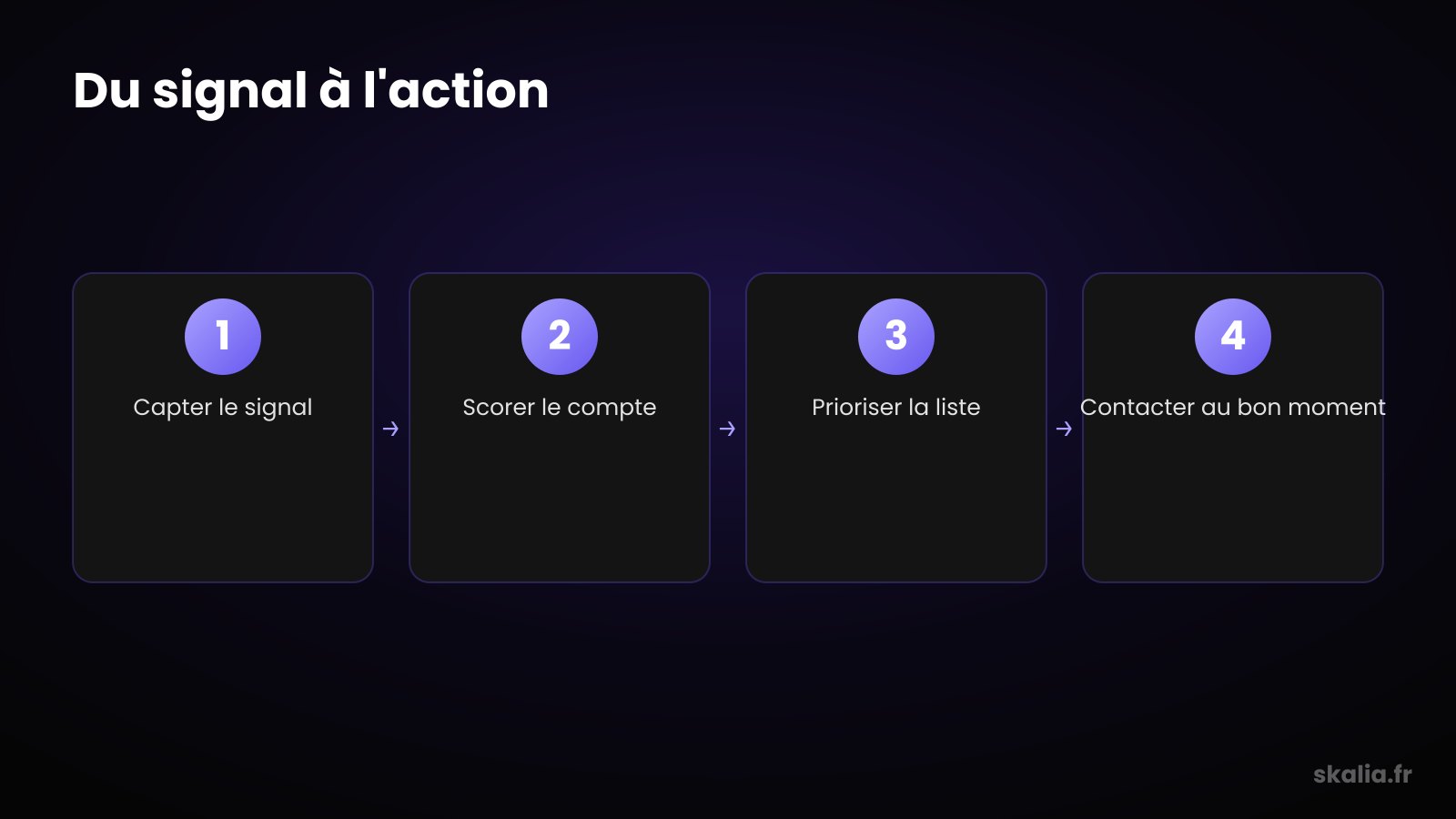
The method comes down to four steps: capture the signal, score the account, prioritize the list, reach out at the right moment. Without this framework, intent data stays a nice-looking dashboard that goes nowhere. Execution creates the value, not the raw data.
Step one, capture. Set up tracking on your sensitive pages, connect your CRM, and if needed, subscribe to a third-party network for your market.
Step two, score. Assign points per signal: pricing-page visit = 3, funding round = 5, email open = 1. An account that crosses a threshold becomes a priority.
Step three, prioritize. Every morning, your day's list isn't static: the hottest accounts rise to the top. You talk to the ones that are moving first.
Step four, reach out. Adapt the message to the signal detected. You don't follow up the same way with an account that just raised funding as with one that reopened a quote. This signal-plus-message pairing is at the heart of automated prospecting that stays relevant.
What Tools Can You Use to Capture and Act on B2B Intent Data?
No single tool covers everything: you combine a first-party signal tracker, a third-party provider, and an execution engine. The right stack depends on your market and budget, not the trendiest brand name. Start small, with your own data.
For first-party, a visitor-tracking tool (identifying which companies visit your site) plus a properly configured CRM is often enough to get started. You already see who's coming back, on which pages, how often.
For third-party, intent platforms (topic intent, publisher networks) and enriched databases with triggers (hiring, company news) take it further. Prices climb fast, so validate relevance for your sector first.
On execution, these are your usual sequencing tools. To choose, our comparison of the best prospecting tools breaks down the options by team size and preferred channel, especially on LinkedIn.
Intent Data and GDPR: What Can You Legally Do?
In B2B, using intent data at the account level (the company) is legally safer than non-consented individual targeting. GDPR governs personal data: as soon as a signal identifies a specific individual, you're within its scope. Thinking in terms of "company" rather than "person" limits the risk.
Three principles hold up. One, favor aggregated account-level signals over nominative tracking outside your own ecosystem. Two, for your first-party data, clearly inform visitors (privacy policy, banner) and respect their choices.
Three, for sales outreach, rely on legitimate interest in B2B, with a relevant message, an opt-out option, and a clean data source. These rules align with those detailed in our guide on cold email and GDPR. If in doubt about a third-party source, ask the provider for its legal basis and compliance documentation.
What Are the Limits of Intent Data to Keep in Mind?
Intent data doesn't predict a purchase: it indicates a higher probability, nothing more. A strong signal could come from an intern doing market research, a competitor, or idle curiosity with no budget. Treating it as a certainty wastes time and credibility.
Three traps come up often. The first, confusing volume with relevance: a third-party platform surfacing 500 "interested" accounts overwhelms you more than it helps. Filter it.
The second, forgetting the message. Detecting a signal isn't enough; you still need an opener that proves you understood the context. Otherwise you're just doing disguised cold outreach.
The third, over-investing too early. Before paying for an expensive third-party subscription, fully exploit your first-party data. It's free, reliable, and already covers a good share of hot accounts. This framing aligns with the logic of a profitable acquisition funnel: spend where the return is proven.
FAQ
What's the Difference Between First-Party and Third-Party Intent Data?
First-party data comes from your own channels: website, CRM, emails. It's free and reliable but limited to your audience. Third-party data comes from external networks that aggregate browsing behavior across thousands of sites. It covers an entire market, with more noise and a cost attached.
Is Intent Data Legal in France?
Yes, provided you comply with GDPR. The safest approach is to think at the account level (the company) rather than non-consented individual targeting. For your own data, inform visitors and respect their choices. For outreach, rely on B2B legitimate interest with an opt-out option.
Do You Need a Big Budget to Get Started With Intent Data?
No. You can start without spending a cent on a third-party provider, by exploiting your first-party data: repeat visitors, reopened quotes, LinkedIn interactions. These signals already cover a good share of hot accounts. Paid subscriptions come next, once the need for volume is proven.
How Do You Know If an Account Is Really Ready to Buy?
No single signal guarantees it. Reliability comes from accumulation: a pricing-page visit plus a company event plus a recent interaction form a much stronger cluster. A scoring system that adds up signals helps you tell passing curiosity from genuine buying intent.
Turning Signals Into Meetings, in Practice
Intent data is only as good as what you do with it. Capturing the right signals, scoring them, prioritizing, then reaching out at the right time: that's a system, not a magic tool. Properly tuned, it turns volume-based prospecting into timing-based prospecting, with reply rates that look completely different.
At Skalia, we wire this system into the channels that matter for your market and tie it to a focused acquisition strategy rather than trying everything at once. Want to know which signals to watch in your sector and where to start? Let's talk.