
 kevin@skalia.ca


Best Automated Prospecting Tools in 2026: The Guide by Category

There's no single best automated prospecting tool — there's a stack to build based on your needs. Here are the categories that matter in 2026, their leading tools, pricing, and who they're built for.
- There's no single best automated prospecting tool, but a stack tailored to your needs.
- Five families: multichannel, enrichment, cold email, orchestration, AI SDR.
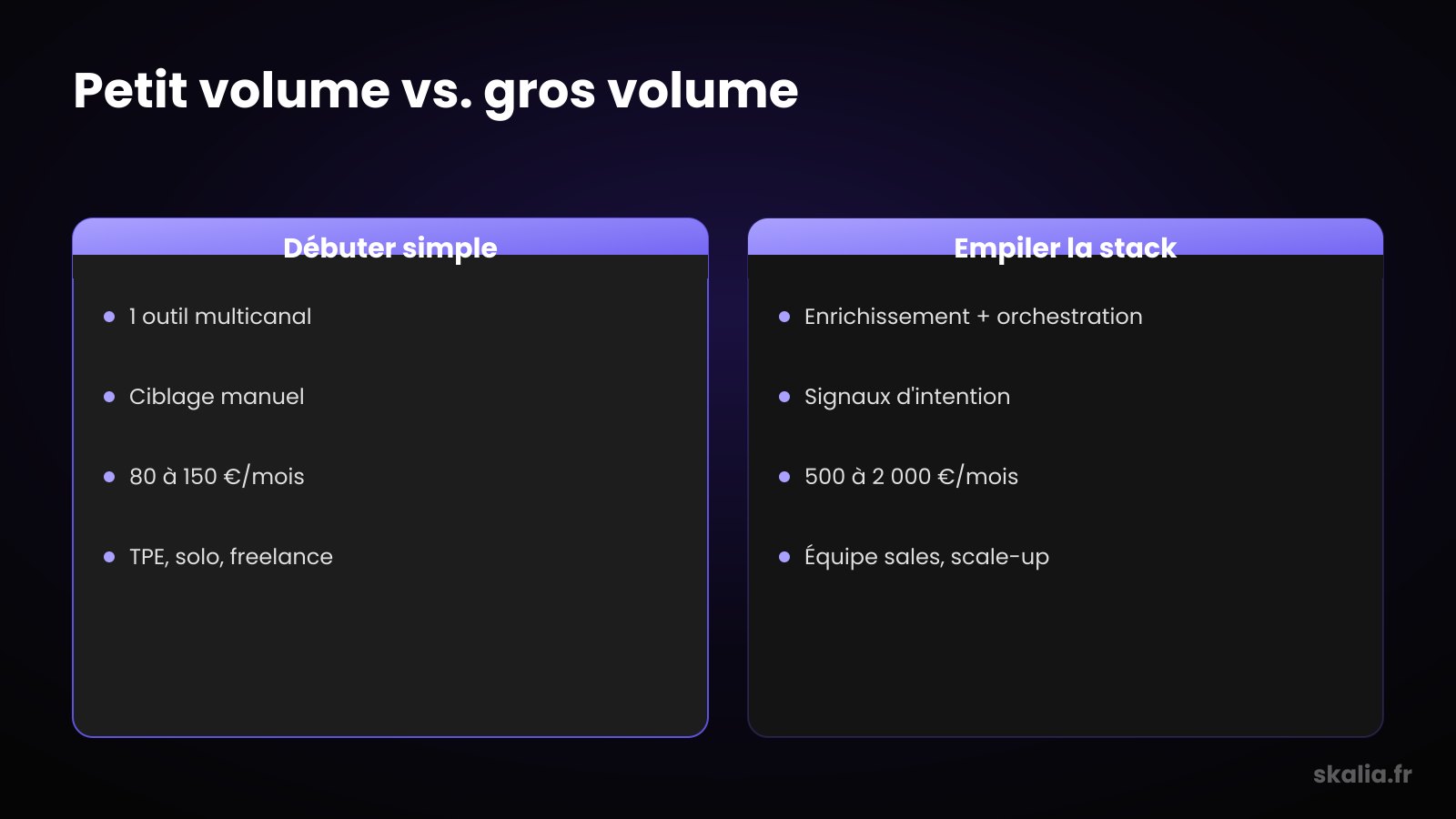
- Budget €80 to €150/month to get started, €500 to €2,000/month for a full stack.
- Start simple, stack tools on top as volume justifies it.
Is there a single best automated prospecting tool?
No, there's no single best automated prospecting tool: there's a stack to build based on your needs, your volume, and your channel. A freelancer sending 30 messages a day doesn't need the same tools as a sales team handling 2,000 contacts a month.
The right question isn't "what's the best tool?" but "which building block do I need right now?" There are five families: multichannel (LinkedIn + email), data enrichment, cold email and deliverability, orchestration, and AI SDR. Each answers a specific moment in your scaling journey.
To lay the groundwork before picking tools, read our automated prospecting guide.
What are multichannel LinkedIn + email tools for?
Multichannel tools automate sequences that alternate LinkedIn messages and emails to the same contact. It's the starting building block for most small and mid-sized businesses, since it covers the two most effective B2B channels under a single subscription.
In practice, you build a scenario: profile visit, connection request, message, then an email follow-up if there's no reply. The go-to tools are Waalaxy, Lemlist, and La Growth Machine. Budget €80 to €150/month per user depending on the plan.
It's ideal for a solo operator, a freelancer, or a small team just getting started. To choose between the three, compare Lemlist, Waalaxy, and La Growth Machine. And if LinkedIn is your main channel, our LinkedIn prospecting method breaks down the sequences that convert.
Why add an enrichment tool and a database?
An enrichment tool turns a list of names into complete profiles: verified professional email, job title, company, size, industry. Without it, your sequences run on incomplete data and your email bounce rate climbs fast.
These tools also supply B2B contact databases you can filter by criteria. The go-to names are Apollo, Cognism, and Dropcontact for email verification and compliance. Prices range from €40 to €100/month for individual use, more for enterprise-level volumes.
It's useful as soon as you're short on qualified contacts or your emails bounce too often. Watch the legal framework, though: building or buying a database comes with specific rules, explained in our article on buying email databases.
How do you guarantee deliverability in cold email?
Deliverability is your emails' ability to land in the inbox rather than spam. Without technical setup, one in two cold emails can end up marked as junk, which ruins even a well-targeted campaign.
Dedicated tools handle inbox warm-up, sending address rotation, and reputation monitoring. Instantly, Smartlead, and Mailreach lead this space, usually priced between €30 and €100/month. They get added to your multichannel tool once your sending volume scales up.
They become necessary once you exceed a few dozen emails a day. For the full method, from targeting to follow-up, see our cold email guide.
What is an orchestration tool like Clay?
An orchestration tool centralizes enrichment, scoring, and personalization into a single automated flow. It connects dozens of data sources and triggers conditional actions — something no standalone multichannel tool can do.
Clay is the reference in this category, with alternatives like Trigify or workflows built on n8n. It's powerful but technical: budget €150 to €800/month depending on enrichment credits consumed, plus a real learning curve.
It's reserved for teams managing large volumes who want fine-grained personalization at scale. A small business doesn't need this at the start. This kind of tool makes sense once several manual building blocks are costing you too much time each week.
Should you already move to an AI SDR?
An AI SDR is an agent that detects intent signals, writes personalized messages, and autonomously handles part of the follow-up. The category is young in 2026: promising, but still uneven depending on the use case.
Solutions like 11x, Artisan, or custom-built agents promise to automate the work of a junior salesperson. Pricing often starts at €300 to €500/month and climbs quickly. Quality depends heavily on your data and your market.
Worth testing once your stack is already mature and your processes are proven, not before. Automation layered on top of fuzzy targeting just reproduces your mistakes faster. Before investing, weigh the choice between an in-house SDR and a prospecting agency.
Which automated prospecting tool should you choose for your profile?
Choose based on your volume and maturity, not the tool's reputation. A beginner starts with a single multichannel building block; a seasoned team stacks enrichment, orchestration, and intent signals. The table below sums up the five families and their uses.
| Category | Example tools | Indicative price | Ideal for |
|---|---|---|---|
| Multichannel LinkedIn + email | Waalaxy, Lemlist, La Growth Machine | €80 to €150/month | Solo, small business getting started |
| Enrichment & database | Apollo, Cognism, Dropcontact | €40 to €100/month | Lacking qualified contacts |
| Cold email & deliverability | Instantly, Smartlead, Mailreach | €30 to €100/month | High sending volume |
| Orchestration (Clay-type) | Clay, Trigify, n8n | €150 to €800/month | Teams, personalization at scale |
| AI SDR & intent signals | 11x, Artisan, custom agents | €300/month and up | Mature stack, proven processes |
FAQ
How much does a full automated prospecting stack cost?
To get started, a single multichannel tool is enough: €80 to €150/month. A full stack with enrichment, cold email, and orchestration climbs to €500 or €2,000/month depending on volume. Add the cost of LinkedIn subscriptions and dedicated email inboxes.
Can you do automated prospecting without coding?
Yes, most multichannel and cold email tools work no-code, with visual sequence builders. Only advanced orchestration tools like Clay or n8n require more technical logic. A beginner can launch their first campaigns without writing a single line of code.
Which tool should you start with as a beginner?
Start with a single multichannel LinkedIn + email tool, then add enrichment once your data starts limiting your results. There's no point stacking building blocks too early: each tool adds cost and complexity that only pay off once you have volume.
Are these tools GDPR compliant?
Tools themselves aren't compliant or non-compliant by nature: it's your use of them that determines that. You must respect the legal basis for processing, inform contacts, and honor the right to object. Our article on cold email and GDPR details the rules to follow in B2B.
Bottom line: start simple, stack up later
Remember this simple rule: start with a single multichannel building block, then stack tools only once your volume justifies it. An oversized stack costs a lot and is hard to manage; a well-calibrated stack grows with you, category by category.
The best automated prospecting tool is the one that fits your current need, not the biggest subscription. If you're unsure which building block to add next, or in what order to scale up, our automated prospecting guide lays the foundations. Let's talk about building the stack that matches your real volume.