
 kevin@skalia.ca


Why Your LinkedIn Messages Get No Reply (and How to Fix It)
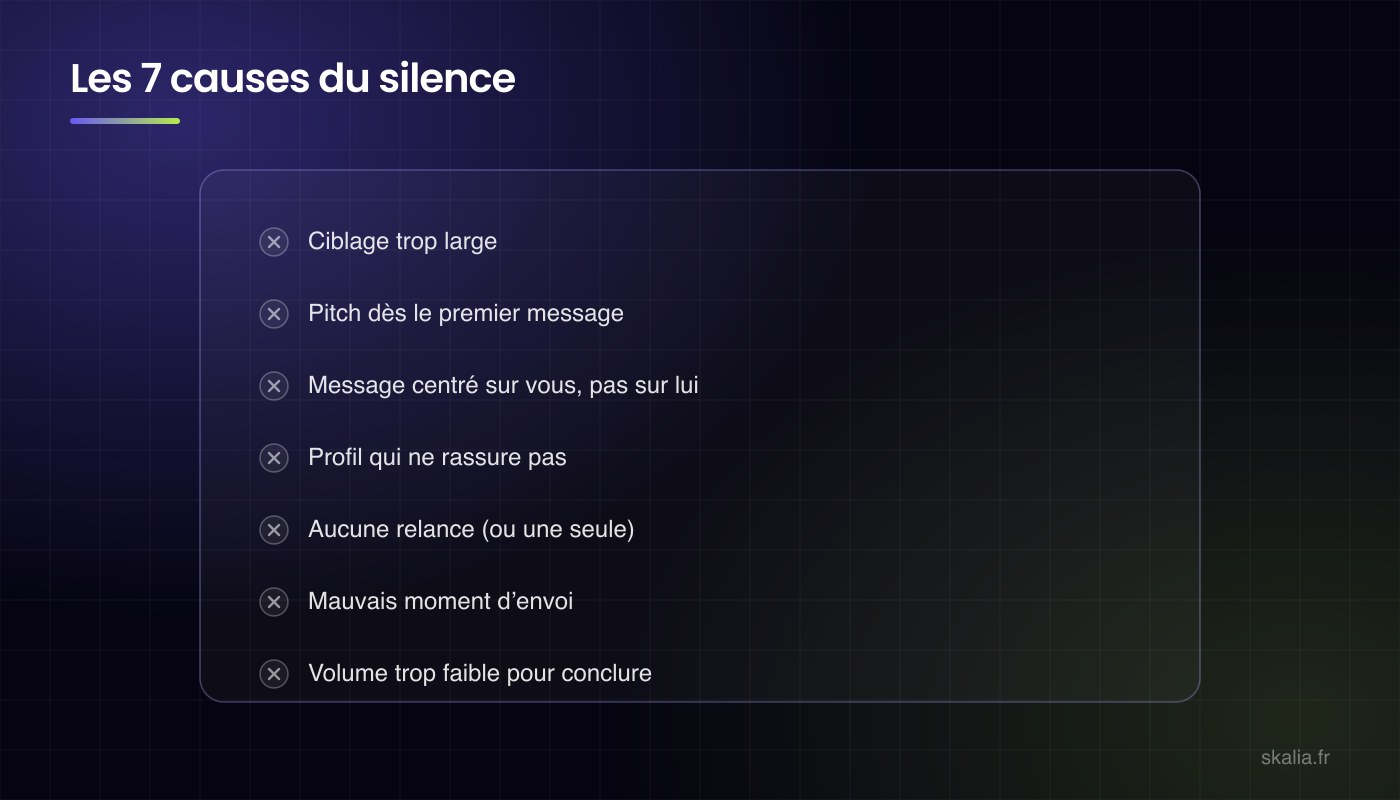
If your LinkedIn messages keep going unanswered, the cause is almost always one of the seven described here: targeting that's too broad, pitching from the very first contact, a message centered on you, a profile that doesn't build trust, no follow-up sequence, bad timing, or a sample size too small to judge anything. Here's the cause-by-cause diagnosis, plus the fix for each one.
- 7 causes explain nearly every silence: vague targeting
- pitching in the first message
- a message that's all about you
- a profile that doesn't inspire trust
- zero follow-up
- bad timing
- too small a sample to judge.
- Follow-ups typically generate half of a campaign's replies.
- Below a 2% reply rate, stop and fix the approach, don't increase volume.
Cause 1: your targeting is too broad
The symptom: an invitation acceptance rate under 25-30%. When you write to "every executive," your message can't be precise for anyone, and it shows from the subject line onward. The fix: narrow it down to one specific role, one industry, one company size, and write for that segment only. 300 well-chosen prospects beat 2,000 scraped profiles, every single time. The full targeting method is in our guide to LinkedIn prospecting.
Cause 2: you're pitching from the first message
The first message has exactly one job: get a reply. A full pitch, complete with a deck and a booking link, sent on first contact triggers the "salesperson" reflex and gets archived instantly. The fix: one observation about the prospect's company, one open question about their challenge, and nothing else. The offer comes once the conversation is actually underway.
Cause 3: your message talks about you, not the prospect
Re-read your last message: how many "I / we / our" versus how many "you / your"? A message that opens with "We're an agency specializing in..." is a monologue. The fix: flip the focus. One line about their company, their news, or their market, then a question that's about them. The you-versus-I ratio should tilt heavily toward the prospect.
Cause 4: your profile doesn't make people want to reply
Before replying, the prospect clicks through to your profile. No photo (or an outdated one), a vague headline ("CEO at X" with no clear promise), no recent activity: the conversation stops right there. The fix: a headline that states what you deliver and for whom, a decent photo, a client-focused "About" section, and ideally a few recent posts. Your profile is your landing page.
Cause 5: you're not following up (or only once)
Most of a campaign's replies land between the 2nd and 4th follow-up: silence after the first message means almost nothing. The fix: plan 2 to 4 follow-ups spaced 4 to 7 days apart, each with a fresh angle (a stat, a case study, a different question), then a short, no-pressure closing message, often the best performer in the whole sequence.
Cause 6: you're reaching out at the wrong time
August, the year-end holidays, the day before a weekend: reply rates drop mechanically. Nothing unusual about that, you just need to factor it in before writing off a campaign launched on August 10th as a failure. The fix: send midweek, during business hours, and judge a campaign over 4 to 6 full weeks, excluding slow periods.
Cause 7: your sample size is too small to judge anything
20 messages with no reply prove nothing: at an expected 10% reply rate, that's two replies on average, zero on some days. The fix: think in statistically meaningful volume (200 to 300 contacts minimum per message variant) before drawing any conclusions, while staying within LinkedIn's daily quotas. The reply rates you should actually be aiming for are detailed in our cold email and LinkedIn benchmark report.
The diagnosis, in one table
| Symptom | Likely cause | Priority fix |
|---|---|---|
| Few invitations accepted (under 25-30%) | Targeting too broad or weak profile | Narrow the target, redo headline + photo |
| Accepted, but no reply | Pitching too soon or a message centered on you | Rewrite it: observation + question, zero pitch |
| Polite but negative replies | Poor fit between target and offer | Revisit the offer/segment match |
| A few replies, then nothing | No structured follow-up sequence | Sequence of 2 to 4 spaced follow-ups |
| Everything looked fine, then results dropped | Slow period or segment fatigue | Check the calendar, refresh the target |
Key takeaways
- Widespread silence is a diagnosis, not a fatality: every cause has its symptom and its fix.
- Fix one variable at a time, otherwise you'll never know what actually worked.
- Follow-ups typically generate half the replies: never judge a campaign on the first message alone.
- Below a 2% reply rate after 200+ contacts, stop and fix the approach instead of increasing volume.
FAQ: unanswered LinkedIn messages
How long should you wait before following up?
4 to 7 days between each message. Too soon and you look pushy; too late and the context is forgotten.
Do connection request notes improve acceptance rates?
It depends on the content: a generic note performs worse than a blank invitation. Test both on your target audience; the note-free invite often wins.
Is a LinkedIn voice or video message a good idea?
As a follow-up, yes: it's still underused and it humanizes the outreach. As a first touch, it can feel intrusive. Worth testing at the 2nd or 3rd step of a sequence.
At what point should you switch channels entirely?
If, after fixing your targeting and messaging, 300+ contacts still bring in under 2% replies, your audience probably isn't very active on LinkedIn: shift the effort to cold email or combine both in a multichannel approach.
Article written by Kevin Sazarin, Growth Marketer and founder of Skalia (Toulouse, France). To hand off the diagnosis and execution: AI-powered prospecting.