
 kevin@skalia.ca


Meta Ads in 2026: Structuring Your Campaign to Scale

In 2026, what makes a Meta Ads campaign scale is no longer micro-targeting: it's a simple account structure, varied creatives, and a clean signal. Here's how to put it all together to scale up without breaking the learning phase.
- A Meta Ads campaign has three levels: campaign (objective), ad set (audience + budget), creative.
- In 2026, simplify with Advantage+ and let the algorithm target broadly.
- The real lever is no longer targeting but creative diversity and signal quality (Pixel + CAPI).
- Scale in 20% budget increments so you don't break the learning phase.
How do you structure a Meta Ads campaign in 2026?
A Meta Ads campaign is structured on three levels: the campaign (the objective), the ad sets (the audience and budget), and the ads (the creatives). In 2026, best practice is to keep this hierarchy simple: few campaigns, few ad sets, lots of creatives. Complexity no longer buys you performance.
This logic has changed. A few years ago, you'd multiply ad sets to test ten audiences in parallel. Today, Meta's algorithm targets better than most manual setups. Your job has shifted: less micro-managing audiences, more time spent on the message and the signal you send the platform.
Before scaling, you need to lay clean foundations. It's the same logic as building a profitable acquisition funnel: every floor needs to be solid before you increase traffic.
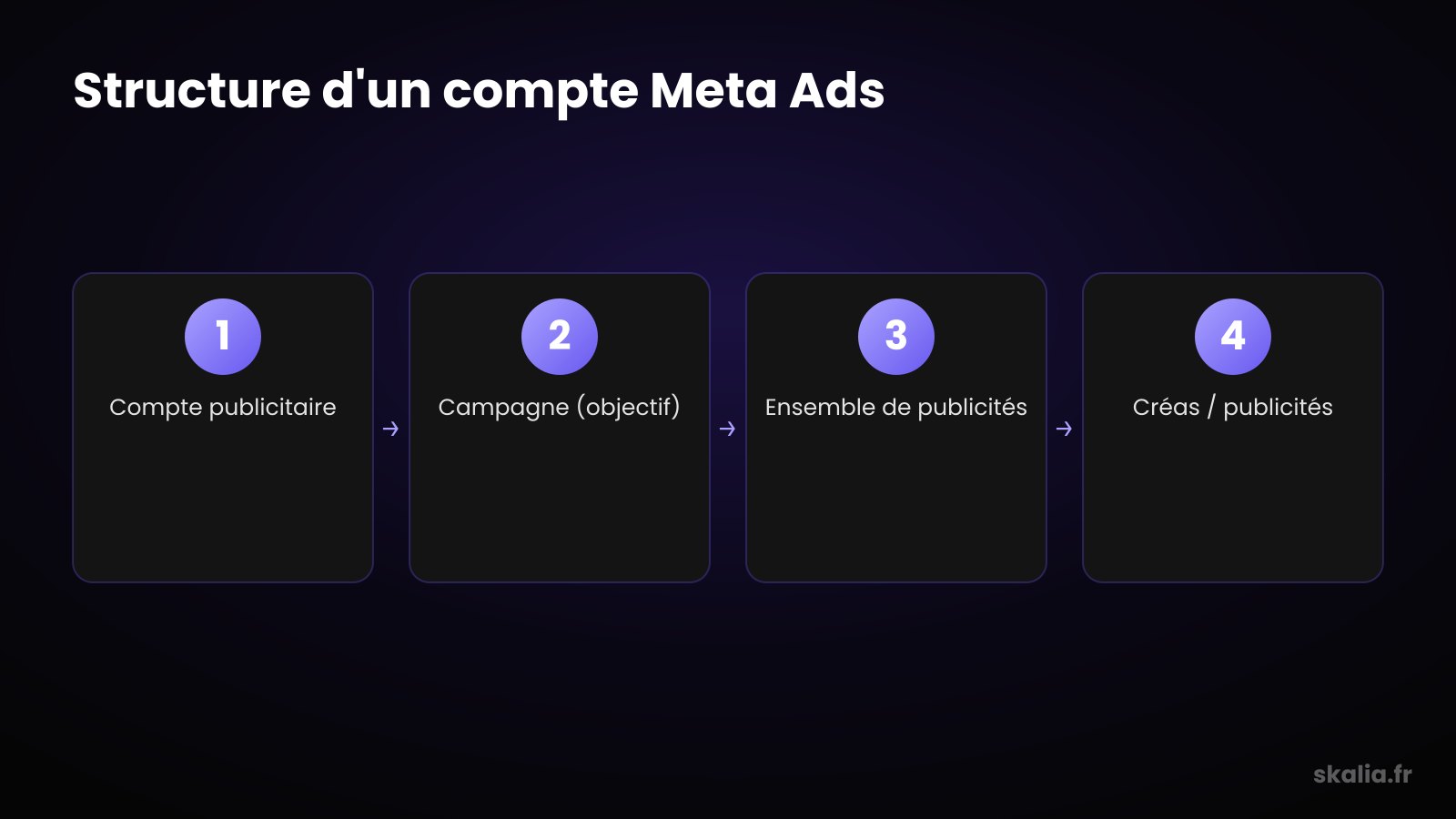
What are the three levels of a Meta Ads account?
A Meta Ads account is organized into three hierarchical levels, each with a specific role. The campaign defines the objective, the ad set manages the audience and the budget, the ad carries the creative. Understanding this breakdown avoids 80% of the structural mistakes seen on small and medium business accounts.
| Level | Role | 2026 best practice |
|---|---|---|
| Campaign | Sets the objective (conversions, traffic, awareness) | One objective per campaign, no mixing |
| Ad set | Defines the audience, placement, and budget | Few ad sets, broad audiences, consolidated budget |
| Ad (creative) | Carries the message: visual, video, copy | 3 to 5 varied creatives per ad set, tested continuously |
The golden rule: don't fragment. An account with twenty ad sets at €5/day per set scatters the budget and prevents each ad set from accumulating enough data to exit the learning phase. Three ad sets at €30/day that learn fast are far better.
Should you use Advantage+ to structure your campaigns?
Yes, in most cases Advantage+ simplifies the structure and delivers good results in 2026. This Meta automation suite bundles targeting, placements, and creative selection under algorithmic control. For an SME with no dedicated media team, it's often the most effective starting point.
Advantage+ Shopping Campaigns (ASC) and Advantage+ Audience targeting reduce the number of manual settings. You provide a budget, an objective, and a stock of creatives; the algorithm distributes and optimizes. In exchange, you lose fine-grained control over audiences, which is only a problem if your offer is highly niche.
When should you keep a manual structure?
Keep manual control when you have a very specific audience to exclude, a regulatory constraint, or a need to segment by funnel stage. Many high-performing accounts mix both: an Advantage+ campaign for volume, a manual retargeting campaign for warm visitors. This platform choice mirrors the Google Ads vs Meta Ads trade-off: it all depends on your offer and your buying cycle.
Why do creatives matter more than targeting?
Because in 2026 the creative has become the main targeting lever: the algorithm shows each ad to the people most likely to respond to it. In other words, your visual and your message sort the audience for you. A good creative reaches the right person, even with broad targeting.
In practice, you need diversity. Different formats (image, short video, carousel, UGC), different angles (price, benefit, social proof, objection handling), and different lengths. Three to five creatives per ad set give the algorithm something to arbitrate between. If everything looks the same, it has nothing to optimize.
Ad fatigue sets in fast: a creative that performs well often runs out of steam within two to four weeks on a given audience. Plan a steady flow of new creatives rather than one big batch once a quarter. It's ongoing work, not a one-time setting.
How does the Pixel and CAPI signal change the game?
The signal is what lets Meta optimize toward your real conversions, and its quality depends directly on the Pixel and the Conversions API (CAPI). Without a reliable signal, even the best structure runs on empty: the algorithm optimizes toward a fuzzy objective and wastes budget.
The browser-side Pixel is no longer enough. Between ad blockers, GDPR consent, and the limits of client-side tracking, a share of conversions is no longer captured. CAPI sends events from your server, in addition to the Pixel, to recover that lost signal. Together, they give a more complete measurement and better optimization.
What to check on the signal side
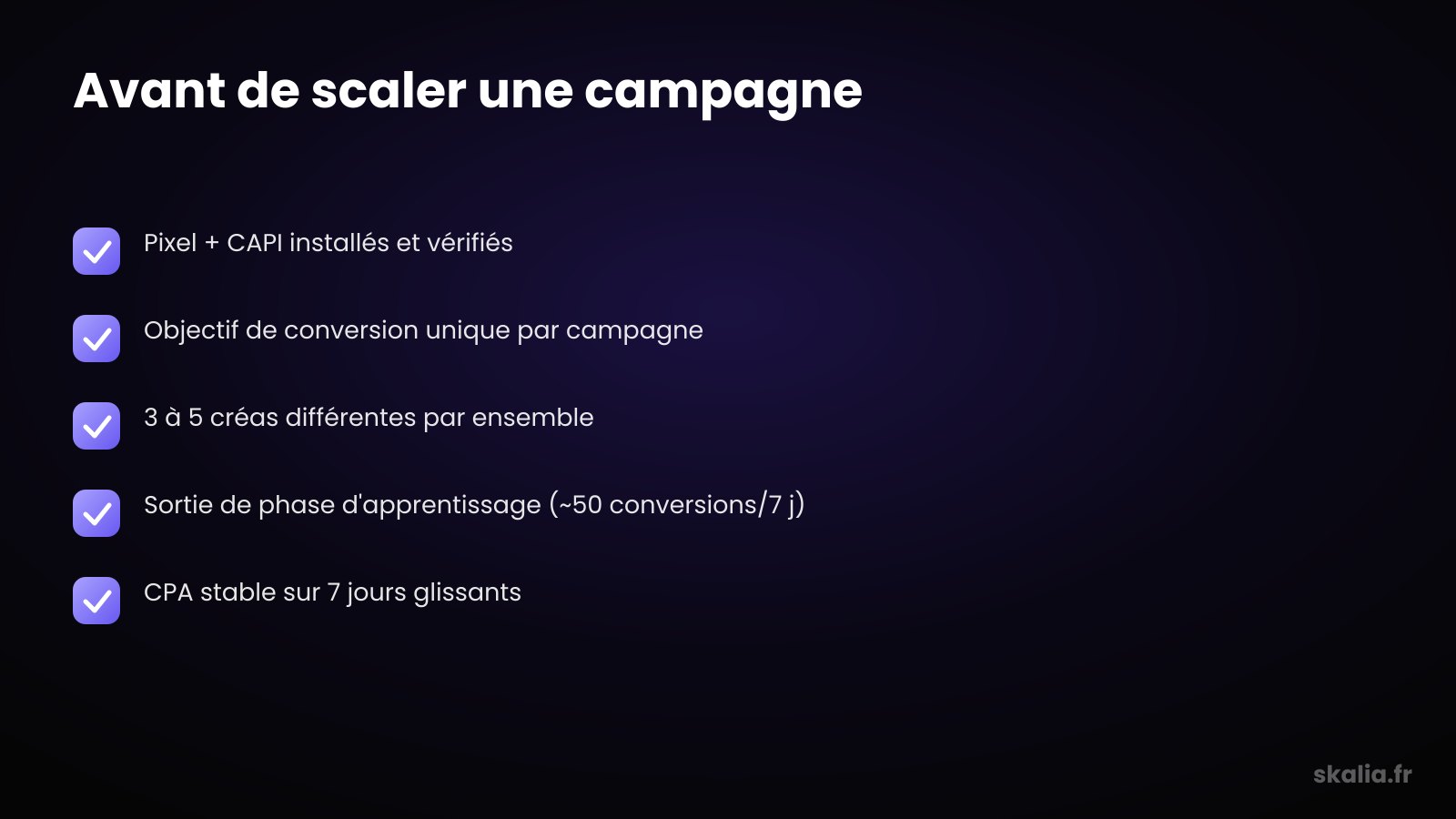
- Pixel installed on all key pages and firing on the right events
- CAPI configured with active deduplication (so events aren't counted twice)
- A clearly defined priority conversion event
- Event matching verified in the Events Manager
A clean signal also benefits the rest of your acquisition. The same events feed your other channels and your overall measurement, in line with a focused acquisition strategy where every euro spent is traceable.
How do you manage budget and the learning phase?
Every ad set enters a learning phase and exits it after roughly 50 conversions over a rolling 7-day period. Until that threshold is crossed, performance is unstable and cost per result is misleading. The first mistake impatient advertisers make: judging a campaign too early.
Three principles hold up. First, size your budget to hit those 50 weekly conversions: if your cost per conversion is €20, aim for at least €1,000 over the week for that ad set. Second, avoid frequent changes: every significant change (budget, audience, objective) can reset the learning phase. Third, let it run a full 7 days before drawing conclusions.
The question of minimum budget comes up here just as it does on other platforms. The reasoning is the same as for a minimum budget on Google Ads: below a certain threshold, there isn't enough data for the algorithm to learn.
How do you scale a campaign without breaking the learning phase?
To scale without breaking the learning phase, increase the budget in increments of 15 to 20% every 3 to 4 days rather than all at once. A sudden increase often sends the ad set back into the learning phase and destabilizes results. Scaling up happens in small steps, on an already stable base.
Two paths to grow. Vertical scaling: gradually increase the budget of an ad set that's performing well. Horizontal scaling: duplicate the winning logic to new audiences, new placements, or new markets. In practice, you combine both, while keeping a stable “control” ad set as a benchmark.
Only scale what's proven. A stable cost per result over 7 days, a clean signal, and a ready stock of creatives: those are the green lights. Scaling a fragile campaign only speeds up the losses. Discipline matters more than speed.
FAQ
How many Meta Ads campaigns does an SME need?
Often two or three are enough: a prospecting campaign (cold acquisition) and a retargeting campaign (warm visitors), plus possibly an awareness campaign. Multiplying campaigns scatters the budget and slows down learning. It's better to have few well-funded campaigns than many underfunded ones.
How many creatives do you need per ad set?
Plan for 3 to 5 different creatives per ad set in 2026. That's enough to give the algorithm something to arbitrate between, without diluting the data across too many variants. What matters is the diversity of angles and formats, not just the count. Refresh regularly to counter ad fatigue.
Is CAPI mandatory to perform well?
It isn't mandatory in the strict sense, but it has become almost essential in 2026. Pixel tracking alone lets a share of conversions slip through due to consent requirements and ad blockers. CAPI recovers that signal server-side and significantly improves optimization. It's a standard today, not an advanced option.
Why does my campaign keep going back into the learning phase?
Because a significant change relaunched it: a major shift in budget, audience, objective, or the optimized event. Meta then resets learning to recalibrate. To avoid this, limit your changes, make them in small increments, and let each adjustment stabilize over several days before making the next one.
Structure, then scale: where to start with Skalia?
A Meta Ads campaign that scales rests on a few things done well: a simple structure, varied creatives, a clean signal, and a patient budget. In 2026, Advantage+-style automation does most of the targeting; your added value lies elsewhere, in the message and the measurement. The rest is just discipline, one step at a time.
At Skalia, we build this machinery from A to Z, from Pixel/CAPI through to the creative plan, keeping every euro traceable. If you're still torn between platforms, our comparison Google Ads vs Meta Ads will help you decide. Let's talk about it: we'll look at your account and identify the next realistic step.