
 kevin@skalia.ca
Multichannel LinkedIn + Email Sequence: The 2026 Guide
Alternating LinkedIn and email over two to three weeks multiplies your touchpoints and your reply rate compared to a single channel. Here's the day-by-day sequence template, the right pacing, and how to automate it without losing personalization.
- Alternate LinkedIn and email over 2 to 3 weeks to multiply touchpoints and reply rate.
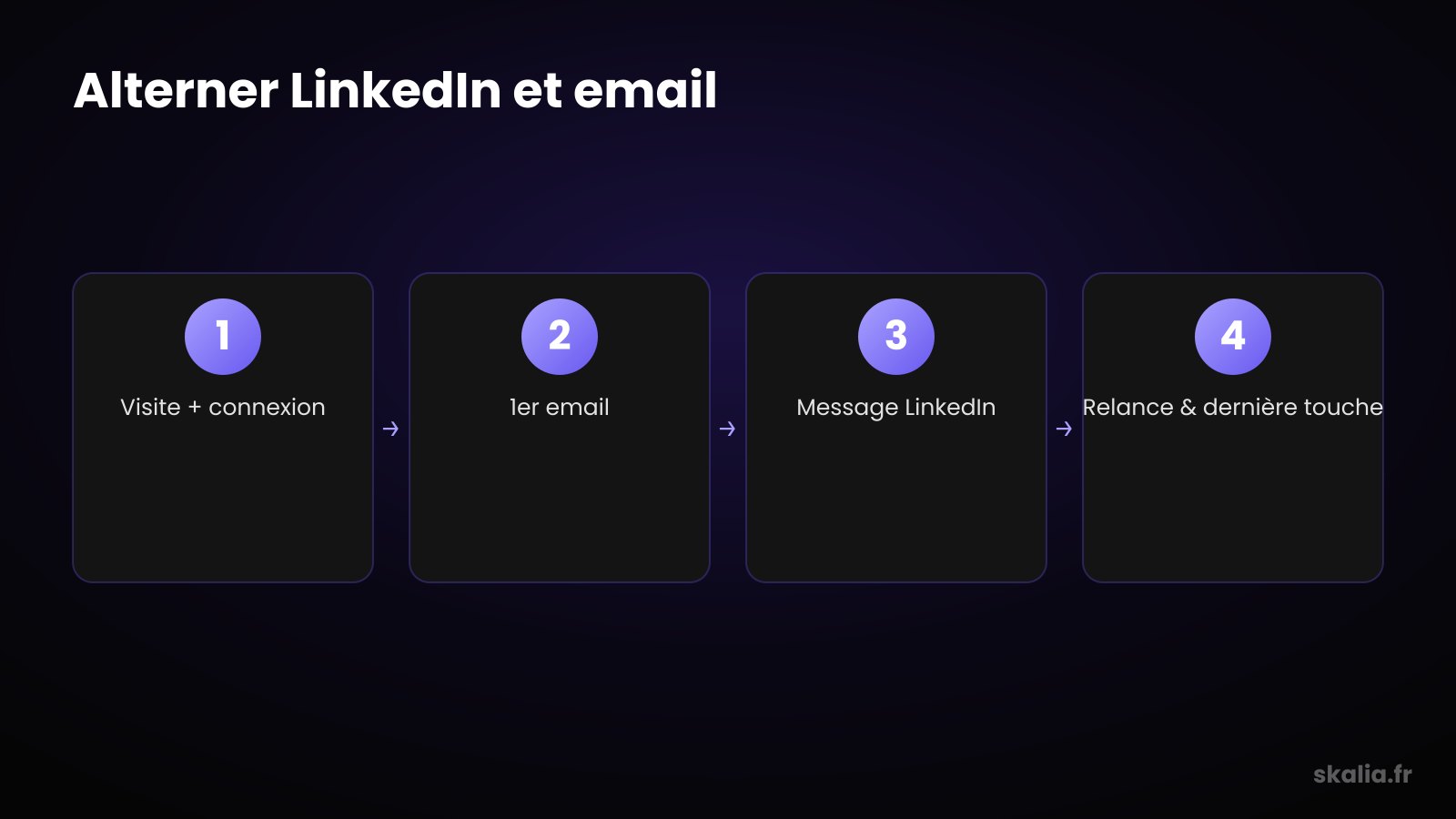
- Standard sequence: profile visit, connection, 1st email, LinkedIn message, email follow-up, final touch.
- Space touches 2 to 3 days apart, never two messages the same day.
- Automate the pacing, personalize every opening line.
Why does a multichannel LinkedIn + email sequence convert better?
Alternating LinkedIn and email over two to three weeks multiplies your touchpoints and drives up your reply rate compared to a single channel. A prospect who ignored you on LinkedIn might open your email, and vice versa. Spaced-out repetition builds familiarity without feeling like harassment.
Two mechanics work in your favor. First, repetition: it often takes 5 to 8 touchpoints before a B2B prospect replies. Second, the complementarity of channels. LinkedIn makes your face and your company visible; email leaves room for a well-crafted message and a link.
Each channel has its blind spots. Some decision-makers live in their inbox and never check LinkedIn. Others filter out every unknown email but accept a relevant connection request. By combining both, you cover both profiles instead of guessing blind.
Multichannel remains useful even when a single channel is already working for you. If your LinkedIn prospecting is producing results, layering email on top recaptures the passive prospects on the platform. The reverse is also true for cold email.
What does a day-by-day sequence over 14 days look like?
An effective multichannel sequence runs over 14 days and alternates six touches split between LinkedIn and email. The principle: one touchpoint every two to three days, never two on the same day, gradually building in value. Here's a concrete plan you can copy and adapt to your offer.
The table below details each day, the channel used, the specific action, and its objective. Use it as a skeleton: keep the structure, change the content to fit your target and your industry.
| Day | Channel | Action | Objective |
|---|---|---|---|
| Day 1 | Visit the prospect's profile | Show up in their notifications, warm up | |
| Day 2 | Connection request with no note (or a short one) | Enter their network | |
| Day 4 | 1st email: personalized hook + value | Open the dialogue off-platform | |
| Day 7 | Message if connection accepted | Extend the conversation directly | |
| Day 10 | Follow-up: new angle, proof, or case study | Re-engage the undecided | |
| Day 14 | Email or LinkedIn | Final "break-up" touch | Prompt a reply or close things out cleanly |
Each touch has a role. The visit and the connection warm things up without asking for anything. The first email delivers value before any sales pitch. The Day 7 LinkedIn message capitalizes on an accepted connection, a sign of openness. Days 10 and 14 follow up with a fresh angle, never just a copy of the previous message.
What timing and pacing should you adopt?
The right pace is one touch every two to three days, over a 14- to 21-day window, never stacking two messages on the same day. Too tight, and you come across as pushy. Too spread out, and the prospect forgets you between touches. The 2- to 3-day interval keeps attention without becoming annoying.
Day and time matter too. For B2B email, aim for Tuesday, Wednesday, or Thursday, early morning or late afternoon. For LinkedIn, the same windows work, with strong activity early in the week. Avoid Monday morning, buried under urgent tasks, and Friday afternoon.
Adjust the length to your sales cycle. A simple offer plays out over 10 to 14 days. A complex sale, involving several decision-makers, can stretch over three weeks and a seventh touch. What matters most is consistency, not speed. A sequence carried through to the end beats a fast one abandoned halfway.
One last benchmark: measure before you optimize. Compare your results against reply rate benchmarks to know whether your timing holds up or whether the sequence needs tightening.
What mistakes should you avoid in a multichannel sequence?
The first mistake is being too aggressive: piling on follow-ups, asking for a meeting in the very first message, cramming multiple touches into a single day. An over-solicited prospect mentally files you under spam, sometimes for good. Multichannel amplifies this risk, since two poorly paced channels create an impression of harassment.
A second common trap: copy-pasting the same message across channels. If your email and your LinkedIn message are identical, the prospect notices and disengages. Every touch should bring a fresh angle: a question, proof, a case study, useful content. Redundancy kills credibility.
- Too many touches close together or on the same day
- LinkedIn message and email that are strictly identical
- Ignoring LinkedIn quotas and getting your account restricted
- Following up without ever changing the angle or adding value
- Automating 100% with zero personalization
The third pitfall concerns LinkedIn quotas. The platform limits connection requests and messages per day; exceeding them risks a restriction. Respect the daily LinkedIn message limit and spread out your sends instead of launching everything at once.
How do you automate without losing personalization?
Automation handles the pacing and the sending, but personalization stays human on the visible elements. You program the sequence, the delays, and the conditions; you write, by hand, the opening line and the hook for each prospect. That balance is what separates a converting campaign from an ignored mass send.
In practice, the tool triggers the profile visit, the connection request, and the follow-ups on schedule. It also manages the conditions: stop the sequence as soon as a prospect replies, skip the LinkedIn message if the connection wasn't accepted. You focus on the variable that matters most: the opening sentence, the one that proves you actually read their profile.
Three rules to maintain quality at scale. Segment by persona or industry so each sequence genuinely speaks to its target. Cap daily volumes to stay under quotas and come across as human. Review a sample of sends every week to fix anything that sounds robotic. For more, our automated prospecting guide covers the tools and the guardrails.
FAQ
Should you start with LinkedIn or email?
Start with LinkedIn in most B2B cases. The profile visit and connection request warm up the prospect without asking for anything, which makes the first email land better. If you don't have a credible profile, start with a value-driven email instead.
How many touches should a multichannel sequence have?
Plan for five to seven touches spread over 14 to 21 days. Fewer than five, and you give up before the prospect reacts. More than seven, and you risk annoying them without gaining extra replies. The ideal count depends on your sales cycle and industry.
Is multichannel compatible with GDPR for email?
Yes, as long as you follow the rules for B2B cold email: legitimate interest, a message relevant to the prospect's role, easy unsubscribe, and up-to-date data. Our article on cold email and GDPR details the exact framework to follow.
Can you automate everything without risking your LinkedIn account?
No. Overly aggressive automation on LinkedIn puts your account at risk of restriction. Stay under the daily quotas, spread out your sends, and keep a human touch on visible messages. The tool manages the pace; you keep control of the content and the volume.
Want a multichannel sequence that runs on its own?
A well-built multichannel LinkedIn + email sequence combines repetition, channel complementarity, and controlled pacing, while staying personalized at scale. That's exactly what we set up at Skalia: campaigns that are automated on rhythm and human on message. If you're torn between building this in-house or outsourcing it, our comparison in-house SDR vs. prospecting agency will help you decide. Let's talk.