
 kevin@skalia.ca


AI Phone Prospecting: Where Do We Stand in 2026?
AI doesn't replace your sales reps on the phone yet, but it's transforming call prep, targeting, and follow-up. Here's a clear-eyed look at what works, what's still risky, and when picking up the phone still makes sense.
- In 2026, AI mainly helps prepare, target, and coach calls — not make them for you.
- Autonomous AI voices remain limited and risky in B2B (quality, legal framework, trust).
- Humans stay in control of the call itself; AI handles the invisible work around it.
- The phone remains relevant alongside LinkedIn and email, not as a replacement.
Does AI Phone Prospecting Replace Sales Reps in 2026?
No, and it's important to say this clearly: in 2026, AI doesn't reliably call your prospects for you in B2B. It excels at everything around the call: prior research, script personalization, note-taking, and analysis. The call itself stays human.
The confusion comes from voice-agent demos that look impressive. In real conditions, on a complex B2B sales cycle, these voices fall apart fast: unexpected objections, poorly handled silences, ignored business context. The prospect often senses they're talking to a machine, and that breaks the relationship.
Our position is simple. AI is a formidable copilot for preparing and improving your calls. It's not a credible replacement for the rep on the actual conversation, especially when the average deal size is high and the relationship matters.
What Does AI Actually Change Before and After the Call?
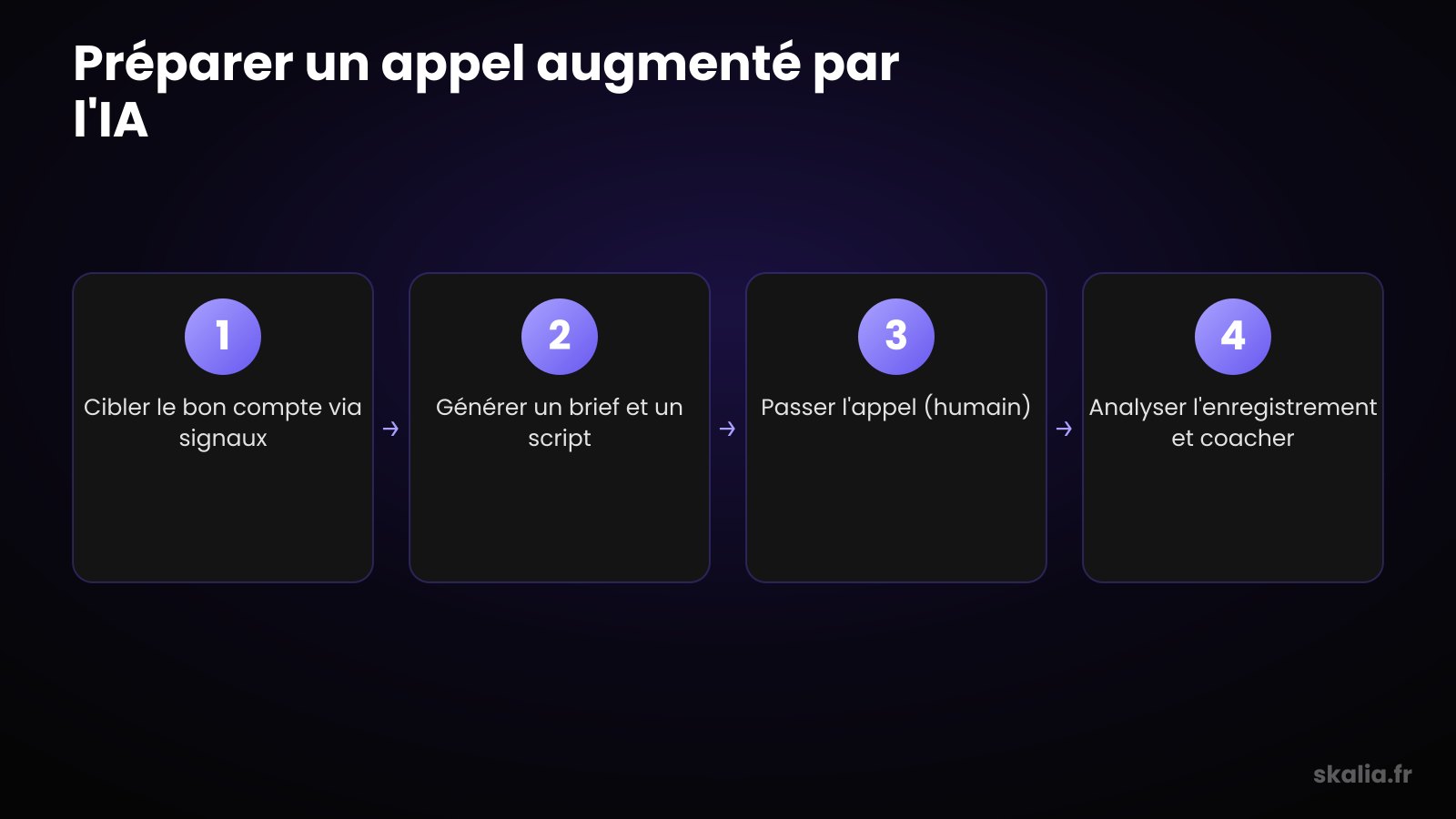
AI mainly changes four things around the call: research, scripting, note-taking, and coaching. That's where the real time savings show up, with no risk to the relationship, because the prospect never interacts with the machine.
Pre-Call Research
It used to take ten minutes per prospect to prepare a qualified call. Today, an AI assistant pulls together the role, company news, a recent funding round, or a recent hire in seconds. You show up with a precise angle instead of a generic pitch.
Personalized Scripts
AI generates a call outline tailored to the account: an opener tied to a signal, qualifying questions, answers to likely objections. You're not reading a script — you're starting from a solid base that you adapt out loud. It's the same principle as signal-based selling applied to the phone.
Analysis and Coaching
After the call, AI transcribes, summarizes, and pushes the key points into the CRM. Across a team, it spots the phrasing that converts and the phrasing that gets hung up on. This kind of coaching on real data helps a junior rep improve far faster than a simple debrief.
Classic Call vs. AI-Assisted Call: What's the Difference?
The difference lies in the invisible work around the call, not the voice. A classic call relies on the rep's memory and improvisation; an AI-assisted call is built on a briefing, a contextualized script, and automated follow-up. The voice stays human in both cases.
| Step | Classic Call | AI-Assisted Call |
|---|---|---|
| Preparation | Manual research, often rushed | Target briefing generated in 30 seconds |
| Personalization | Reused generic script | Opener tied to a real signal |
| Follow-up | Memory notes, forgotten CRM | Transcription and CRM auto-filled |
| Improvement | Occasional debrief | Coaching based on recorded calls |
The gain isn't magic, it's mechanical: you spend less time preparing and logging, so you have more time to call and listen. It's exactly the logic of a well-designed automated prospecting system, applied to the voice channel.
Why Do AI Voice Agents Remain Limited in B2B?
Autonomous AI voice agents remain limited because B2B selling is an unpredictable conversation, not a script reading. Latency, handling interruptions, off-script objections, accents, or industry jargon: these are all places where synthetic voice still trips up and loses the prospect's trust.
There's also a perception issue. A decision-maker who realizes a robot called them without warning feels used. In B2B, where relationships and reputation carry real weight, that risk often outweighs the productivity gain. A bad automated call damages the brand.
Voice agents do have a real place, but on simple, well-defined tasks: appointment confirmation, reminders, very basic qualification at volume. For these cases, they fall into the same logic as an AI customer service agent. For a complex first sales contact, the human remains essential.
What Does the Legal Framework Say About AI Calls?
The legal framework requires transparency and compliance with telemarketing rules, whether the call is human or AI-assisted. In France, B2B phone prospecting falls under Bloctel for B2C and GDPR as soon as personal data is processed, including a named professional phone number.
Two points of caution with AI. First, recording calls for transcription and coaching purposes must be disclosed and backed by a legal basis. Second, an autonomous voice agent must not let the prospect believe they're talking to a human: the spirit of the EU's AI regulation pushes toward clear transparency.
In short, assistive AI (briefing, notes, coaching) raises few problems as long as you handle recording properly. The autonomous voice, on the other hand, combines legal risk with reputational risk. The same compliance habits that apply to cold email and GDPR apply to the phone.
When Does the Phone Remain Relevant Versus LinkedIn and Email?
The phone remains relevant when the target is high-value, the message is hard to convey in writing, or a hot signal just came in. It loses value at large, cold volumes, where LinkedIn and email remain more effective and less intrusive.
The right practice in 2026 isn't choosing one channel — it's combining them. A well-placed call after a few LinkedIn messages or an opened email converts far better than an isolated cold call. The phone becomes a touchpoint in a multichannel LinkedIn and email sequence, not a standalone channel.
The right instinct: reserve call time for the accounts that deserve it. AI helps you spot them via signals, then prepare a call that actually makes sense. You call less, but better.
FAQ
Can AI Make Prospecting Calls on My Behalf?
Technically yes, but in practice it's risky in B2B. AI voices handle unexpected objections poorly, and prospects often sense the machine. Reserve these agents for simple tasks like appointment confirmation, and keep humans on sales calls.
Is AI Phone Prospecting Legal in France?
Assistive AI is legal as long as you comply with GDPR and disclose any call recording. Autonomous voice agents must clearly state they're not human. Telemarketing remains subject to the usual rules, including Bloctel for individuals.
What Tools Should I Use to Improve My Calls With AI?
Prioritize account research tools, script generation, and call analysis (transcription, summaries, coaching). They integrate with your CRM and never interact directly with the prospect. See our roundup of the best automated prospecting tools to place each building block.
Is the Phone Still Useful in 2026?
Yes, but used strategically. It excels on high-value accounts and hot signals, alongside LinkedIn and email. At cold volume, written channels remain more cost-effective and less intrusive. The key is to combine channels, not pit them against each other.
How Do You Put AI to Work on Your Calls Without Losing the Human Touch?
The right balance in 2026: let AI prepare, target, and coach, and keep the human hand on the call itself. This combination is what drives up your conversion rates without damaging your relationships or your brand image.
At Skalia, we build sequences where the phone is never used in isolation: it comes in at the right moment, on the right accounts, backed by AI-driven targeting and preparation. The goal isn't to call more, it's to call smarter. If you're torn between building this in-house or outsourcing it, our comparison of in-house SDR vs. agency will help you decide. Let's talk.