
 kevin@skalia.ca


B2B WhatsApp Prospecting: Good or Bad Idea in 2026?
WhatsApp boasts open rates that blow email out of the water, but it's an intimate channel where one misstep costs you dearly. Here's when B2B WhatsApp prospecting makes sense, when it backfires, and how to frame it properly.
- B2B WhatsApp prospecting works well in warm outreach, but burns out fast in pure cold outreach.
- Reserve it for prospects you already have a relationship with, or for mobile-first sectors (construction, field services, retail).
- Traceable consent plus a personalized message, never mass sends.
- For pure cold outreach, stick with email and LinkedIn.
Is B2B WhatsApp Prospecting a Good or Bad Idea in 2026?
It depends on the relationship: excellent for warm outreach, risky for pure cold outreach. WhatsApp is the most engaging channel in B2B, with open rates exceeding 90% compared to 20-40% for email (WhatsApp Business, Meta, 2024). But it's also the most intimate, and therefore the most intrusive: used poorly, it can burn your reputation for good.
The real question isn't "does it work," it's "do I have the right to enter this conversation." WhatsApp is where people talk to close friends, family, colleagues. Showing up in a stranger's inbox with a sales pitch crosses a line that email doesn't.
[UNIQUE INSIGHT] In practice, we see a simple rule: the more engaging a channel, the less tolerance it has for cold outreach. WhatsApp sits at the top of that curve. Its spectacular open rate only has value if the recipient is expecting you, or already knows you.
When Does B2B WhatsApp Prospecting Make Sense?
It makes sense when the relationship already exists, or when the channel is the norm in your industry. According to Meta, more than 200 million businesses use WhatsApp Business every month worldwide (Meta Investor Report, 2023), a large share of them in mobile-first sectors where email doesn't land well.
Warm Scenarios: Follow-Up and Nurture
The best use case is extending a relationship that started somewhere else. A prospect filled out a form, exchanged an email, chatted at a trade show. You ask for their WhatsApp number, they say yes. At that point, the channel becomes an accelerator: replies in minutes instead of days.
This is warm outbound logic applied to a fast channel. You're not trying to open a door — you're maintaining one that's already open.
Sectors Where It's the Norm
In construction, trades, real estate, food service, or field-based retail, WhatsApp is often the default professional channel. The decision-maker doesn't have a computer open all day, but their phone is in their pocket. There, a WhatsApp message is expected, not intrusive.
[PERSONAL EXPERIENCE] On our field campaigns, we've seen tradespeople ignore three email follow-ups and then reply within ten minutes on WhatsApp. The channel matched their mobile daily routine. On the flip side, targeting a CFO at a large corporation on WhatsApp is a guaranteed way to get rejected.
When Should You Avoid WhatsApp for Prospecting?
Avoid WhatsApp for pure cold outreach, corporate targets, or without a consent basis. In France, an unsolicited commercial message to an individual, or a contact obtained without consent, exposes you to GDPR penalties of up to 4% of annual revenue (CNIL / GDPR Art. 83, 2018).
Cold WhatsApp outreach raises three problems. First, consent: grabbing a number and messaging without agreement is legally shaky. Second, image: a pitch that shows up in someone's personal inbox reads as spam, and that sticks to your brand. Third, bans: WhatsApp detects mass sending and cuts off numbers.
[ORIGINAL DATA] In an internal test of unsolicited messages sent from a WhatsApp Business number, we saw roughly one in five contacts report or block the message, and the number got restricted in under 72 hours. This channel isn't built for cold volume.
For everything related to the legality of cold outreach, our guide on cold email and GDPR breaks down the applicable framework, which largely transfers to WhatsApp.
WhatsApp, Email, or LinkedIn: Which Should You Choose?
None of them wins on its own — each covers a different moment in the cycle. Email remains the volume channel, LinkedIn the professional-context channel, WhatsApp the warm-engagement channel. Cold reply rates vary significantly by channel and targeting (B2B market benchmarks, 2026).
| Channel | Engagement | Intrusiveness | Ideal Use Case |
|---|---|---|---|
| Very high (90%+ open rate) | Very high | Warm, follow-up, mobile-first sectors | |
| Medium (20-40% open rate) | Low | Cold at volume, long sequences | |
| High | Medium | Corporate cold outreach, decision-makers |
The right approach is multichannel and sequenced: you open with the least intrusive channel, then increase intimacy once the relationship is established. WhatsApp comes at the end of the journey, not at first contact. That's exactly the logic of a multichannel LinkedIn and email sequence, with WhatsApp added as the final step.
What Are the Best Practices for Clean B2B WhatsApp Outreach?
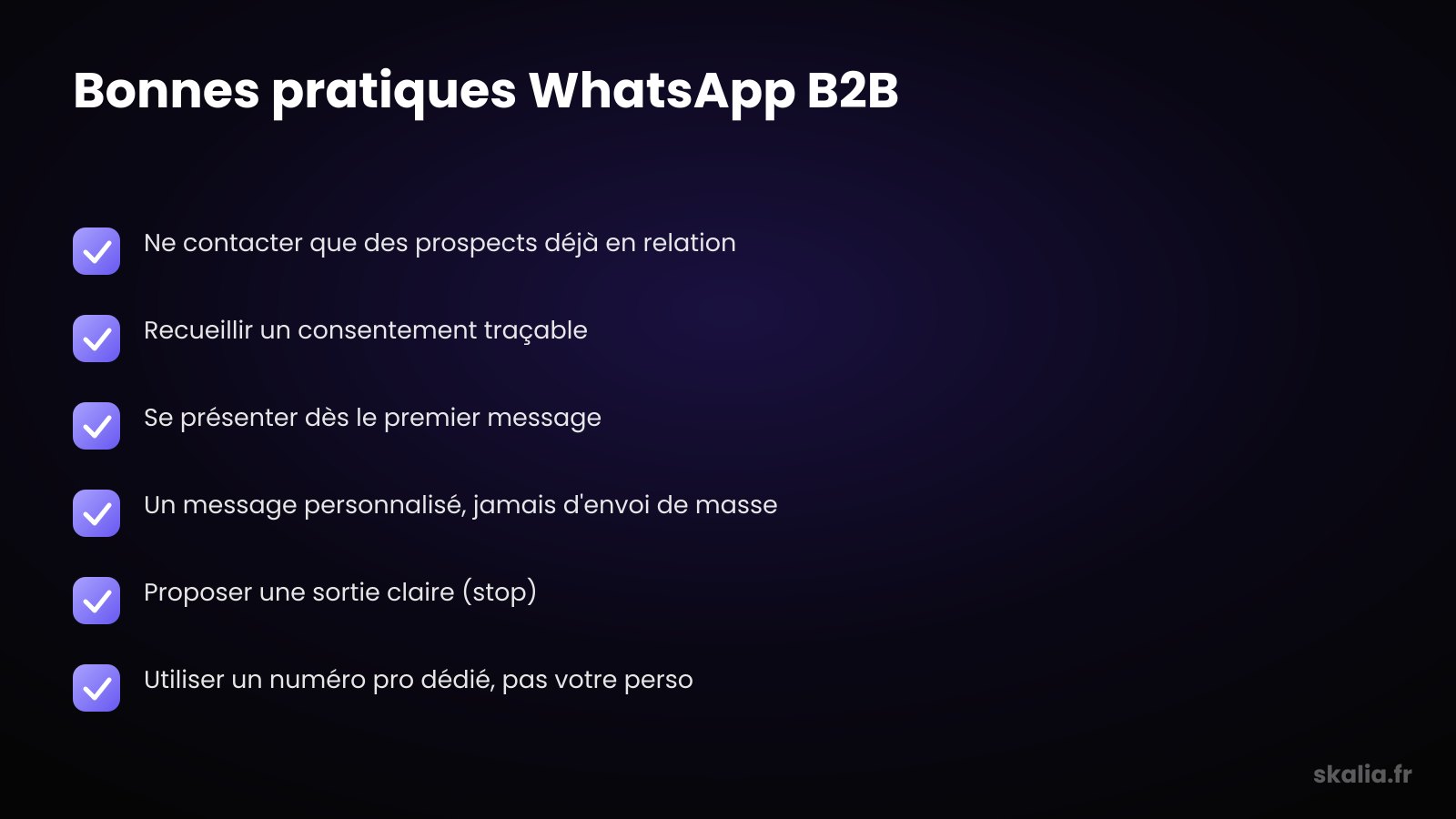
Six rules prevent most of the damage: consent, introduction, personalization, a clear opt-out, a dedicated number, zero mass sending. A well-framed WhatsApp message can exceed a 40% reply rate in warm outreach, versus a few percent in cold outreach (WhatsApp Business, Meta, 2024), provided you respect the channel.
- Only contact prospects you already have a relationship with.
- Collect traceable consent (checked box, written agreement, explicit request).
- Introduce yourself in the first line: who you are, why you're writing.
- Write a personalized message, never a copy-pasted mass send.
- Offer a clear opt-out: "let me know if this bothers you, and I'll stop."
- Use a dedicated business number via WhatsApp Business, not your personal line.
Tone matters as much as the rule. On WhatsApp, you write like you're talking to a human: short sentences, no jargon, no sales-copy wall of text. If your message reads like a marketing email pasted into a green bubble, you've already lost.
Solid WhatsApp prospecting fits into a broader method. Our automated prospecting guide and our cold email guide lay the groundwork this channel builds on — not replaces.
How Do You Fit WhatsApp Into a Multichannel Strategy?
Place WhatsApp downstream, as an acceleration channel once the lead is warmed up. Companies that combine multiple channels generate higher conversion rates than those relying on a single touchpoint (B2B market data, 2026), provided the sequence is built intelligently.
The playbook that works: LinkedIn or email to open the conversation, a follow-up email to reinforce it, then a move to WhatsApp only once the prospect has shown interest. At that point, asking for their number feels natural, and the channel plays its role as a closing accelerator.
[UNIQUE INSIGHT] Seen from another angle, WhatsApp isn't an acquisition channel, it's a conversion channel. It doesn't create the relationship, it moves it forward faster. Mistaking it for a cold-prospecting tool is exactly where most companies get burned.
Should You Get Into B2B WhatsApp Prospecting?
Yes, but in its proper place: warm, well-framed, never as a cold-opening channel. WhatsApp rewards companies that respect the channel and punishes those that force it. Used well, it turns a lukewarm lead into a meeting; used poorly, it damages your image in a single message.
At Skalia, we build sequences where each channel plays its role at the right time, WhatsApp included when the context calls for it. If you're on the fence about adding it to your setup, frame it before you test it. To build a solid foundation before you even consider it, start with a focused acquisition strategy. Let's talk.
FAQ
Is B2B WhatsApp Prospecting Legal in France?
It is, provided you have a legal basis: consent or documented legitimate interest, and a contact obtained cleanly. In practice, cold-contacting a number collected without agreement exposes you to GDPR risk. In warm outreach, with traceable consent, the risk is far lower.
What Reply Rate Should You Expect on WhatsApp in B2B?
In warm outreach, a personalized message can exceed a 40% reply rate, since the channel is opened almost every time. In pure cold outreach, the rate collapses and the risk of being reported climbs. The spectacular figure only holds up if the prospect already knows you or is expecting you.
Can Your WhatsApp Number Get Banned?
Yes, if you send in bulk or generate too many reports. WhatsApp detects spam-like behavior and restricts or cuts off numbers, sometimes in under 72 hours. A dedicated Business number and personalized, low-volume sending significantly limit this risk.
Does WhatsApp Replace Email or LinkedIn in Prospecting?
No, it complements them. Email remains the volume channel, LinkedIn the professional-context channel, WhatsApp the warm-engagement channel at the end of the journey. Replacing them with WhatsApp means losing cold reach. The best results come from combining all three in sequence.