
 kevin@skalia.ca


Google Ads Quality Score: Pay Less for Your Clicks

Two advertisers can pay very different prices for the same click. The hidden variable is called Quality Score. Here's what Google rates, why it affects your CPC, and the concrete levers to bring the bill down.
- Quality Score is a rating from 1 to 10 assigned to each keyword.
- It rests on 3 components: expected click-through rate, ad relevance, landing page experience.
- A good score can cut your CPC by 30 to 50%.
- You improve it by tightening ad groups and polishing the landing page.
What is Google Ads Quality Score?
Quality Score is a rating from 1 to 10 that Google assigns to each of your keywords to evaluate the quality of your ad and your page. The higher the rating, the less you pay for the same position. It's the metric that explains why two advertisers pay very different prices for the same click.
This rating appears directly in the Google Ads interface, column by column at the keyword level. It isn't fixed: it evolves in real time based on your campaigns' actual performance. A keyword that disappoints sees its score drop, which makes every click more expensive.
Remember this: Quality Score isn't a vanity metric. It's a cost multiplier. Neglecting it means accepting a permanent premium on every auction.
Why does Quality Score lower your CPC?
Quality Score lowers your CPC because Google combines your bid and your rating to calculate your ranking, via Ad Rank. A high score lets you outrank a competitor who bids higher, while paying less per click. In practice, a score of 8 to 10 can cut CPC by 30 to 50% compared with a score of 3 to 4.
The mechanism is simple. Your position in the results depends on Ad Rank, which roughly multiplies your bid by your quality. With higher quality, you reach the same position with a lower bid. Google rewards advertisers who make the experience useful.
Conversely, a poor score acts as a penalty. You have to overbid just to stay visible, and your budget runs out faster. This is often the first cause of a CPC that spirals with no apparent explanation.
If your budget is running out too fast, Quality Score is the first thing to audit before touching your bids. We cover the other critical settings in our guide to the 6 Google Ads settings to check.
What are the 3 components of Quality Score?
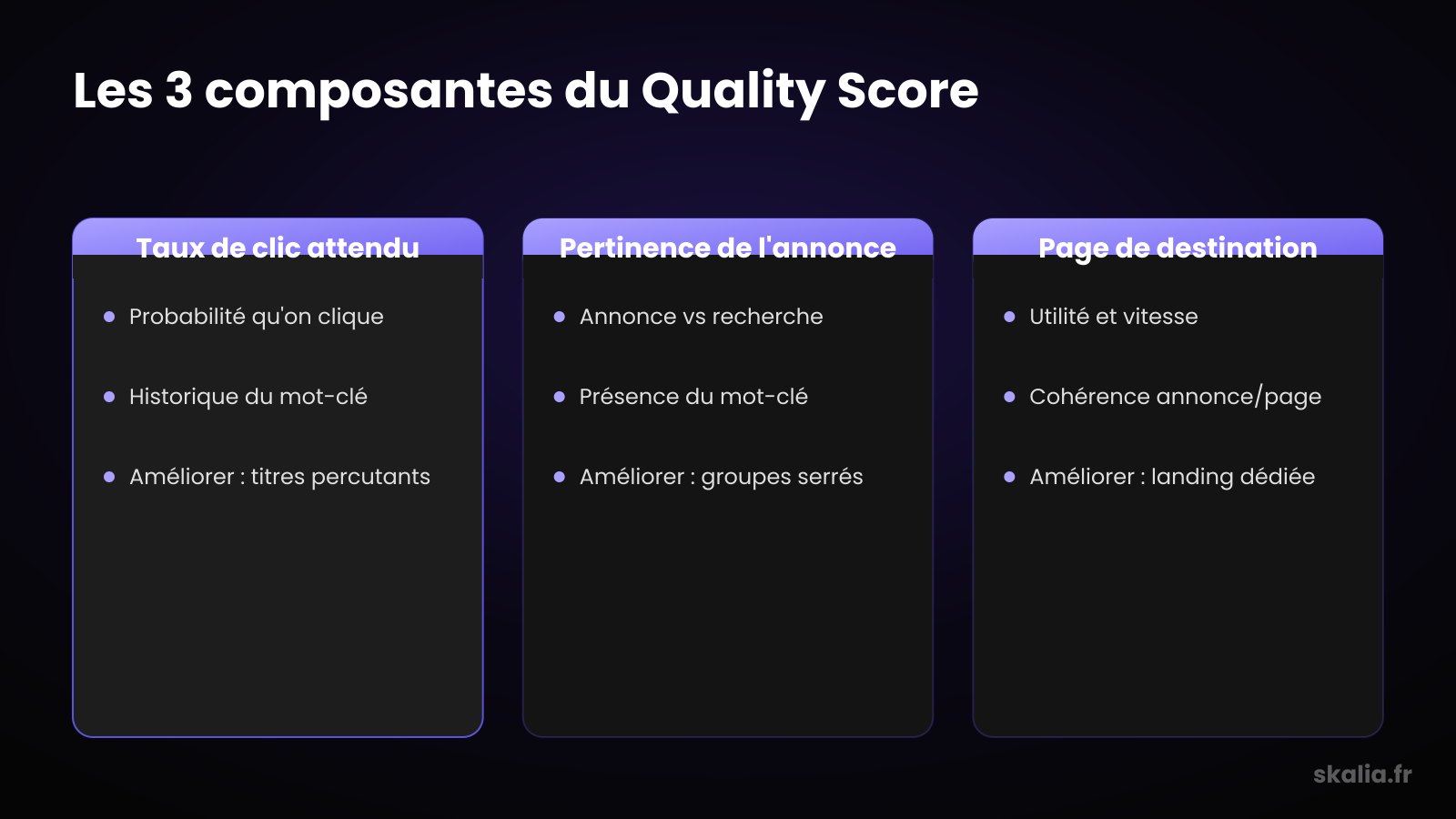
Quality Score rests on three components, each rated by Google as “below average,” “average,” or “above average”: expected click-through rate, ad relevance, and landing page experience. These three signals are visible at the keyword level and guide your optimization priorities.
Each component measures one specific thing. Expected click-through rate estimates the likelihood a searcher clicks your ad. Relevance measures how well your ad matches the search query. Landing page experience judges the usefulness and speed of your landing page. Improving one without the others rarely yields a score of 8 or higher.
| Component | What Google evaluates | How to improve it |
|---|---|---|
| Expected click-through rate | The likelihood a searcher clicks your ad, regardless of position | Write punchy headlines, test callouts, use extensions |
| Ad relevance | How well the ad copy matches the search query | Tighten ad groups, work the keyword into the headline |
| Landing page experience | The usefulness, clarity, and speed of the landing page | Build a dedicated landing page, align the message, speed up load time |
How do you improve expected click-through rate?
You improve expected click-through rate by making your ad more clickable than your competitors' at the same position. It's the most influential of the three components, because a keyword with a poor click history drags its score down for a long time. Clear headlines and a concrete benefit are often enough to unblock the situation.
Start with the headlines. Put the benefit or the keyword in the very first headline, add a number or a differentiator, test at least three variants per group. Enable every relevant extension: sitelinks, callouts, structured snippets. They increase the clickable surface area and the click-through rate.
Then watch for very low-volume keywords. An overly generic term attracts off-topic clicks and drags down the score. It's better to pause it than let it pollute your ad group.
How do you improve ad relevance?
You improve ad relevance by tightening your ad groups so each ad matches as closely as possible the keywords it targets. The golden rule: one theme = one group. When a group mixes ten different intents, no single ad can be truly relevant to all of them.
Organization is what matters most here. Group keywords by narrow intent, then write an ad that echoes their exact vocabulary. If you're targeting “emergency plumber Toulouse,” the headline should contain those words, not a generic phrase about plumbing.
This is the principle behind single-theme ad groups, sometimes called SKAGs. They take more work to set up, but they boost relevance and therefore the score. Also think about negative keywords: they block off-topic searches that dilute your relevance.
How do you improve landing page experience?
You improve landing page experience by sending the visitor to a dedicated, fast landing page that's consistent with the ad they just clicked. Google penalizes pages that are slow, confusing, or disconnected from the promise made. A page that takes more than 3 seconds to load, or that doesn't display the expected keyword, sees its rating drop.
Three concrete projects. First, consistency: the page must echo the message and the keyword from the ad, without landing on a catch-all homepage. Second, speed: compress images, limit scripts, aim for mobile load times under 3 seconds. Third, clarity: a clean headline, a benefit, a single visible call to action.
Never send paid traffic to your default homepage. A landing page designed for the query converts better and reassures the algorithm. It's also what protects your budget, as we explain in our article on minimum Google Ads budget.
What myths should you avoid about Quality Score?
The first myth to avoid: believing that raising your bid improves your Quality Score. That's false — the score depends on quality, not on the amount bid. Many advertisers waste budget by overbidding when the real lever is elsewhere.
Second myth: thinking there's one overall account-level score that decides everything. Quality Score is calculated keyword by keyword. An account can have excellent keywords and terrible ones at the same time. You optimize at a granular level, not on average.
Third myth: obsessively chasing a 10. A score of 7 or 8 on your strategic keywords is plenty to reduce your costs. Chasing a perfect 10 everywhere costs more time than it's worth. What matters is your cost per conversion, not the rating displayed. Your choice of channel matters too: our comparison Google Ads vs Meta Ads helps you decide before optimizing.
FAQ
Is a good Quality Score enough to make Google Ads profitable?
No. A good score lowers your CPC, but profitability also depends on your conversion rate, your average order value, and your targeting. Quality Score lowers the cost of the click, not the cost per customer. Both need to be worked on together.
How quickly does Quality Score change?
The score evolves continuously, as soon as Google accumulates enough performance data. After an optimization, expect anywhere from a few days to two weeks to see the rating move, the time it takes for the new click-through rate to be confirmed. Patience and click volume are both necessary.
Does Quality Score also exist on the Display Network?
Classic Quality Score applies to the Search network. On Display, Google uses other quality signals, less visible in the interface. The principles remain similar: ad relevance and page quality still weigh on your costs and your delivery.
Should you pause keywords with a low Quality Score?
Not automatically. First analyze which component is at fault and fix it. If a keyword stays below 3 or 4 despite your efforts and doesn't convert, pause it. It's consuming budget and dragging down your group's average.
Want to pay a fair price for your clicks?
Optimizing Quality Score is precision work, keyword by keyword, combined with solid targeting and account structure. At Skalia, we audit these three components before touching the bids, to bring down CPC without sacrificing volume. If your clicks cost too much and you don't know why, Quality Score is often the first culprit. To go further on the cost question, also see Google Ads agency pricing. Let's talk about it.