
 kevin@skalia.ca


AI SDR: What Is an AI SDR in 2026 (and Its Limits)?
An AI SDR is a software agent that takes over outbound prospecting: finding the right prospects, personalizing messages, running multichannel sequences, and qualifying replies. Here's what it truly does well, what it misses, and when to adopt it without getting burned.
- An AI SDR automates sourcing, personalization, sequencing, and qualification — not closing.
- Expect mainly a time saving on repetitive tasks, not a volume miracle.
- Poorly configured, it destroys your deliverability and your brand.
- AI amplifies a good prospecting system; it doesn't create one from scratch.
What is an AI SDR in 2026?
An AI SDR is a software agent that automates outbound prospecting: it searches for prospects, personalizes messages, runs multichannel sequences, and qualifies replies, without replacing humans on closing and relationship-building. The term SDR stands for "Sales Development Representative," the role responsible for generating and qualifying meetings ahead of the sales team.
In practice, an AI SDR replaces part of the manual work typically done by a junior prospecting hire. It doesn't replace judgment, negotiation, or trust-building. It's a tool for amplification, not an autonomous salesperson.
The nuance matters. Many vendors sell the idea of an "autonomous rep who fills your calendar on their own." The 2026 reality is more modest: a very fast assistant on low-value tasks, still in need of a human at the controls.
What does an AI SDR actually do?
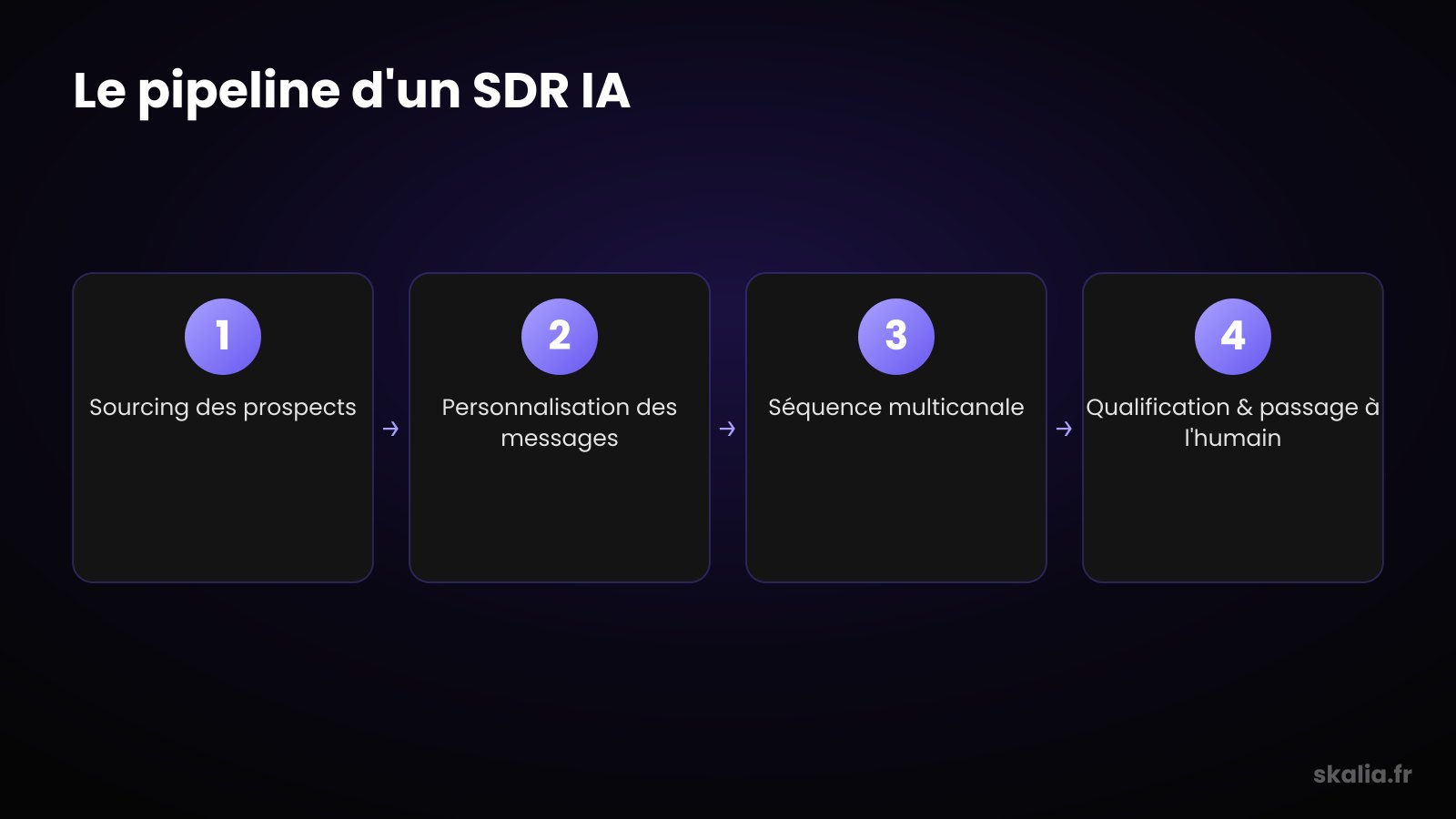
An AI SDR handles four specific tasks: prospect sourcing, message personalization, sending multichannel sequences, and qualifying replies. Each of these steps has historically been time-consuming and repetitive, making it fertile ground for automation.
Sourcing and enrichment
It identifies accounts and contacts matching your target (industry, size, role), then enriches records with public data: professional email, current job title, interest signals. You go from a raw list to a usable one without spending hours on it.
Personalization at scale
It generates hooks tailored to each prospect based on their profile, their company, or a recent event. This is where it shines and where it derails: well configured, it personalizes better than a rushed human; poorly configured, it produces generic messages disguised as personalization.
Sequencing and qualification
It runs email-plus-LinkedIn sequences, follows up automatically, detects positive replies, and sorts genuine interest from polite refusals. To structure these sequences, our automated prospecting guide covers cadences that hold up without burning your database.
What doesn't an AI SDR do well?
An AI SDR falls short exactly where prospecting becomes human: relationship, nuance, and closing. It starts conversations; it doesn't win them. Confusing the two is the leading cause of disappointment after buying a tool.
It struggles with ambiguous replies, implicit objections, and irony. A prospect who writes "interesting, but not right now" needs a nuanced follow-up, not an automated reminder ten days later. That's a job for discernment, not processing.
It also doesn't build your strategy. Targeting the right segment, crafting the right promise, choosing the right channel: these decisions remain human. An AI SDR plugged into a fuzzy offer or a poorly defined target mainly amplifies your mistakes, faster and at greater scale.
Finally, it doesn't replace the sales conversation. A qualified meeting needs to be handed to a human who listens, adapts, and engages. On this point, our article on AI agents in customer relations shows where automation genuinely helps and where it needs to step back.
Human SDR or AI SDR: what are the differences?
On paper, the AI SDR wins on cost, volume, and scalability, while the human SDR keeps the edge on fine-grained personalization and reply management. In practice, the two complement each other more than they compete: AI prepares, the human closes.
| Criterion | Human SDR | AI SDR |
|---|---|---|
| Cost | High (salary + overhead) | Low (tool subscription) |
| Volume | Limited by time | High, nearly unlimited |
| Personalization | Fine-grained and intuitive | Good if well configured, otherwise generic |
| Reply handling | Nuanced, adaptive | Basic, simple sorting |
| Scalability | Slow (hiring) | Immediate |
The table highlights a point often overlooked: an AI SDR isn't "cheaper than a human" across the board. It's cheaper on repetitive volume, but it still depends on a human who steers it and picks up the meetings it books. The real calculation compares in-house cost versus outsourcing, as in our comparison in-house SDR vs. prospecting agency.
What realistic results should you expect from an AI SDR?
The main gain from an AI SDR is time, not a miracle: it frees up the hours spent on sourcing, enrichment, and follow-ups — often half the operational time of a prospecting role. The volume of contacts reached increases, but the reply rate still depends on your offer and your targeting, not on the tool.
Let's be clear about magnitude. A well-configured AI SDR gets you time savings and consistency: no more forgotten sequences, no more manual follow-ups. It doesn't turn an average offer into a meeting-generating machine. Reply rates remain governed by message relevance and list quality.
Watch out for the volume effect too. Sending more doesn't equal closing more. Past a certain threshold, increasing email volume degrades deliverability and wears out your brand. The right metric remains the number of qualified meetings generated, not the number of messages sent.
What are the risks of a poorly configured AI SDR?
The main risk of an AI SDR is scaling the mistake: misconfigured, it sends spam at scale, burns your sending domains, and damages your image within days. What was once a one-off blunder becomes an industrial-scale problem.
Three dangers come up most often:
- Deliverability: too much volume, too fast, on a poorly warmed-up domain, and your emails end up in spam.
- Fake personalization: unfilled variables (like "Hi {firstname}") expose the automation and destroy credibility.
- Compliance: B2B prospecting remains governed by GDPR — the database must be legitimate and opting out must be simple.
The common thread: an AI SDR amplifies whatever you feed it. Good target, good message, good pace, it becomes an ally. Bad settings, it becomes a machine for torching your reputation. That's why it should be deployed on top of an already-healthy prospecting system, never the other way around.
When should you adopt an AI SDR (and when should you be wary)?
Adopt an AI SDR once your prospecting already works manually and the bottleneck is time, not strategy. If your messages convert at a small scale and you want to hold more conversations without hiring, AI is the right lever. It's an accelerator, not a starter.
Be wary in the opposite case. If you don't yet know who to target, what to say, or why anyone would reply, an AI SDR won't answer that for you. It will just make your hesitations more visible and more costly. Better to clarify the offer and the message by hand first.
Before automating, list what genuinely deserves it: our article on marketing tasks worth automating helps sort what saves time from what creates noise. The simple rule: automate what's repetitive and well-defined, keep human judgment where it's needed.
How does Skalia position AI in prospecting?
At Skalia, AI amplifies, and the human stays in control. We use AI SDRs to absorb repetitive work — sourcing, enrichment, sequencing — but we always place a human on fine qualification and relationship-building. That balance is what protects your deliverability and your brand image.
Our approach stays grounded: no promise of a calendar that fills itself, but an outbound prospecting system built to last, where automation serves relevance instead of diluting it. Wondering whether an AI SDR makes sense for your business, or whether a human-plus-AI setup would be more profitable? Let's talk — we'll look at your target and your offer together before plugging in anything.
FAQ
Does an AI SDR replace a salesperson?
No. An AI SDR automates the upstream part of prospecting: finding, contacting, and qualifying. Closing, negotiation, and relationship-building remain human. It frees up sales time; it doesn't replace the salesperson.
How much time does an AI SDR save?
It mainly absorbs repetitive tasks: sourcing, enrichment, follow-ups — often a significant share of a prospecting role's operational time. The actual gain depends on your volume and your organization, not a vendor's promise.
Is an AI SDR legal for B2B prospecting?
Yes, as long as it complies with GDPR: legitimate database, clear purpose, easy unsubscribe. The tool doesn't exempt you from compliance. You, not the AI, remain responsible for the messages sent and consent obtained.
Should you start with an AI SDR or a human SDR?
If your prospecting has never been tested manually, start with a human to validate the target and the message. The AI SDR then makes full sense to scale up a system that already converts.