
 kevin@skalia.ca


Local SEO: How to Appear in Google's Local Pack
The local pack is the set of 3 business listings displayed under the map when someone searches for a service near them. Being featured there captures the bulk of local clicks. Here's what determines ranking and how to act on it, step by step, without an advertising budget.
- The local pack is the set of 3 listings displayed alongside Google's map for a local search.
- Three factors decide the ranking: relevance, distance, prominence.
- Your Google Business Profile listing is the central lever, ahead of reviews and NAP citations.
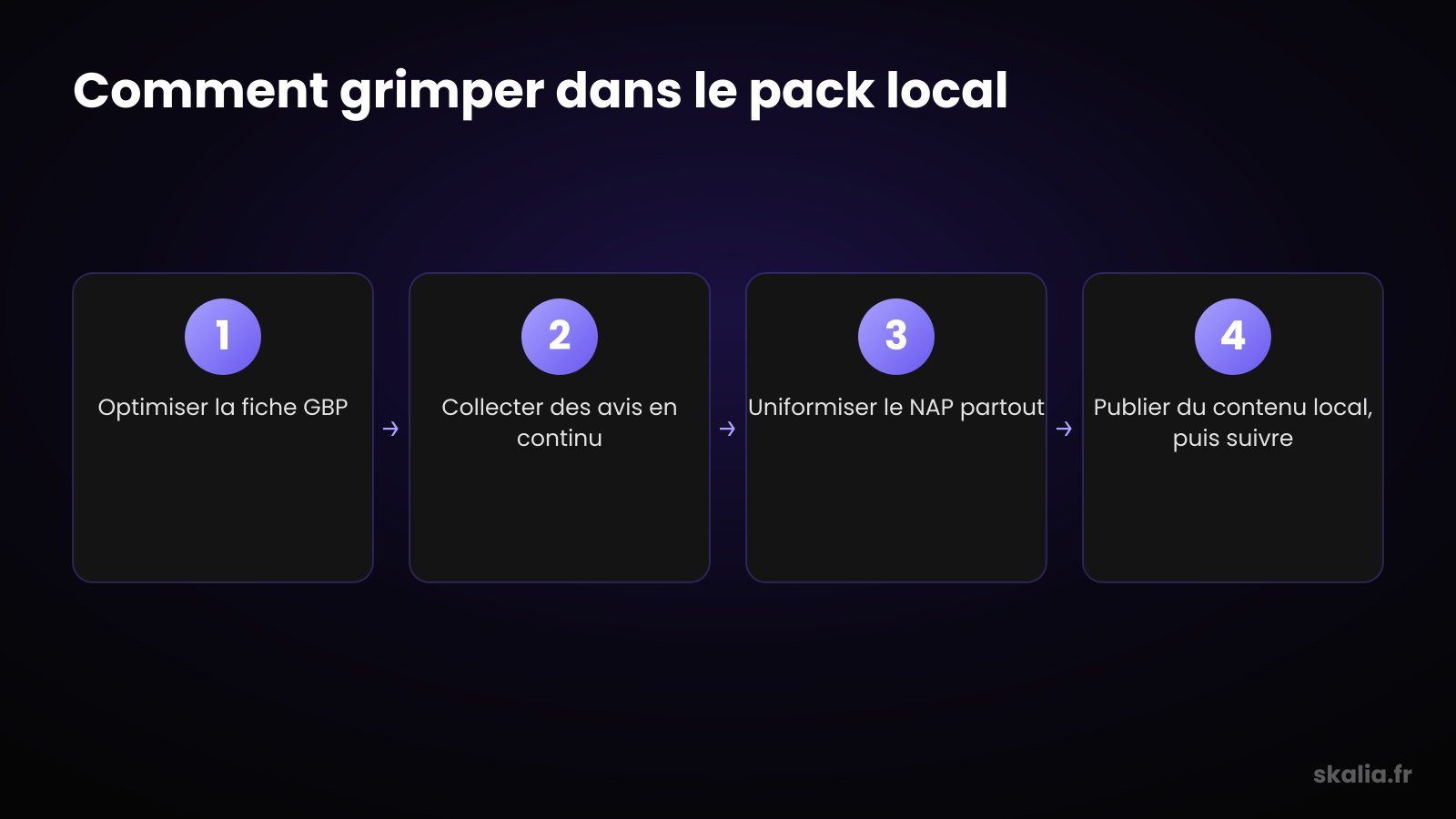
- Optimize the listing, collect reviews continuously, keep your contact details consistent, publish local content, then track your rankings.
What is Google's local pack?
The local pack is the set of 3 business listings displayed with a map, at the top of the results, when a search has local intent. Google triggers it for queries like “plumber in Toulouse” or “hairdresser near me.” These 3 spots capture a large share of clicks before even the standard results.
In practice, each listing shows your name, your star rating, your category, your hours, and a link to directions or a call button. It's free, highly qualified advertising: the person is searching for exactly what you sell, right when they're searching for it.
Being featured doesn't depend on your website alone. The local pack has its own rules, largely driven by your Google Business Profile listing. Good news: these rules are well known and actionable, even for a small business with no advertising budget.
What are the 3 ranking factors of the local pack?
Google ranks the local pack on three official factors: relevance, distance, and prominence. Relevance measures how well your listing matches the search. Distance calculates how far the searcher is from your location. Prominence evaluates your online reputation, reviews included.
**Relevance** depends on your primary category, your description, and the words on your listing. If you're a “plumber” but your category says “tradesperson,” you'll miss searches. Choose the most precise category possible.
**Distance** is calculated from the searcher's location or the place they typed. You don't control it directly, but an exact address and a well-defined service area help Google position you correctly.
**Prominence** combines your reviews, your citations, your links, and your overall web presence. It's the factor you can work on most over time. The more your business is mentioned, rated, and consistent online, the more reliable Google judges it to be.
| Factor | What matters | Concrete action |
|---|---|---|
| Relevance | Category, description, listed services | Choose the most precise category, describe your services |
| Distance | Exact address, service area | Fill in your address and service areas honestly |
| Prominence | Reviews, rating, NAP citations, links | Collect reviews, standardize contact details, earn mentions |
Why is your Google Business Profile listing so central?
Your Google Business Profile listing is the linchpin of the local pack: without a verified, complete listing, you simply don't appear. It's the listing that Google displays, not your website. A 100%-complete listing sends a strong signal of credibility and covers all three ranking factors at once.
A high-performing listing checks several boxes: precise primary category, relevant secondary categories, up-to-date hours, local phone number, link to the right website, service area, and a description rich in services. Every empty field is a missed opportunity to be judged relevant.
Photos matter more than people think, too. A listing with recent visuals reassures the searcher and increases clicks, which in turn indirectly strengthens your ranking. To dig deeper into the topic, our complete Google Business Profile guide covers every setting in detail, and this article on photos for your Google Business listing explains which ones to add first.
How do customer reviews boost your ranking?
Reviews are the fuel of local prominence: their number, average rating, freshness, and your responses all weigh into the local pack ranking. A listing with 80 recent reviews at a 4.7-star average almost always beats a listing with 12 reviews, all else being equal.
What matters isn't just the rating. Google watches for consistency: ten reviews spread across the year are worth more than a burst of twenty in one week, which looks like manipulation. Aim for a steady stream, by systematically asking for a review after a successful job.
Respond to every review, positive and negative alike. A polite, personalized reply shows the business is active and attentive — a signal appreciated by Google and by your future customers alike. For a concrete, ethical method, read our article on how to get Google reviews.
Citations, NAP, and local content: what should you do?
Citations are mentions of your business (name, address, phone) on other sites: directories, local listings, social networks, partner sites. Their consistency, called NAP, strengthens Google's confidence in your contact details and solidifies your prominence.
The rule of thumb: strict consistency. Write your name, address, and phone number exactly the same way everywhere. “Street” here and “St.” there, a landline here and a mobile elsewhere, and Google starts to doubt. An identical NAP across every platform removes the ambiguity.
On your site, **local content** makes the difference on tightly targeted searches. A dedicated page for each city or neighborhood you serve, with natural mentions of your service areas and offerings, strengthens relevance. Avoid keyword stuffing: genuinely talk about your area and your local track record.
How do you track and improve your ranking?
Tracking is essential: without measurement, you're flying blind and don't know which lever paid off. Local pack rankings vary depending on where the search is made from, so track your positions from several points across your area, not just from your office.
Three metrics are enough to get started: your average ranking on your local keywords, the volume of calls and direction requests generated by your listing (visible in your Google Business Profile insights), and the growth in your review count. A simple monthly spreadsheet works perfectly well at first.
From there, move forward by iterating: one adjustment at a time, then measure. You improve a category, restart your review collection, add a local page, and observe the effect over four to six weeks. Local SEO rewards consistency far more than one-off bursts of effort.
FAQ
How long does it take to appear in the local pack?
Generally, expect 1 to 3 months for a new, well-optimized listing on low-competition searches. In dense markets like a big city, it often takes 3 to 6 months of steady work on reviews, citations, and local content before you stabilize a top-3 position.
Are the local pack and traditional SEO the same thing?
No, they're two distinct rankings. The local pack relies mostly on your Google Business Profile listing, your reviews, and your NAP citations. Traditional SEO ranks your website's pages using the usual criteria. The two reinforce each other, but you can absolutely dominate the local pack without ranking first in the organic results.
Do you need a website to appear in the local pack?
No, a verified Google Business Profile listing is technically enough to appear. But a website clearly improves your odds: it strengthens your relevance, hosts local content, and reassures visitors. Without a site, you'll quickly hit a ceiling on competitive searches where your rivals have one.
Can you appear in the local pack outside your own city?
It's difficult, because distance is a direct ranking factor. Google favors businesses close to the searcher. You can broaden your visibility by filling in your service areas and publishing dedicated local pages, but you'll remain weaker than a competitor physically based in the targeted city.
Take action on your local pack
Winning the local pack takes method, not luck: an optimized listing, regular reviews, consistent NAP, local content, and tracking. None of these levers are out of reach for an SME, but putting them in place demands consistency week after week. That's often where it stalls, between two already packed days.
At Skalia, we structure this local visibility for businesses in Toulouse and the surrounding region, from auditing the listing through to tracking rankings. If you want to delegate or structure your strategy, check out our approach as a local SEO agency in Toulouse, and to plan your budget, our article on local SEO agency pricing. Let's talk about it.