
 kevin@skalia.ca


Cold Email and LinkedIn Response Rates: 2026 Benchmarks
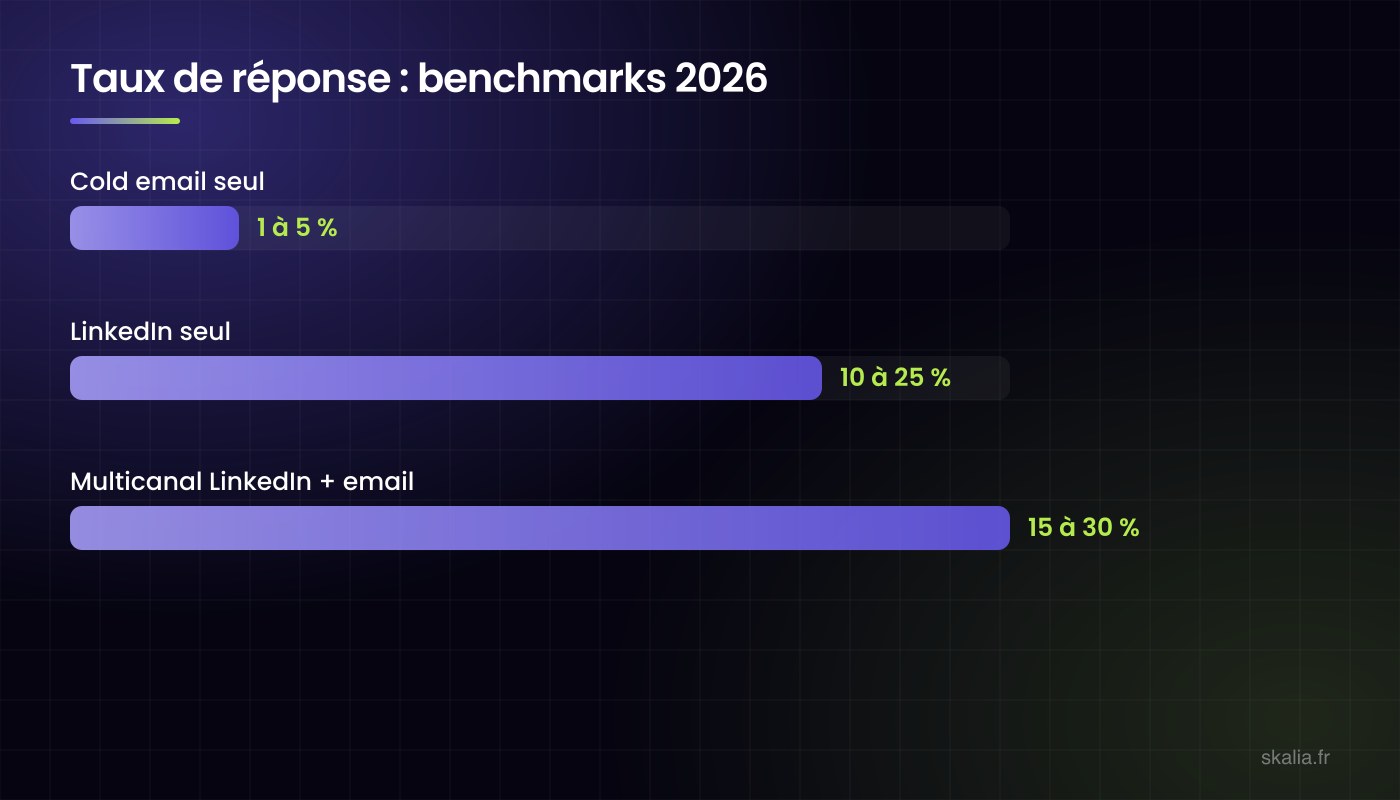
The 2026 benchmarks in one sentence: cold email gets a 1-5% response rate, a well-targeted LinkedIn message 10-25%, and a multichannel LinkedIn + email sequence 15-30%. Here are the step-by-step reference figures (open rate, response rate, meetings booked), the thresholds that should raise a red flag, and the factors that actually move these numbers.
- Cold email: 40-60% open rate, 1-5% response rate.
- LinkedIn: 30-50% acceptance rate, 10-25% response rate.
- Multichannel LinkedIn + email: 15-30% combined response rate.
- Warning thresholds: under 30% email open rate (technical issue), under 25% LinkedIn acceptance (targeting issue), under 2% overall response rate (stop and fix).
The 2026 benchmarks, channel by channel
These ranges combine the major industry studies (Backlinko's analysis of 12 million emails, data published by outreach platforms like Lemlist or Belkins) with what we see across our own French B2B campaigns. They apply to properly executed campaigns: clean targeting, personalized messages, follow-ups.
| Metric | Cold email | Multichannel LI + email | |
|---|---|---|---|
| Open / acceptance rate | 40-60% | 30-50% acceptance | combination of both |
| Response rate (all responses) | 1-5% | 10-25% | 15-30% |
| Positive / interested responses | 0.5-2% | 3-8% | 2-4% of total contacted |
| Qualified meetings booked | 0.3-1% | 1-3% | 0.5-1.5% |
Important caveat: these rates don't simply stack. Multichannel wins because each channel catches the prospects the other one missed, not because it doubles the outreach volume. The full funnel breakdown (from 1,000 contacts to 5-15 meetings booked) is covered in how many leads to expect from a campaign.
Which thresholds should raise a red flag?
- Email open rate below 30%: this is almost always a technical issue first (deliverability, subject line, an under-warmed domain). Check the deliverability checklist before touching the message itself.
- LinkedIn acceptance rate below 25-30%: targeting that's too broad, or a profile that doesn't inspire trust (the 7 causes and fixes).
- Responses below 2% after 200-300 contacts: stop and fix something (the message or the target), never increase volume on a campaign that isn't getting responses.
- Plenty of responses but mostly negative: the mechanics are working, it's the offer-to-segment fit that's off.
What actually moves the numbers?
Three factors outweigh everything else, in this order: targeting precision (a hand-picked list can double your response rate), genuine personalization of the first message (one sincere observation about the prospect beats any template), and follow-ups (2-4 follow-ups often generate half of all responses). Brand awareness, offer clarity, and seasonality come next. The full playbook for pulling each lever is in the automated outreach guide.
How to use these benchmarks without getting it wrong
Two precautions. First, compare like with like: a "response rate" includes polite rejections; only positive responses actually predict meetings booked. Second, judge on a statistically meaningful volume: at least 200-300 contacts per message variant and 4-6 weeks of campaign time, excluding slow periods (August, the holidays). A benchmark is a diagnostic reference point, not a guaranteed outcome: your real numbers depend on your market, and anyone who promises you a precise rate upfront is selling you a story (how to spot these empty promises).
Key takeaways
- 2026 reference figures: 1-5% response rate for cold email, 10-25% on LinkedIn, 15-30% multichannel.
- Every stage of the funnel has its own warning threshold: open rate = technical, acceptance = targeting, response = messaging.
- Targeting, personalization, and follow-ups account for most of the gap between an average campaign and a great one.
- Judge results over 200-300 contacts and 4-6 weeks, never over 20 messages.
FAQ: outreach response rates
What counts as a good cold email response rate in 2026?
Above 3%, your campaign is performing well; above 6%, it's excellent. The market average, pulled down by mass-blast campaigns, stays under 9% according to the Backlinko study.
Why does LinkedIn get so many more responses than email?
The social context: your face, your background, and your content are all visible, and the message lands in a space that's less saturated than an inbox. LinkedIn claims roughly 3x more responses than an equivalent cold email.
Do response rates decline year after year?
For generic, mass-blast campaigns, yes: saturation crushes them. For targeted, personalized campaigns, the ranges have stayed remarkably stable for several years.
What volume do you need for a benchmark to be meaningful?
At least 200-300 contacts per message variant. Below that, the differences you're seeing are statistical noise, not a real trend.
Written by Kevin Sazarin, Growth Marketer and founder of Skalia (Toulouse). Parent guide: automated outreach from A to Z.