
 kevin@skalia.ca


Best Lead Generation Agency: The Comparison Framework for 2026
The "best" lead generation agency doesn't exist in the abstract: there's the best one for your offer, your target audience, and your budget. Rather than an unsellable ranking, here's a 7-criteria evaluation framework, the types of providers on the French market, and the questions that expose empty promises in a single meeting.
- Be wary of "top 10 agency" rankings: they're almost always sponsored or self-proclaimed.
- Compare against 7 objective criteria: specialization, method, transparency, data ownership, commitment, full pricing, proof.
- Three questions in a meeting are enough to expose 80% of empty promises.
- A good provider refuses to guarantee volumes.
Why Are Agency Rankings Worthless?
Because nobody measures them. The "top 10 lead generation agencies" lists circulating online are sponsored articles, pay-to-play directories, or self-rankings. No independent body audits agencies' actual results on comparable campaigns. The only reliable method is to compare them yourself, using objective criteria and precise questions.
What Types of Providers Exist?
| Type | What it does | Best for |
|---|---|---|
| Outbound prospecting agency | LinkedIn + email + follow-ups, direct meetings | B2B SMEs wanting meetings fast |
| Advertising agency (Google/Meta Ads) | Captures existing demand through ads | Offers actively searched for by the target audience |
| Inbound / content / SEO agency | Attracts through content, long-term effect | Companies investing on a 12-month horizon |
| Pay-per-meeting platforms | Sell meetings individually | One-off tests, with vigilance on quality |
| Outbound freelancers | Lightweight outsourced prospecting | Small budgets, highly variable quality |
These families complement each other more than they compete: prospecting produces results right away, advertising captures intent, and content builds a long-term asset. How the first family works in detail is in the guide to automated prospecting.
The 7-Criteria Evaluation Framework
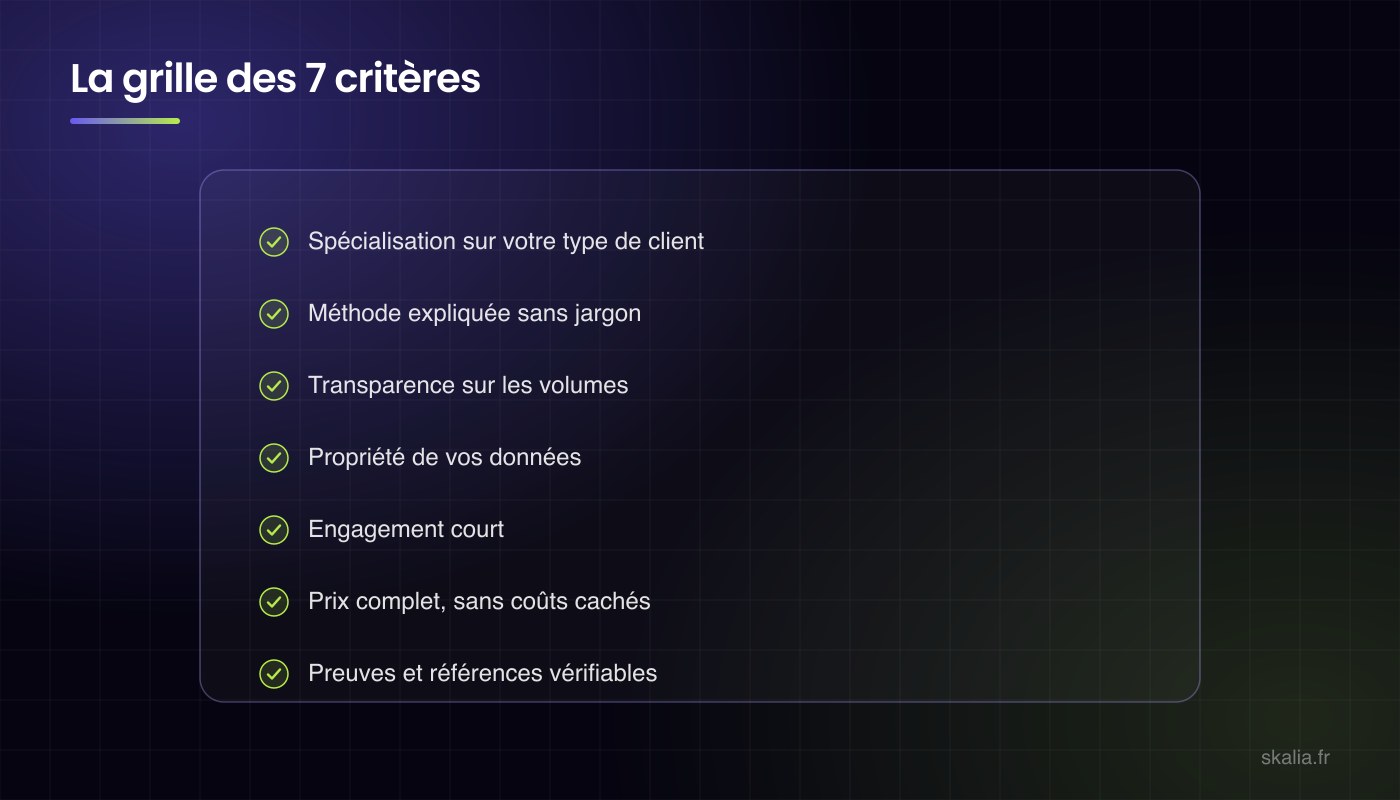
Score each agency from 1 to 5 on these criteria, and the differences become obvious.
- Specialization: does the agency know your type of target audience (B2B, SME, industry), or does it do everything for everyone?
- Explicit method: can it precisely describe its steps (scoping, targeting, copywriting, testing, optimization)?
- Transparency about numbers: does it quote realistic ranges rather than guaranteed volumes?
- Data ownership: does the prospect database and the sequences belong to you contractually?
- Commitment: 3 months to prove itself, or 12 months locked in upfront?
- Full pricing: does the quote include licenses, setup, follow-ups, reporting?
- Verifiable proof: authentic Google reviews, detailed client cases, contactable references.
Criteria 3 and 4 alone eliminate half the market: full details in our guide to choosing a prospecting agency.
The 3 Questions That Expose Empty Promises
- "What reply rates do you see on targets like mine, and why?" A real agency answers with ranges and explanations; a sequence factory answers with a guarantee.
- "What happens if I stop after 3 months?" The answer reveals the real commitment, reversibility, and asset ownership.
- "Who writes my messages, and can I see examples written for other clients?" Copywriting drives 30% of the result: if it's handled on an assembly line, the results will follow suit.
Round it out with the reference budgets in how much does lead generation cost and the realistic volumes in how many leads to expect from a campaign: you'll immediately know whether a proposal is credible.
Where Does Skalia Fit In?
We put our cards on the table rather than calling ourselves the "best agency": AI-powered automated prospecting on a transparent quote, 3-month commitment, database owned by the client, ranges disclosed before signing, and 46 verifiable Google reviews at 5.0/5. Put us through the framework above during a free audit: that's exactly what it's built to evaluate.
Key Takeaways
- No agency ranking is independently measured: compare them yourself with an objective framework.
- 7 criteria are enough: specialization, method, transparency, data ownership, commitment, full pricing, proof.
- Volume guarantees are red flag #1.
- Three questions in a meeting expose the essentials: observed rates, exit conditions, who writes the messages.
FAQ: Choosing Your Lead Generation Agency
Should You Prefer a Local Agency?
It's not decisive for digital prospecting, which is managed remotely. Proximity mainly helps with the relationship and understanding of the local business landscape.
Can a Generalist Agency Do the Job?
Sometimes, but B2B lead generation is an execution-driven craft where the details (deliverability, quotas, copywriting) determine the result. An agency that has made it its specialty starts with a considerable head start.
How Long Should You Give an Agency to Prove Itself?
3 months: enough to run through scoping, launch, and two optimization cycles. If nothing budges after 6 to 8 weeks despite adjustments, the problem is structural.
Can You Work With Two Agencies at Once?
On different channels, yes (one for prospecting, one for advertising). On the same channel, it's counterproductive: your targets would receive competing messages, both coming from you.
Written by Kevin Sazarin, Growth Marketer and founder of Skalia (Toulouse).