
 kevin@skalia.ca


Managing Google Ads Yourself or Hiring an Agency: How to Decide?
Should you manage your Google Ads campaigns in-house or hand them off to an agency? The answer hinges on three things: your media budget, the time you can dedicate to it, and how technical your industry is. We compare both options without bias, including the real hidden costs on each side.
- Whether to manage Google Ads yourself or hire an agency depends on 3 criteria: media budget, available time, and how technical your industry is.
- With DIY, expect 5 to 10 hours/month and a 2-to-3-month learning curve.
- An agency charges €300 to €1,500/month, but saves time and avoids costly mistakes.
- Tipping point: beyond €1,500 to €2,000/month in media budget, an agency often becomes worth it.
Should You Manage Google Ads Yourself or Go Through an Agency?
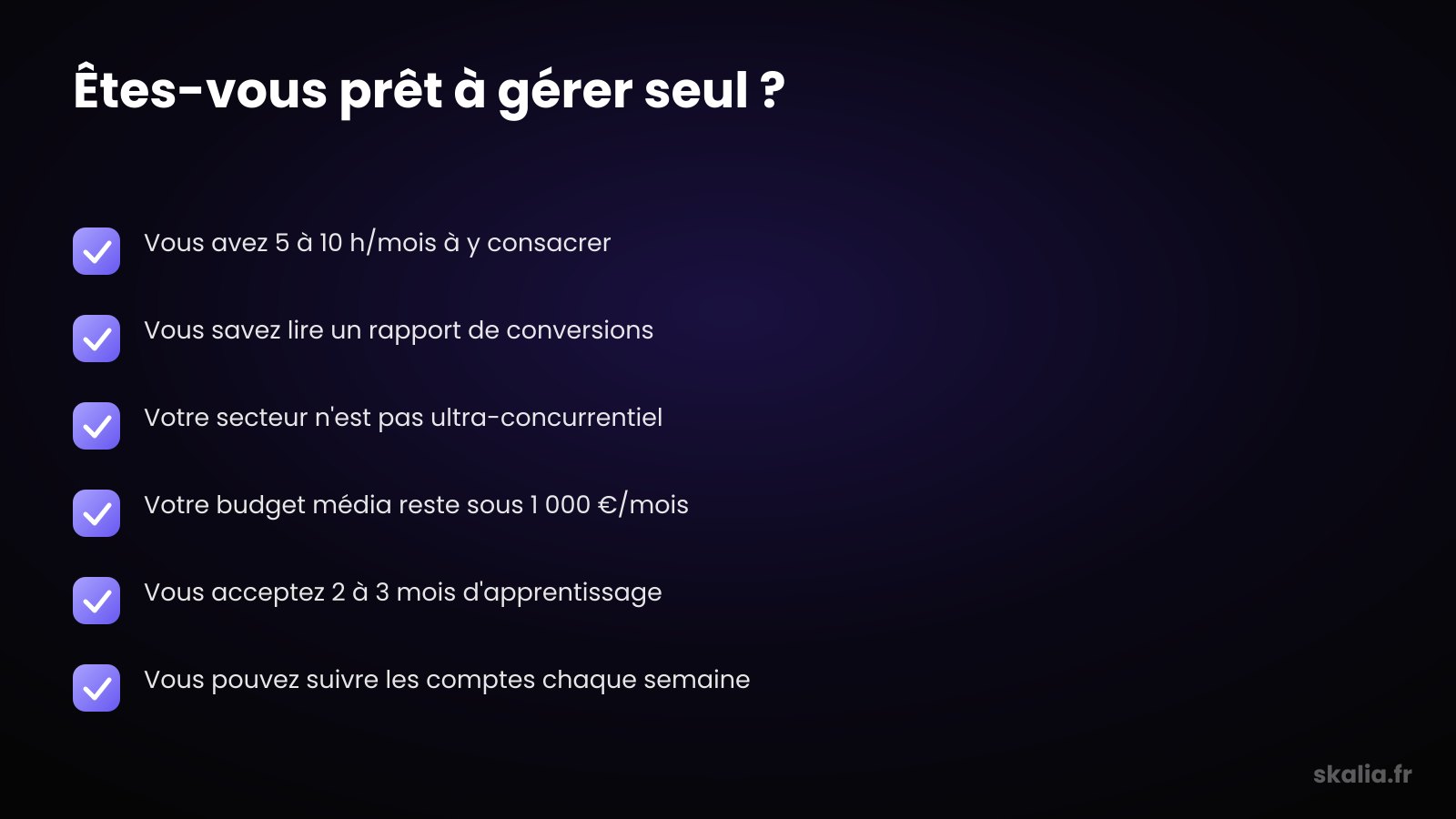
It depends on your media budget, the time you have, and how complex your industry is. Below €1,000/month in budget and in a straightforward industry, DIY is doable. Beyond €1,500 to €2,000/month, or in a highly competitive market, an agency pays for itself quickly by avoiding wasted spend.
There's no universal answer, and be wary of anyone who gives you one. A tradesperson with a €400/month budget doesn't have the same needs as an e-commerce business spending €5,000/month. The real question isn't "who manages it," but "which option costs me less for the same end result."
In this article, we weigh the pros and cons of each side. Then we give concrete thresholds to help you decide.
What Are the Advantages and Limitations of DIY?
Managing Google Ads yourself eliminates agency fees, but it demands 5 to 10 hours a month and a 2-to-3-month learning curve before you're truly effective. It's the cheapest-looking option, as long as you factor in the cost of your own time.
The main advantage of DIY is control. You know your business, your margins, your customers. No one understands better than you which products to push or which season to avoid. You can adjust in real time, with no middleman.
The downside is technicality. Google Ads looks simple at first glance, then quickly gets complicated: keyword matching, negative keywords, smart bidding, conversion tracking. A single configuration mistake can burn through an entire budget in a few days. We regularly see accounts paying for clicks completely unrelated to their business, simply for lack of negative keywords. To avoid these pitfalls, start by mastering the 6 essential Google Ads settings and keep an eye on your Quality Score, which drives your costs up or down.
The Hidden Cost of Time
DIY is never free. If your time is worth €50 an hour, 8 hours a month represents €400 of "invested" time. At that level, the gap with a small agency shrinks considerably. The question becomes: is that time better spent on your campaigns, or on your core business?
What Are the Advantages and Limitations of an Agency?
An agency brings immediate expertise and saves time, for €300 to €1,500/month in fees for a small business, on top of the ad budget. It avoids beginner mistakes that waste money and manages multiple accounts daily — something a solo business owner simply can't do.
The key advantage is the experience effect. An agency has already managed dozens of accounts across various industries. It knows which levers to pull, which settings to avoid, and when to cut an underperforming ad. You're buying a shortcut past the 2-to-3-month DIY learning curve.
The weak point is control and transparency. You delegate, so you see less of the day-to-day. Some agencies bill as a percentage of the budget, which creates a conflict of interest: the more you spend, the more they earn. Others lock down account access, a real risk if you decide to leave. Before signing, check Google Ads agency pricing and insist on owning your account.
What Does Each Option Really Cost?
The real cost adds together the money spent and the time invested. With DIY, expect €0 in fees but 5 to 10 hours/month of your time, worth roughly €250 to €500. With an agency, expect €300 to €1,500/month in fees, but your own monitoring time drops to just 1-2 hours/month.
The classic DIY trap is only seeing the "zero fees" line. Two costs get overlooked: the time spent and the media budget wasted during the learning phase. A poorly configured account can lose 20 to 40% of its budget on useless clicks in the first few weeks. On an €800/month budget, that's €160 to €320 gone up in smoke.
On the agency side, the real cost isn't the fee on the invoice, but the cost per result achieved. An agency charging €800/month that brings you leads at €30 each ends up cheaper than "free" DIY that produces leads at €90 each. Always look at cost per lead, never the service price alone. To set realistic expectations, first establish a minimum Google Ads budget aligned with your goals.
DIY or Agency: The Comparison Table
Across the five criteria that actually matter, DIY and agencies aren't playing in the same league depending on your budget. DIY wins on direct cost, the agency wins on time and expertise. Here's the summary to decide at a glance.
| Criterion | DIY (yourself) | Agency |
|---|---|---|
| Direct cost | €0 in fees | €300 to €1,500/month |
| Time invested | 5 to 10 hours/month | 1 to 2 hours/month of monitoring |
| Expertise | Needs to be built (2-3 months) | Immediate |
| Waste risk | High at the start | Low |
| When to choose | Budget < €1,000/month, simple industry | Budget > €1,500/month, technical industry |
What Are the Thresholds for Switching to an Agency?
Three thresholds signal it's time to delegate: a media budget exceeding €1,500 to €2,000/month, fewer than 5 hours a month to dedicate to campaigns, or a highly competitive industry where clicks are expensive. Once any one of these thresholds is crossed, an agency often becomes the more profitable option.
The budget threshold is the clearest signal. Below €1,000/month, agency fees weigh too heavily against the media budget — DIY remains the logical choice. Between €1,000 and €1,500/month, it's debatable depending on your available time. Beyond that, every optimization point gained by a professional pays for more than it costs.
The time threshold matters just as much. Google Ads requires weekly monitoring, not a one-time setup. If you don't have those hours, an unattended account drifts and burns budget. Better to delegate than to manage it half-heartedly.
Finally, the technicality of your industry tips the scales. In legal services, insurance, or specialized B2B, a single click can cost €5 to €15. At that level, the smallest targeting mistake gets expensive, and an agency's expertise pays for itself faster.
FAQ
Can You Really Learn Google Ads on Your Own?
Yes, but expect 2 to 3 months before you're effective. The basics can be learned through Google's free guides and Skillshop. The challenge isn't creating a campaign — it's optimizing it over time. Budget for a "learning cost" during the first few weeks.
Does an Agency Guarantee Results?
No, no serious agency guarantees a number of sales. Too many factors are beyond Google Ads' control: your offer, your website, your prices. A good agency commits to rigorous management and tracked metrics (cost per lead, conversion rate), not to a numerical revenue promise.
How Much Media Budget Do You Need Before Paying for an Agency?
Generally, an agency becomes profitable starting at €1,500 to €2,000/month in media budget. Below €1,000/month, fees represent too large a share of total spend. Between those two figures, everything depends on how much time you can dedicate yourself.
Can You Start With DIY and Then Switch to an Agency?
Yes, and it's often the best path. Start on your own with a small budget to understand the basics and your metrics. When the budget grows and time runs short, delegate. You'll then be an informed client, capable of judging the agency's work.
How Do You Decide With Confidence for Your Business?
The right decision isn't "always DIY" or "always agency" — it's whichever one minimizes your cost per result, accounting for your real available time. Do the math honestly — media budget, available hours, technicality of your market — and the answer reveals itself.
At Skalia, we'd rather see a client managing things well on their own than take on a poorly-fitted engagement. If you're unsure, we can look at your situation together and tell you honestly whether DIY holds up or whether delegating makes sense. Before deciding, revisit our guide on the minimum Google Ads budget to start on solid footing. Let's talk.