
 kevin@skalia.ca


How to Write an SEO Article That Ranks on Google in 2026

Publishing an article is no longer enough to rank. Here's the complete 2026 method for writing an SEO article that truly answers search intent, climbs Google's rankings, and gets cited by AI Overviews.
- An article that ranks answers search intent first, not an isolated keyword.
- Answer-first structure: the answer in the first sentence of every section, for both Google and AI Overviews.
- E-E-A-T (experience, expertise, authoritativeness, trust) makes the difference on competitive topics.
- Strong internal linking and regular updates are worth more than publishing one more article.
Why Do Most Blog Articles Never Rank?
Most articles don't rank because they target a keyword without answering the real intent behind the search. Google doesn't rank words, it ranks answers. An article that doesn't solve the searcher's problem stays invisible, no matter its keyword density.
In 2026, the bar is higher. Google's AI Overviews answer directly on the results page, and a growing share of searches end without a single click. To capture traffic, you either need to be the source the AI cites, or deliver value an automated summary can't replace: a concrete method, real data, firsthand experience.
The old reflex of "write 1,500 words and sprinkle in the keyword" no longer works. The method below starts from intent, not word count. It builds on the 2026 SEO fundamentals and applies them article by article.
How Do You Identify Search Intent Before You Write?
Search intent can be read directly from the Google results page: type your query and observe what Google already ranks. The type of content at the top — guide, comparison, product page, definition — tells you exactly what the searcher is expecting.
There are four broad intent types. **Informational** intent ("how to write an SEO article") calls for a guide. **Commercial** intent ("best SEO tool") calls for a comparison. **Transactional** intent ("SEO agency Toulouse") calls for a service page. **Navigational** intent targets a specific brand. Writing a guide for a transactional query means picking the wrong format entirely.
Also look at the "People also ask" box and related searches: these are the sub-questions you need to cover. An article that treats the topic in depth, not just on the surface, sends Google a signal of completeness. This is what's known as semantic field coverage.
How Do You Structure an Answer-First Article for Google and AI Overviews?
An answer-first article gives the answer in the very first sentence of each section, before any context. This structure serves two goals: it reassures the time-pressed reader, and it gives AI Overviews a short, self-contained passage to cite. In 2026, being cited by AI has become an acquisition channel in its own right.
In practice, every section heading (H2) becomes a **question**, and the sentence that follows answers it directly in one or two lines. The rest of the paragraph then develops, nuances, and illustrates the point. This is the logic of GEO (Generative Engine Optimization): you write to be extracted, not just read.
Heading Hierarchy
Keep a single H1 (the article title), H2s for the major questions, and H3s for sub-points. Never skip a level. This clean hierarchy helps Google understand the article's outline and feeds tables of contents and rich snippets.
The Opening Paragraph
The intro beneath the H1 should state the problem and the promise in two or three sentences. Place your primary keyword naturally in this introduction and in the first H2. No stuffing: one well-placed occurrence beats ten forced ones.
Which On-Page SEO Elements Should You Check on Every Article?
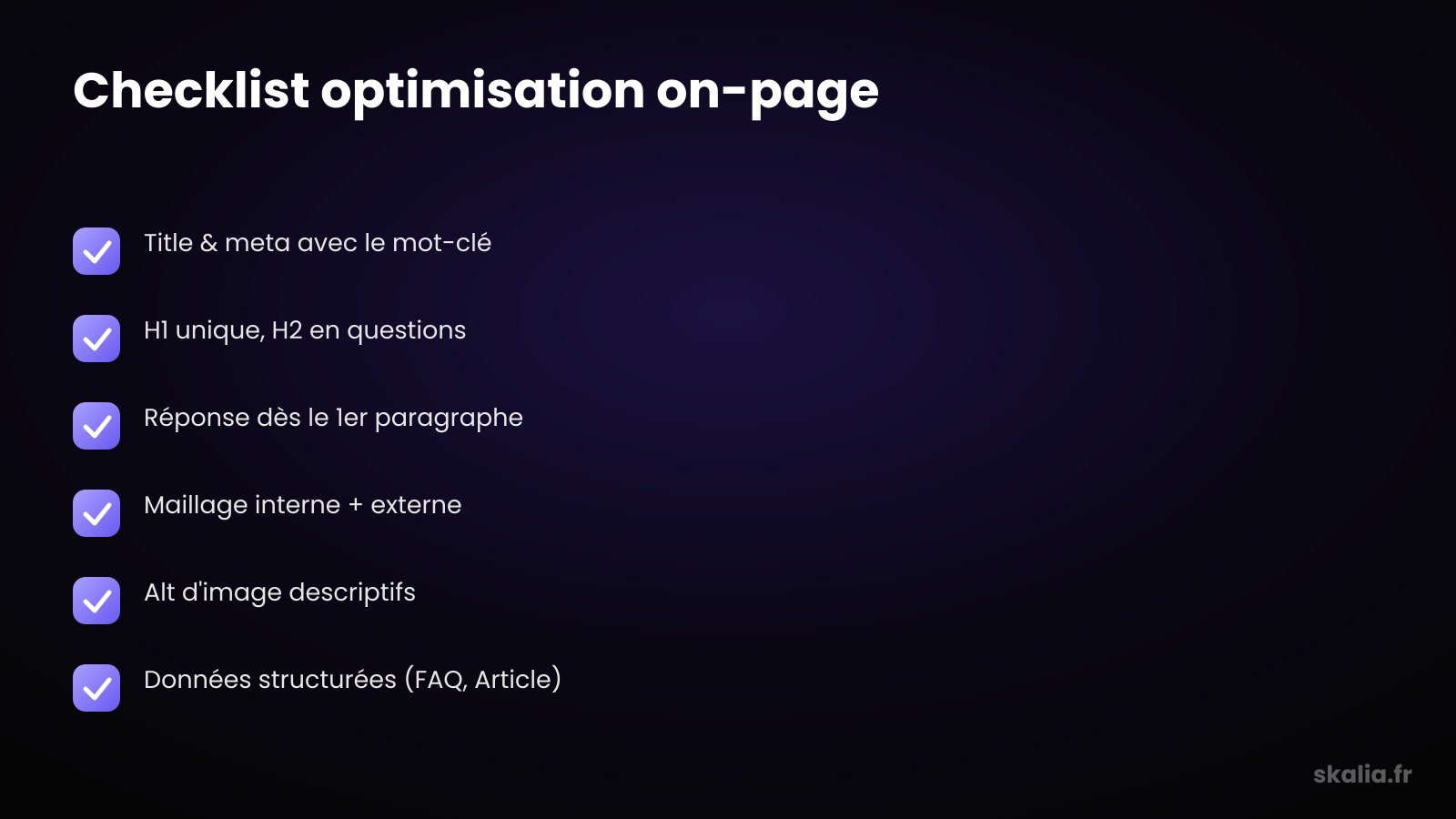
Seven on-page elements determine how an article ranks: the title tag, meta description, H1, heading structure, internal linking, images, and structured data. Neglect even one of these levers and you're leaving ranking potential on the table. Here's the checklist to run before every publication.
| Element | Role | Best practice |
|---|---|---|
| Title tag | What Google displays in results, drives click-through | 55-60 characters, keyword up front, a clear promise |
| Meta description | Doesn't affect ranking but drives click-through rate | 140-155 characters, compelling, includes the keyword |
| H1 | Main heading, topic signal | One per page, contains the keyword |
| H2/H3 structure | Readable outline for Google and AI Overviews | H2s as questions, answer in the first sentence |
| Internal linking | Distributes authority, guides navigation | 3-5 links to related articles, natural anchor text |
| Images & alt text | Accessibility, image search visibility | Descriptive alt text with the keyword, lightweight files |
| Structured data | Rich snippets, AI eligibility | Article schema + FAQPage when relevant |
This checklist doesn't replace substance, but it prevents the mistakes that cap a good piece of content. To go further on the local side, our guide to the Google local pack rounds out these settings with proximity logic.
How Do You Place Keywords Without Over-Optimizing?
A keyword belongs in the right spots, not everywhere: the title tag, H1, opening paragraph, one or two H2s, and naturally throughout the body. Density is no longer a ranking factor. Google understands meaning, not repetition. Keyword stuffing now hurts more than it helps.
Work on the **semantic field** instead. An article about "writing an SEO article" should touch on search intent, internal linking, title tags, E-E-A-T, and AI Overviews. This related vocabulary proves to Google that the topic is covered in depth. Long-tail variants ("how to structure an SEO blog post") also capture precise, less competitive queries.
A good rule of thumb: one primary keyword per article, two or three secondary keywords. Beyond that, your articles start cannibalizing each other, competing against themselves on Google.
How Do You Strengthen the E-E-A-T of Your Articles?
E-E-A-T (Experience, Expertise, Authoritativeness, Trust) is strengthened by showing who wrote the piece, why they're credible, and what the content is based on. Google favors content that demonstrates real experience, especially on sensitive or competitive topics. An anonymous, generic article starts at a disadvantage.
In practice, sign your articles with a credible author bio, cite your sources and data, and weave in firsthand experience: observed figures, real cases, client feedback. It's the "E" for Experience — added by Google in 2023 — that has carried the most weight since. One lived example is worth ten generic claims.
Authority is also built off-page: mentions, inbound links, thematic consistency across the site. A blog that covers a domain in depth, with tight internal linking between articles, gains topical authority. It's the same principle behind a focused acquisition strategy: better to dominate one topic than to spread yourself thin.
What Length and Update Frequency Should You Aim For?
The right length is whatever fully covers the intent — no more, no less: often 1,200 to 2,000 words for a guide, sometimes less for a precise question. Word count isn't a ranking factor in itself. A short, thorough article beats a long, diluted one.
Updating matters as much as publishing. An article losing traffic needs a refresh: update the figures, add new questions, rework weak sections. Google rewards freshness on topics that evolve. Refreshing an existing article often delivers a better return than publishing a new one.
Set yourself a sustainable pace: one solid, regularly updated article per month beats four rushed articles that never get revisited. Consistency and quality outweigh volume.
FAQ
How Long Does It Take for an Article to Rank on Google?
Generally expect three to six months for an article to gain durable positions, longer on competitive queries. SEO is a medium-term investment. A new or low-authority site will take longer than a blog that's already established in its niche.
Should You Write for Google or for Readers?
For readers first, while keeping things legible for Google. A useful, clear, answer-first article satisfies both. SEO techniques (structure, linking, tags) organize good content — they never replace the value delivered to the reader.
Will AI Overviews Kill Blog Traffic?
No, but they redistribute it. Simple searches get resolved right in the SERP, while complex or decision-driving queries still generate clicks. Being the source AI cites, and delivering value that can't be summarized away, remains the best protection.
How Many Internal Links per Article?
Aim for three to five relevant internal links per article, with natural anchor text. They distribute authority across your pages and guide readers toward related content. Too many links dilute the message; too few isolate the article from the rest of the site.
Want a Blog That Actually Brings You Clients?
An article that ranks isn't a stroke of luck — it's a repeatable method, from intent all the way through to the update cycle. At Skalia, we build SEO content designed to rank and to convert, integrated into a coherent acquisition strategy. If you're in Toulouse, discover how a local SEO agency in Toulouse works and what a blog can really deliver. Let's talk.