
 kevin@skalia.ca


Focused Acquisition Strategy: Stop Chasing Every Channel

TikTok, SEO, ads, newsletter, podcast: the temptation to do it all is the surest way to succeed at nothing. Here's how to pick 1-2 priority channels, master them thoroughly, and only open the next one at the right time.
- Trying to be on every channel means working them all halfway and mastering none.
- Pick 1-2 channels where your customers are truly receptive and where each euro invested pays off the most.
- Master that channel for at least 3 months before opening another.
- Only expand once the first one is profitable, predictable, and starting to plateau.
Why Does a Scattered Acquisition Strategy Fail?
A scattered acquisition strategy fails because an SMB has neither the time nor the budget to properly run five channels at once. According to the 2024 CMO Survey, companies that concentrate their marketing spend on a small number of levers report a better return than those who spread it thin. Dispersion is a trap disguised as ambition.
You see brands everywhere and figure you need to do the same. What you don't see is the entire team behind them. Every channel has its own codes, its own rhythm, its own toolset. Running TikTok, SEO, Google Ads, a newsletter, and a podcast all at once with two people means, mechanically, running each one at 20% of its potential.
And on most channels, 20% of potential isn't enough to generate a single customer. [PERSONAL EXPERIENCE] We regularly see business owners who've "tried SEO," "tried LinkedIn," "tried ads," and concluded that nothing works. In reality, nothing was worked long enough to actually work.
[UNIQUE INSIGHT] The real cost of dispersion isn't financial, it's cognitive. Every extra channel steals attention from the others. You're not just losing budget, you're losing your ability to learn. A channel you glance at for one hour a week never produces usable data.
How Do You Choose Your Priority Acquisition Channel?
You choose your priority channel by crossing three criteria: where your customers are, how much the lever costs, and how long a prospect takes to sign. A local tradesperson and a B2B software company don't play on the same field. The right channel isn't the trendiest one — it's the one where each euro invested pays off the most right now.
Start by looking at where your audience actually spends its time. A local consumer service lives on Google Business Profile and local SEO. A high-ticket B2B service lives more on LinkedIn and cold email. Don't guess: ask your last few customers how they found you.
Next, weigh that landscape against your budget and sales cycle. A paid channel like Google Ads delivers quickly but costs you on every click. SEO costs little per lead but takes months to gain traction. The table below sums up the questions to ask before deciding.
| Criterion | Question to ask |
|---|---|
| Customer presence | Where do my prospects look for a solution like mine? |
| Cost per result | What does a lead, then a customer, actually cost me on this channel? |
| Sales cycle | Do I need results in weeks (paid) or can I wait months (organic)? |
| Resource fit | Do I have the time, skills, or tools to run this channel every week? |
| Compounding effect | Does this channel build a lasting asset, or does it stop the moment I cut the budget? |
[UNIQUE INSIGHT] One criterion is often overlooked: repeatability. A brilliant channel that can't be reproduced every month isn't an acquisition strategy, it's a stroke of luck. Always favor the lever you'll be able to pull consistently and predictably.
Why Should You Master One Channel Before Adding Another?
You need to master one channel before adding another because a lever only pays off once you go deep. According to HubSpot data, most acquisition campaigns require several months of iteration before reaching a stable cost per lead. Testing for three weeks and then giving up means missing out every single time.
Every channel has a learning curve. On Google Ads, the first few weeks mostly serve the algorithm and let you clean out keywords that cost money without converting. With cold email, it takes several sequences to find the hook that triggers replies. That work only happens if you stick around.
Mastering a channel also means building a system. Once you understand the lever, you document what works, stabilize your cost per result, and make the flow predictable. That's what we cover in detail in our article on the profitable acquisition funnel: first a path that converts, then volume.
[PERSONAL EXPERIENCE] We've found that the tipping point usually arrives around month three. Before that, you're paying for the learning curve. After it, the same budget produces two to three times more appointments. Anyone who cuts a channel before reaching that point never gets to see what it could really deliver.
When Should You Add a Second Acquisition Channel?
You add a second channel once the first is profitable, predictable, and starting to plateau. Not before. Adding a channel to escape a lever that isn't working yet just moves the problem elsewhere. The rule is simple: expand from a position of strength, never to compensate for a failure.
Three signals tell you the moment has arrived. First: your cost per lead is stable and known. Second: you no longer have to run it yourself — a process exists. Third: you're saturating the available audience, and increasing the budget no longer pays off as much.
The right second channel is rarely chosen at random. It complements the first. An approach that combines organic and paid, or inbound and outbound, reinforces itself. That's the logic behind allbound: each channel feeds the other instead of competing with it for your attention.
For high-ticket B2B SMBs, the second lever often takes the form of a targeted ABM approach, once a first volume channel is already up and running. You add up systems that work — you don't stack up attempts.
How Does Focus Accelerate Results?
Focus accelerates results because all your energy aimed at a single point breaks through where ten half-hearted attempts fail. Concentrating your efforts isn't limiting yourself — it's moving faster. Focus is an accelerator, not a constraint. It's what separates a brand people can't ignore from a brand that's merely present and forgettable.
Better to be unmissable on one channel than present and forgettable on five. Dispersion feels reassuring; focus is what wins.
A mastered channel becomes an asset. You accumulate data, refine your approach, and lower your cost per acquisition month after month. That compounding effect is impossible when your attention keeps jumping from lever to lever. Speed comes from depth, not from the number of fronts you have open.
Before you dive in, measure what a lead actually costs you by channel: our guide to lead generation cost gives concrete ranges so you can decide without guessing.
FAQ
How Many Acquisition Channels Should a Starting SMB Use?
Just one, at the start. A small business or SMB launching its acquisition efforts benefits from putting 100% of its energy into the channel where its customers are most receptive. A second channel is only justified once the first is profitable, documented, and has reached saturation.
How Do You Know If Your Priority Channel Is Really Working?
Look at cost per result, not traffic or impressions. A channel is working when it produces appointments or customers at a known, stable cost, repeatably, month after month. If your cost per lead still hasn't stabilized after three months, the problem is often the funnel, not the channel.
Should You Abandon a Channel That Isn't Working After Three Weeks?
No, three weeks is almost never enough. Most channels need several months of iteration to reach a stable cost per lead. Before giving up, check that the offer, the target, and the message were right. You cut a channel after really working it, not after barely touching it.
Isn't a Focused Strategy Risky — Betting Everything on One Channel?
The real risk is dispersion, not focus. A mastered, profitable channel is a predictable asset. You diversify afterward, from a position of strength, by adding a complementary second lever once the first is running smoothly. You reduce risk by stacking systems that work, not by running simultaneous experiments.
Where Should You Start Your Focused Acquisition Strategy?
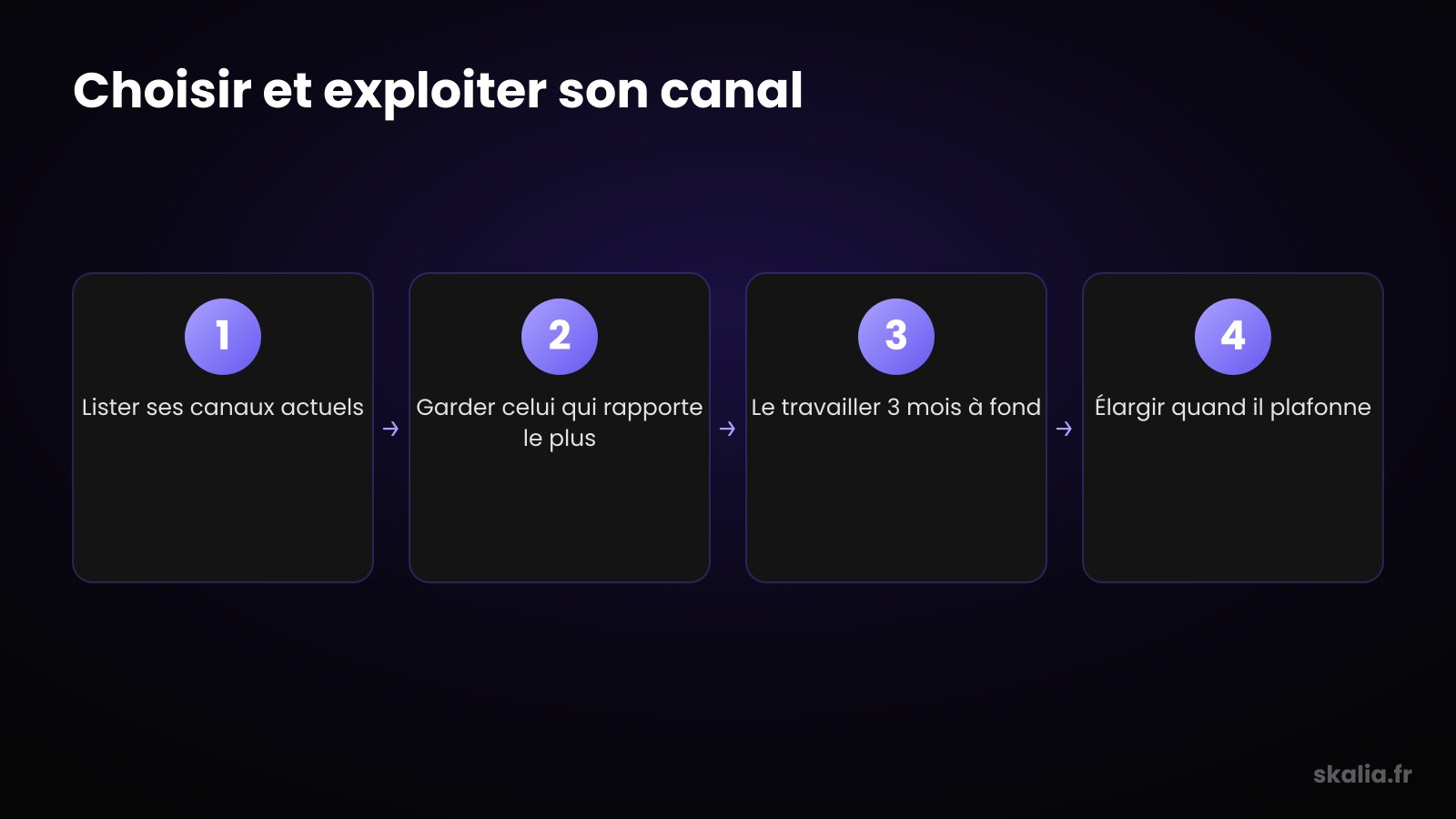
Start by listing your current channels, keep the one that pays off the most, and cut out the noise for three months. You'll be surprised by what a single lever, truly worked, can produce. Focus isn't giving something up — it's the shortest path to a predictable flow of customers.
At Skalia, we help SMBs identify the channel that pays off the most, master it, and then expand at the right time instead of trying everything at once. The logical next step, once the channel is chosen, is building the path that turns visitors into customers: our guide to the profitable acquisition funnel shows you how. Let's talk.