
 kevin@skalia.ca


Allbound: Merging Inbound and Outbound (2026 Guide)

Pitting inbound against outbound no longer makes sense. Allbound coordinates the two: your content warms up prospecting, and inbound signals trigger outbound at the right moment. Here's how an SMB can put it into practice in 2026.
- Allbound merges inbound and outbound into one coordinated system instead of two silos.
- Inbound content warms up outbound prospecting; inbound signals trigger outbound at the right moment.
- To get started: share the same target-account list between marketing and prospecting.
- Classic mistake: keeping two teams that don't talk to each other and measure different KPIs.
What Exactly Is Allbound?
Allbound combines inbound and outbound into a single, coordinated acquisition system, rather than treating them as two separate channels. The idea is simple: instead of waiting for prospects to come to you (inbound) OR cold-canvassing them (outbound), you make both work together on the same target accounts.
In practice, allbound rests on one principle: each channel feeds the other. Your content attracts visitors and leaves traces. Those traces (downloading a guide, repeat visits to a pricing page, opening an email) become signals that tell your prospecting team who to contact, when, and with what message.
The term is recent, but the logic addresses a real problem: silos are expensive. When marketing generates leads that nobody follows up on, and sales reps prospect people who are already warm without knowing it, the company wastes effort on both sides.
Why Is Pitting Inbound Against Outbound Outdated?
Pitting inbound against outbound is outdated because B2B buyers no longer follow a linear journey. According to Gartner, a B2B buyer spends only around 17% of their purchasing time in direct contact with sales reps, with the rest spent on independent research and comparison. Both of your channels are therefore reaching the same person, just at different moments.
In practice, a prospect reads your article, forgets about it, sees an ad again, receives a prospecting email, then comes back to your website. No one decides "I'm an inbound lead" or "an outbound lead." Those labels serve your internal organization, not the customer.
The real gain of allbound lies in the reinforcement effect. A cold prospecting message has a low response rate. That same message, sent to someone who just read two of your pieces of content, converts far better. Inbound makes outbound credible; outbound accelerates what inbound alone would take months to produce.
One nuance remains: allbound doesn't mean "doing both halfway." An SMB with limited resources often benefits from starting with one solid channel, then connecting the second. We cover this in our focused acquisition strategy.
How Do Inbound and Outbound Actually Feed Each Other?
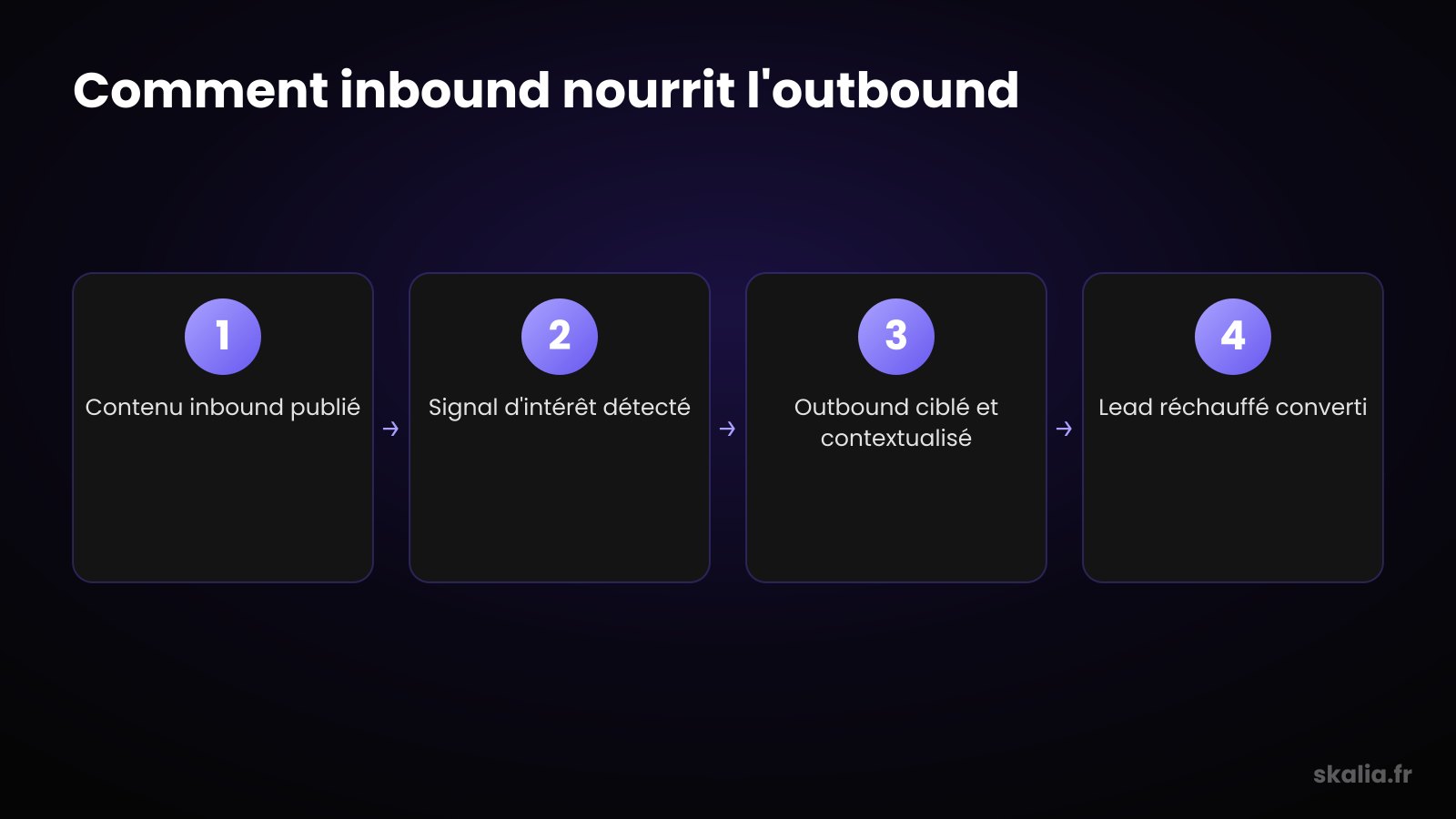
Inbound and outbound feed each other through two mechanisms: content that warms up prospecting, and intent signals that trigger the right message at the right time. This is the practical core of allbound, and it's where an SMB creates an edge that's hard to copy.
Inbound Content Warms Up Outbound
A prospect who's already come across your brand replies more easily. Your articles, LinkedIn posts, and guides build familiarity. When your salesperson then reaches out, you're no longer a total stranger — you become "that agency whose guide I read." Response rates climb, and the message can lean on specific content rather than a generic pitch. Our LinkedIn prospecting method details this approach.
Inbound Signals Trigger Outbound
Every interaction leaves an actionable signal: visiting the pricing page, downloading a template, responding to a newsletter, clicking an ad. These signals tell you who's actively considering. Instead of prospecting at random, your team prioritizes those showing intent. That's prospecting at the right moment, not blind volume. Our guide to automated prospecting explains how to route these signals.
Inbound, Outbound, or Allbound: What Are the Differences?
Allbound brings together the strengths of both approaches: outbound's control over volume and inbound's lasting lead quality. The table below summarizes the differences across four criteria that matter to an SMB: time to results, cost, volume control, and lead quality.
| Criterion | Inbound | Outbound | Allbound |
|---|---|---|---|
| Time to results | Slow (3 to 9 months) | Fast (days to weeks) | Fast, then compounds over time |
| Cost | High upfront, then decreasing | Predictable, linear | Shared across both channels |
| Volume control | Low and delayed | Strong and immediate | Strong, adjustable based on signals |
| Lead quality | High (intent) | Variable (targeting) | High (targeting + intent combined) |
Allbound doesn't eliminate costs — it makes them more profitable. The same content attracts prospects AND equips your prospecting team. The same account list serves marketing AND sales. To dig deeper into profitability, see our profitable acquisition funnel.
How Do You Implement Allbound in an SMB?
To implement allbound in an SMB, start with one single thing: a shared list of target accounts between marketing and prospecting. According to Forrester, companies that align marketing and sales show significantly higher revenue growth than those that keep these functions siloed. Alignment is the real lever, not the tooling.
Step 1: A Shared Account List
Define your 100 to 300 priority accounts together. Marketing produces content designed for them; prospecting works them in parallel. Everyone aims at the same target.
Step 2: Make Signals Visible
Connect your website, CRM, and email so you can see who's engaging. You don't need an overengineered setup from day one: even a simple tracking of visits and opens is enough to prioritize.
Step 3: A Message That Builds on the Content
Your salespeople reference the content the prospect viewed. "You read our guide on X, here's how we apply it for companies like yours." The inbound-outbound connection becomes tangible for the prospect.
Step 4: Shared KPIs
Marketing and sales measure the same end result: qualified meetings and signed clients, not each silo's vanity metrics. Our 2026 SEO guide shows how content fits into this loop.
What Are the Classic Mistakes in Allbound?
The most common mistake in allbound is merging the channels on paper without getting the teams to actually work together. Two teams that keep separate tools, lists, and goals aren't doing allbound — they're doing inbound and outbound side by side.
Second trap: believing you need to launch everything at once. An SMB that starts inbound AND outbound at full power spreads its resources too thin. It's better to solidify one channel, then connect the second once the mechanism is proven.
Third mistake: neglecting timing. Contacting a prospect three weeks after their signal of interest wipes out the whole advantage. Responsiveness is what separates a hot lead from a cold one. Finally, watch out for over-tooling: a CRM crammed with unused features never replaces clear human alignment.
FAQ
Does Allbound Work for a Small Business?
Yes, as long as you start simple. A small business doesn't need a complex stack: a shared account list and genuine communication between marketing and prospecting are enough to get going. Coordination matters more than tooling. We develop the starting point in our focused acquisition strategy.
Do You Absolutely Need a Sophisticated CRM for Allbound?
No. A CRM helps centralize signals, but it's not the starting point. Many SMBs launch allbound with simple tools and a shared spreadsheet. The priority is seeing who's engaging with your content and passing that along quickly to prospecting.
Which Channel Should You Start With in Allbound?
Whichever one you're already credible in. If you're producing content, build outbound on top of it. If you're already prospecting, add content to warm up your targets. Allbound is built by connecting what already exists, not by starting from scratch on both fronts.
How Long Before You See Results With Allbound?
Outbound brings in meetings within a few weeks, while inbound compounds its effects over several months. The whole point of allbound is getting a fast result while building a lasting asset that improves performance over time.
Switch to Allbound With Skalia
Allbound isn't a trend — it's the end of a siloed approach that used to cost SMBs dearly. Getting content and prospecting to work together, on the same accounts and toward the same goals, produces better-warmed leads and shorter sales cycles.
At Skalia, we build this kind of coordinated system for small and mid-sized businesses: content that attracts, prospecting that capitalizes on it, and signals that trigger the right message at the right time. If you're still torn between channels, our guide to automated prospecting is a good place to start. Let's talk — describe your target to us, and we'll tell you where to begin.