
 kevin@skalia.ca


Profitable Acquisition Funnel: The Complete SMB Guide
Attracting prospects isn't enough — you still need to convert them, nurture them, and keep them without blowing your budget. Here's how to build a profitable acquisition funnel, stage by stage, with the right metrics and the leaks to watch for.
- A profitable acquisition funnel runs through 5 stages: attract, convert, nurture, sell, retain.
- Track one key metric per stage: cost per lead, conversion rate, CAC, LTV.
- The profitability rule: LTV should exceed 3x your CAC.
- Most leaks happen between lead generation and the sale, from a lack of follow-up.
What Is a Profitable Acquisition Funnel?
A profitable acquisition funnel is a journey that turns a stranger into a loyal customer for less than that customer is worth to you. In practice, it runs through 5 stages: attract, convert, nurture, sell, retain. Profitability comes down to one principle: what a customer generates (their LTV) must comfortably exceed what it costs to acquire them (their CAC).
Most SMBs think "funnel" in terms of traffic. That's a mistake. A funnel that attracts 10,000 visitors but converts none of them into customers is worthless. Profitability plays out stage by stage, and each stage has its own metric. You don't run a funnel on a single blanket metric — you run it on a chain of measurements.
The goal isn't "more traffic." The goal is for every euro invested at the top of the funnel to come out multiplied at the bottom. To get there, you first need to map out the 5 stages.
What Are the 5 Stages of the Acquisition Funnel?
The 5 stages of the acquisition funnel are: attract (generate qualified traffic), convert (turn traffic into leads), nurture (build the relationship), sell (turn leads into customers), and retain (drive repeat purchases and referrals). Each stage has a clear goal and a metric that tells you whether it's working.
Here's the logic. At the top, you capture the attention of people who don't know you yet. Next, you secure a way to reach them again: email, appointment, form. Then you build trust until they're ready to buy. You close the sale. Finally, you turn that customer into a repeat buyer and an advocate.
The table below sums up the goal and the key metric for each stage.
| Stage | Goal | Key metric |
|---|---|---|
| Attract | Generate qualified traffic | Cost per visitor, CPM, CPC |
| Convert | Turn traffic into leads | Conversion rate, cost per lead (CPL) |
| Nurture | Build and warm up the relationship | Open rate, reply rate |
| Sell | Turn leads into customers | Closing rate, CAC |
| Retain | Drive repeat purchases and referrals | Retention rate, LTV, NPS |
These five stages only work when they're connected. An excellent conversion rate is worthless if the traffic isn't qualified. To frame the top of the funnel, a focused acquisition strategy built around one well-mastered channel beats spreading thin across ten levers at once.
Which Metrics Should You Track at Each Stage?
Each stage has a corresponding metric that drives profitability: cost per lead for conversion, CAC for the sale, LTV for retention. Without these numbers, you're flying blind and unknowingly pouring money into a leaky funnel. Three metrics carry most of the decision-making weight.
**Cost per lead (CPL)** measures what you pay to get one qualified contact. In B2B, it varies widely by industry, from a few euros up to more than €150 for a high-value lead. CPL tells you whether the top of your funnel is sustainable before you even get to talking about sales.
**CAC (customer acquisition cost)** adds up everything you spend to turn a stranger into a paying customer: advertising, tools, sales time. It's the ultimate arbiter. If your CAC exceeds your margin on the first sale, you're losing money on every new customer — unless that customer buys again.
**LTV (customer lifetime value)** represents the total revenue a customer generates over the entire relationship. It's what makes a high CAC acceptable. A customer who buys once isn't worth the same as one who sticks around for three years.
When Is an Acquisition Funnel Truly Profitable?
An acquisition funnel is profitable when LTV is at least 3 times the CAC. This 3:1 LTV/CAC ratio is the benchmark most growth teams use: below it, you don't have enough margin to fund growth; above 5, you're probably under-investing in acquisition.
Take a concrete example. Your CAC is €300. Each customer generates €1,200 in margin over their lifetime. Your ratio is 4:1: the funnel is healthy, and you can push volume. Conversely, a €300 CAC against a €400 LTV (a 1.3 ratio) means you're surviving, but you'll never be able to accelerate without going into the red.
Second benchmark: **CAC payback period**. It shows how many months it takes a customer to pay back their acquisition cost. Under 12 months, your cash flow keeps up. Beyond that, every new customer strains your cash position, even if the funnel is profitable on paper.
Where Do Funnels Leak Most Often?
The most common leaks happen between lead generation and the sale: leads captured, then never followed up on. It's often estimated that the majority of B2B leads are never contacted again beyond one or two attempts, even though most sales actually close after several follow-ups. That's money left on the table.
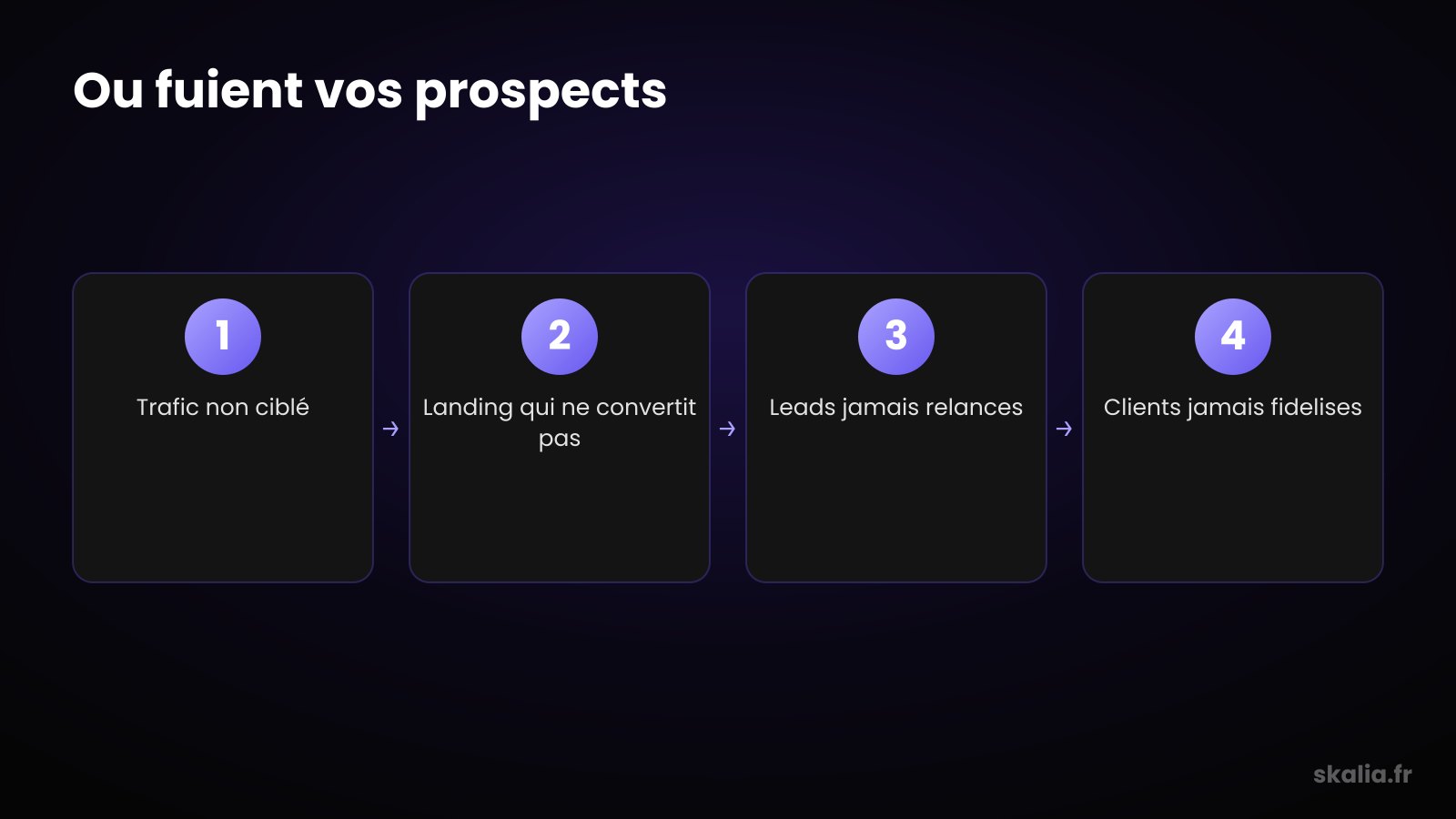
Here are the four classic leaks, in funnel order.
- **Unqualified traffic**: you're attracting people who aren't your target audience. CPL climbs, conversion drops. The cause is usually targeting that's too broad or messaging that's too vague.
- **Landing pages that don't convert**: traffic arrives, then leaves. A form that's too long, a promise that's unclear, no social proof. One conversion point gained at the top ripples through the entire funnel.
- **Leads that never get nurtured**: the lead isn't ready to buy right away, and nobody follows up. Without a nurturing sequence, 80% of your leads simply disappear.
- **Customers who are never retained**: one sale, then silence. You keep pouring money into acquisition instead of driving repeat purchases, which mechanically drags down your LTV.
The good news: plugging a leak in the middle of the funnel costs less than chasing more traffic. Doubling a closing rate has more impact than doubling your ad budget.
How Do You Make Your Acquisition Funnel Profitable?
To make a funnel profitable, work on the middle stages before increasing your acquisition budget. Improving your conversion or closing rate by even one point multiplies your results without spending an extra euro on advertising. Profitability is built through successive corrections, not more volume.
Three concrete levers for an SMB.
- **Qualify the top of the funnel.** A better-targeted lead sometimes costs more per CPL, but converts to sales far better. Combining inbound and outbound in an allbound approach feeds the funnel with warmer leads.
- **Automate nurturing.** An automatically triggered email or follow-up sequence recaptures leads who weren't ready yet. It's the best effort-to-return action for a small team.
- **Choose the right paid channel.** Depending on your audience, Google Ads or Meta Ads won't deliver the same CPL or the same buying intent. Test, measure cost per result, and cut whatever isn't paying off.
Finally, measure before you optimize. You can't improve a funnel whose numbers you don't know. Instrument every stage, even roughly, before changing anything.
FAQ
How Much Does It Cost to Set Up an Acquisition Funnel?
The cost mostly depends on your media budget and tools, not the funnel itself. Factor in your ad budget, a capture and nurturing tool, and possibly outside help. The real metric isn't the setup cost but the cost per lead generated, which needs to stay consistent with your margin.
What's the Difference Between a Sales Funnel and an Acquisition Funnel?
The acquisition funnel covers the entire journey, from stranger to loyal customer. The sales funnel mainly refers to the lower part: turning a lead into a customer. Acquisition therefore encompasses the sale, plus attraction upstream and retention downstream.
What LTV/CAC Ratio Should an SMB Aim For?
Aim for a minimum ratio of 3:1: every customer should generate at least three times their acquisition cost. Below that, growth becomes hard to fund. Well above 5, you're probably under-investing in acquisition and ceding market share to competitors.
Do You Need a CRM to Run Your Funnel?
Not necessarily at first, but it quickly becomes useful. A simple spreadsheet is enough to track CPL, CAC, and conversion rate at a small scale. Once lead volume grows, a CRM prevents leaks by centralizing follow-ups and making every stage measurable.
Turning a Leaky Funnel Into a Profitable One
A profitable acquisition funnel isn't just about generating traffic: it connects five measured stages, from attraction to retention, with LTV as the final judge against CAC. The priority is almost never "more budget" — it's plugging the leaks in the middle and tracking the right metric at every stage.
At Skalia, we help SMBs map out their funnel, spot where it's leaking, and instrument the metrics that matter. If you've got traffic but few customers, or leads sitting idle, build a focused acquisition strategy instead of adding more channels. Let's talk.