
 kevin@skalia.ca


SEO in 2026: The Fundamentals That Actually Matter
SEO in 2026 no longer rewards tricks — it rewards genuine usefulness. Between AI Overviews, INP, and E-E-A-T, here are the concrete fundamentals to prioritize when you're an SMB working with a tight budget.
- 2026 SEO rewards genuine usefulness, not tricks — answer search intent better than anyone else.
- E-E-A-T and proof of expertise are what separate similar content.
- Technical basics remain a prerequisite: mobile, speed, INP under 200ms.
- AI Overviews change the game: structure your content to get cited (GEO).
What Actually Matters for SEO in 2026?
In 2026, SEO comes down to one thing: being the best answer to a search intent, and proving it. Google no longer ranks keyword-stuffed pages — it ranks content that's useful, credible, and fast. For an SMB, that shifts the priority: fewer technical hacks, more genuine value.
That doesn't mean everything else has vanished. Technical SEO, internal linking, and backlinks still count. But they've become prerequisites, not advantages. What separates winners today is quality — as perceived by the algorithm and, increasingly, by the AI that now answers on your behalf right in the results.
Let's go through the fundamentals one by one, with what actually matters in practice and the mistake to avoid.
Why Does Search Intent Come Before Keywords?
Search intent comes first because Google wants to solve the real need behind a query, not match keywords. The same keyword can hide an informational, commercial, or local intent. If your page targets "plumber near me" with a blog post when the searcher actually wants to call someone right now, you won't rank, no matter how good your content is.
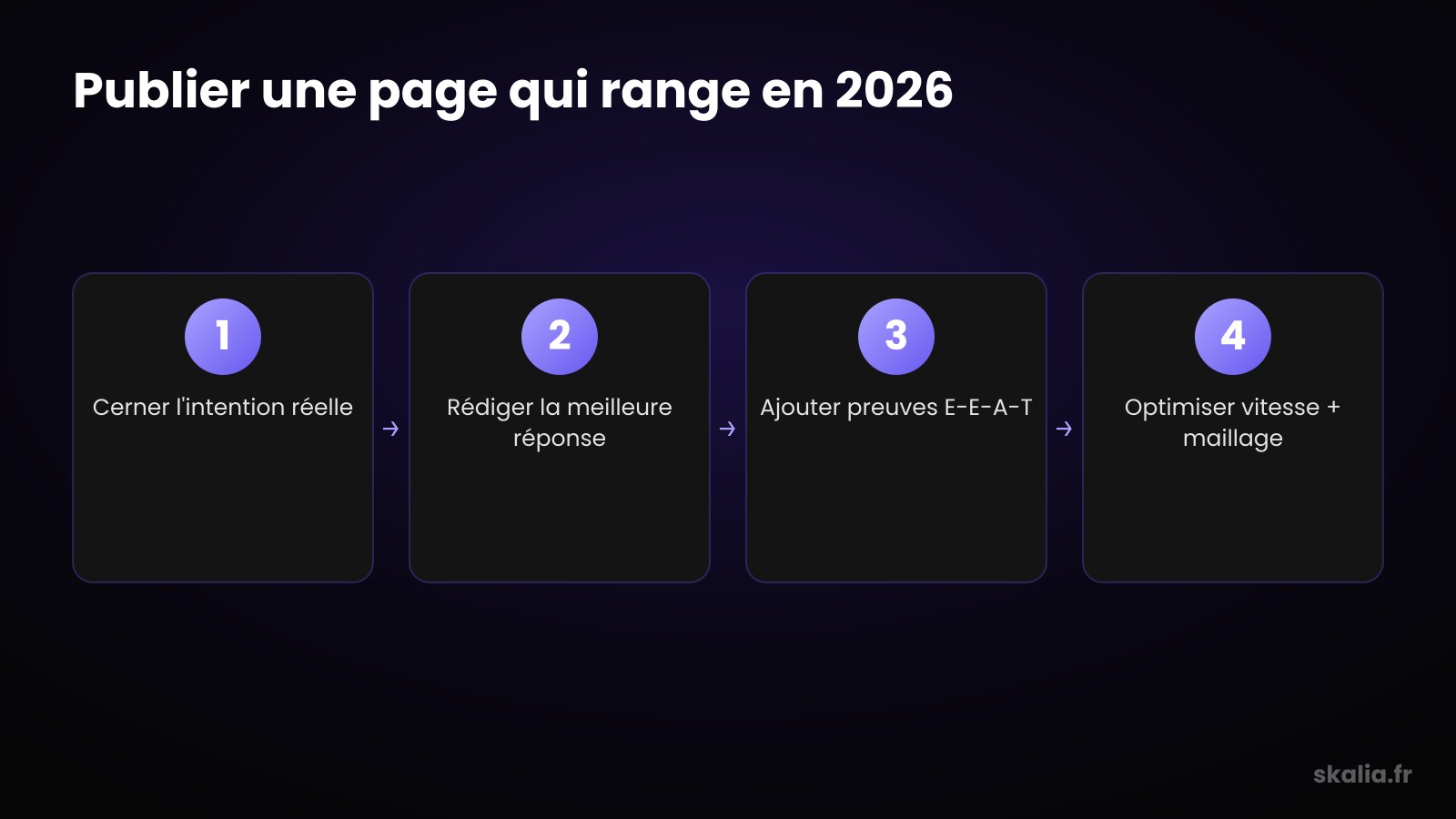
The right method has three steps. First, type the query and look at what already ranks: product pages, guides, comparisons? That reveals the intent Google has already validated. Second, produce the expected format. Third, cover the follow-up questions the searcher will ask next.
Stop asking "which keyword" and start asking "which problem." One page perfectly aligned with an intent beats ten diluted pages. That's the foundation of any good SEO-optimized blog post.
What Does Helpful Content Actually Require?
Helpful content means content written for people, by someone who genuinely understands the topic. Since the "helpful content" updates were folded into the core algorithm, Google has been devaluing generic pages, mass-rewritten content, and anything churned out at scale without real experience behind it. This is where an SMB has an edge: you live your trade every day.
In practice, useful content fully answers the question, without forcing the reader back to Google. It brings a real-world angle: actual figures, client examples, mistakes seen firsthand. It skips the padding and gets straight to the point.
The classic trap of hollow text "written for AI" or "for Google" is now easy to spot. Write what you'd actually tell a client on the phone, then structure it cleanly.
What Is E-E-A-T, and How Do You Prove It?
E-E-A-T (Experience, Expertise, Authoritativeness, Trustworthiness) is the framework Google uses to assess whether you can be trusted. It isn't a direct score, but a set of signals. In 2026, the first "E" — firsthand Experience — carries real weight: Google wants content from people who have actually done the thing they're writing about.
For an SMB, proving E-E-A-T is straightforward:
- Sign your articles with a real author, a bio, and a photo.
- Show your proof: past projects, client reviews, years in business.
- Cite your sources and date your content.
- Polish your sensitive pages (pricing, contact, legal notices).
The common mistake is anonymous content with no author and no proof. On "high-stakes" topics (health, money, legal), that's disqualifying.
Does Technical SEO Still Matter: Speed, Mobile, Core Web Vitals?
Yes, technical SEO remains a non-negotiable prerequisite, but it comes down to just a handful of things. Google indexes mobile-first: if your site is unreadable or slow on a phone, nothing else matters. Since March 2024, INP has replaced FID in Core Web Vitals, with one clear target: the page must respond to every interaction in under 200ms.
The three metrics to watch are simple. LCP (largest contentful paint) should stay under 2.5 seconds. INP (responsiveness) under 200ms. CLS (visual stability) under 0.1. A reasonably optimized, properly hosted WordPress site hits these thresholds without heroics.
The common mistake: stacking up plugins, marketing scripts, and uncompressed images until the page chokes. Test with PageSpeed Insights and fix the worst offender first.
| Pillar | What matters in 2026 | Common mistake |
|---|---|---|
| Search intent | Match the format that's already ranking | Targeting a keyword without reading the intent |
| Helpful content | Complete answer, real-world angle | Generic, mass-produced text |
| E-E-A-T | Real author, proof, dated sources | Anonymous content with no proof |
| Technical | Mobile, LCP < 2.5s, INP < 200ms | Plugins and scripts that tank speed |
| Internal linking | Connect pages by topic | Orphan pages with no inbound links |
| GEO / AI Overviews | Clear, structured, citable answers | Ignoring AI and the "answer" format |
Is Internal Linking Still a Powerful Lever?
Yes, internal linking remains one of the most cost-effective levers — and often the most neglected. Connecting your pages with contextual links tells Google how your site is structured and channels authority toward your strategic pages. It's free, entirely under your control, and immediate.
The logic: group your content by topic (the classic "cluster" approach). A broad pillar page — on local SEO and the Google local pack, for instance — points to more specific pages like the Google Business Profile guide, which link back to the pillar in turn. Every new article strengthens the whole cluster.
The common mistake is the orphan page — published, then forgotten, with no internal link pointing to it. Google struggles to find it, and it benefits no one.
AI Overviews and GEO: What Changes for an SMB?
AI Overviews — those AI-generated answers sitting at the top of the results — change how you get seen, without eliminating SEO. Searchers sometimes read the AI's answer without clicking through. The result: ranking well is no longer enough; you need to be the source the AI cites. That's what's known as GEO (Generative Engine Optimization).
The good news: the fundamentals overlap. Useful, well-structured, credible content has every chance of being picked up. To maximize your odds of being cited, adopt the "answer" format:
- Answer the question in the very first sentence of each section.
- Structure with clear headings phrased as questions.
- Add precise, sourced, dated data.
- Polish your E-E-A-T: AI models favor trustworthy sources.
The mistake would be to panic and rebuild everything. GEO is simply good 2026 SEO, pushed one notch further toward clarity.
FAQ
Is SEO Still Useful Against AI Overviews?
Yes, more than ever. AI models pull their answers from well-ranked pages. Without solid SEO, you're neither ranked nor cited. Direct traffic is dropping on some queries, but brand visibility and qualified clicks still show up for anyone who structures their content well.
How Long Does It Take to See SEO Results in 2026?
Expect three to six months for a healthy site, longer in a competitive sector. SEO remains a long-term investment, not a switch you flip. The first gains usually show up on local or long-tail queries — less contested — before the generic keywords follow.
Do You Need a Huge Budget to Rank in 2026?
No. An SMB wins first by answering specific, often local, intents better than its competitors. Consistency and quality matter more than budget. Useful content, clean technical SEO, and careful internal linking will take you far without an expensive campaign.
Does Word Count Affect Rankings?
No, there's no universal ideal length. What matters is fully covering the expected topic — no more, no less. A complex guide justifies 2,000 words; a simple answer justifies 400. Writing long just for the sake of length dilutes the message and hurts readability.
Where Should You Start Your 2026 SEO?
Start with your most strategic pages: check that they answer the right intent, demonstrate your expertise, and load fast on mobile. There's nothing magic about 2026 SEO — it's rigor applied to the fundamentals, page after page. The hard part isn't knowing what to do, it's doing it consistently and well.
At Skalia, we help local SMBs build lasting visibility by prioritizing what actually pays off, rather than chasing every new trend. If you're not sure where to start, a clear audit beats a scattershot overhaul. Discover our approach as a local SEO agency in Toulouse. Let's talk.