
 kevin@skalia.ca


ABM for Small Businesses: Is Account-Based Marketing Within Reach?
Long reserved for enterprise accounts, ABM (account-based marketing) is now within reach for small businesses. Here's how to target a handful of strategic accounts and personalize deeply, without a Fortune 500 budget.
- Yes, a light version of ABM is highly profitable for a small business: target a short list of strategic accounts and personalize heavily.
- Select 20 to 50 high-potential accounts, not thousands of contacts.
- Align marketing and sales around that same list.
- Aim for a 15 to 30% closing rate, versus 1 to 3% in mass prospecting.
Is ABM accessible to small businesses in 2026?
Yes, a light version of ABM is highly profitable for a small business: just target a short list of strategic accounts and personalize your approach heavily. You don't need an enterprise-sized budget. What matters is the small number of accounts you target and the quality of personalization — both perfectly within reach of a small team.
The logic is simple: instead of casting a wide net, you concentrate all your effort on the 30 or 40 companies that would truly move the needle on your revenue. For a small business with an average deal size in the thousands of euros, winning three of those accounts changes an entire year. That's where ABM becomes profitable, even without expensive tooling.
What is ABM, in concrete terms?
ABM (account-based marketing) is an approach where you treat a target account as a market in itself, with a message and an offer designed just for it. It flips the classic funnel: instead of generating leads in bulk and then sorting them, you choose the accounts first, then roll out a tailored approach for each one.
In practice, you start from a named list of companies. For each one, you identify the right stakeholders (the decision-maker, the user, the influencer), their context, and their current challenges. Marketing and sales work together on that same list. Nothing like sending 2,000 identical emails.
One-to-one, one-to-few, one-to-many ABM
There are three intensities of ABM. One-to-one dedicates an entirely custom approach to a single account, reserved for the very biggest deals. One-to-few groups a handful of accounts with similar challenges and gives them a near-custom message. One-to-many, lighter-touch, personalizes by segment (industry, size) across a broader list. For a small business, one-to-few is the ideal sweet spot.
Why does ABM work particularly well for small businesses?
ABM works for small businesses because a small company has few high-potential accounts, but they carry a lot of weight. When five or six clients make up most of your margin, the logic of volume stops making sense. It's better to pour all your energy into the handful of companies that best fit your ideal profile.
A small business also has an advantage that big companies don't: agility. The founder, the salesperson, and the person writing the messages are sometimes three hats worn by the same team, or even the same person. Marketing/sales alignment, often a headache at large companies, happens naturally over coffee.
Finally, personalization costs less when you target fewer accounts. Spending an hour preparing a custom approach for an account worth €30,000 a year is an excellent investment. Across a list of 40 accounts, that's 40 hours well spent, not an international agency budget.
How do you set up ABM in a small business?
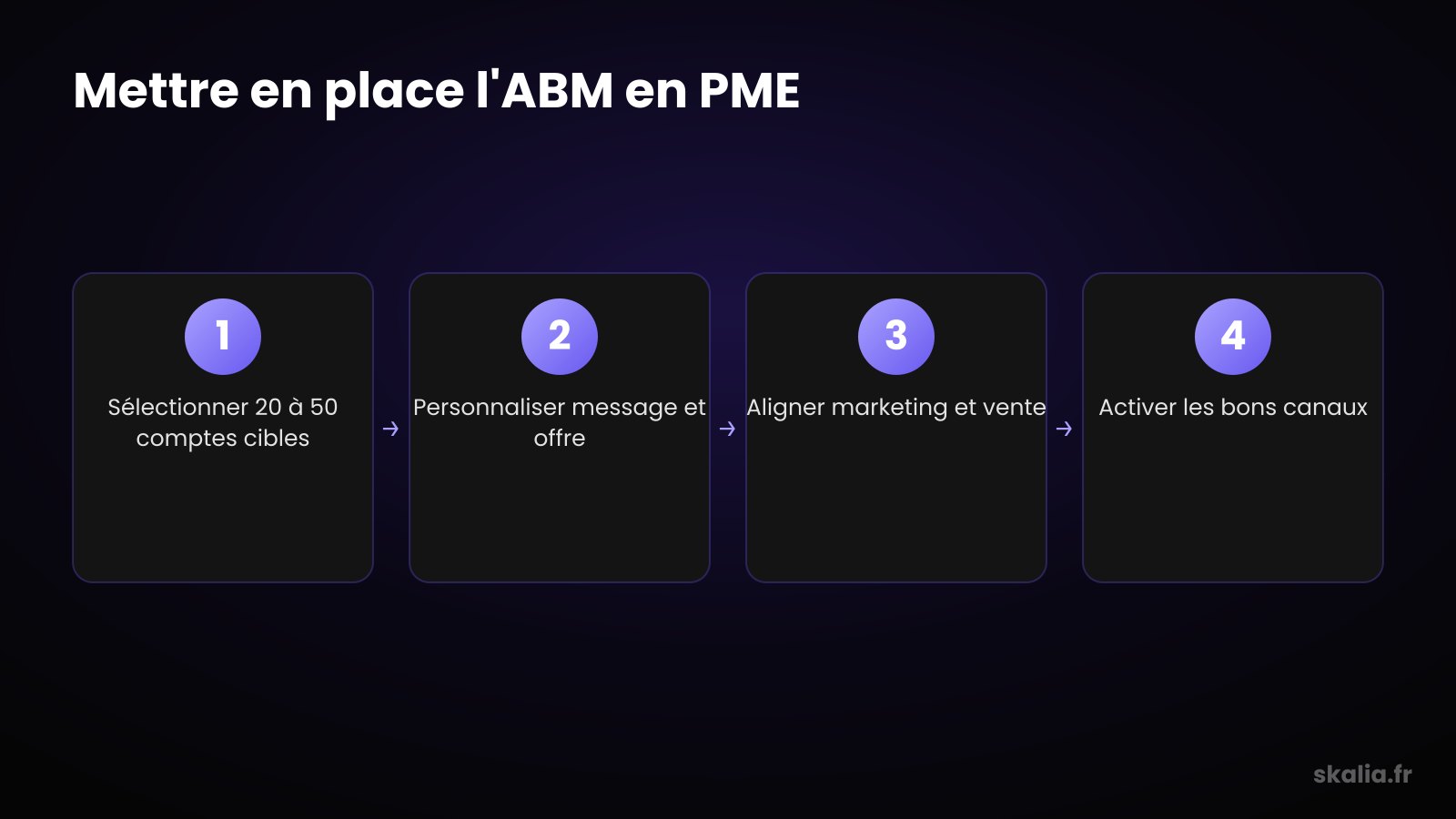
To launch ABM in a small business, follow four steps: select the accounts, personalize the message and offer, align marketing and sales, then activate the right channels. There's no need to automate everything from day one. A spreadsheet, a LinkedIn Sales Navigator account, and real discipline are enough to start off right.
Selecting target accounts
Start with 20 to 50 accounts, no more. Cross-reference three criteria: revenue potential, the likelihood the company has your problem, and your ability to reach it (network, shared connection, familiar industry). Score each account so you only keep the best ones. A good ABM list fits on one page.
Personalizing the message and offer
For each account, look for a specific angle: a hiring push, a funding round, some news, a competitor shaking things up. This work ties into the logic of signal-based selling, where you trigger outreach based on a real event rather than at random. The message must prove you've done your homework.
Aligning marketing and sales
Marketing and sales need to share the same list and the same goals. Marketing prepares the content and the angles, sales takes over on direct exchanges. This coordination is the heart of a focused acquisition strategy: everyone pushes in the same direction, on the same accounts.
Activating the right channels
Combine LinkedIn, email, and sometimes a physical mailer to make an impression. A well-orchestrated multi-channel LinkedIn and email sequence multiplies touchpoints without harassing anyone. The idea isn't to send more, but to reach the right people at the account at the right time, with a consistent thread running through it all.
How does ABM differ from mass prospecting?
ABM differs from mass prospecting on one key point: you trade volume for depth. Mass prospecting sends lots of generic messages at a low unit cost and closes at 1 to 3%. ABM works few accounts, heavily personalized, at a higher cost per account but a far better closing rate.
| Criterion | Mass prospecting | ABM for small business |
|---|---|---|
| Volume | Hundreds to thousands of contacts | 20 to 50 targeted accounts |
| Personalization | Low, generic message | High, tailored per account |
| Cost per account | Very low | High (prep time) |
| Closing rate | 1 to 3% | 15 to 30% |
The two approaches aren't entirely at odds. Many small businesses combine a broader prospecting base for everyday volume with an ABM layer on strategic accounts. That's the spirit of an allbound approach blending inbound and outbound: several speeds depending on the prospect's value.
What mistakes should you avoid when launching ABM in a small business?
The most common mistake is choosing a list that's too long: beyond 50 accounts, personalization collapses and you fall back into mass mode. Three other traps come up often, and they're costly in both time and results.
- Targeting accounts too big for you: chasing an unreachable large enterprise burns out the team for nothing.
- Confusing personalization with fake familiarity: using someone's first name isn't enough, you need a real angle.
- Forgetting to measure: without tracking engaged accounts, there's no way to know what's working.
- Separating marketing and sales: two different narratives on the same account kill your credibility.
Finally, don't judge ABM after a month. A B2B cycle takes time, especially on strategic accounts. You need to nurture the relationship, come back, add value before selling. That patience fits into an acquisition funnel built to be profitable, not an immediate-results mindset.
FAQ
How many accounts should you target for ABM in a small business?
Between 20 and 50 accounts to start. Below that, you lack the volume to create opportunities; above it, personalization becomes impossible to sustain. The ideal is a list your team can track by name, account by account, every week.
Does ABM require expensive tools?
No, not at first. A spreadsheet for the list, LinkedIn Sales Navigator, and an email tool are enough to launch ABM in a small business. Specialized ABM platforms become useful later, once the number of accounts and the coordination truly require them.
How long before you see the first results?
Expect three to six months. ABM targets strategic accounts with a long buying cycle. The first signals (replies, meetings, engaged accounts) arrive within a few weeks, but signed deals follow the pace of the B2B cycle, often a quarter or two.
Are ABM and classic prospecting compatible?
Yes, and it's even recommended. Most small businesses keep broader prospecting for everyday flow and reserve ABM for a handful of key accounts. The two complement each other: volume feeds the pipeline, ABM concentrates effort where value is highest.
Should you launch your ABM now?
If a handful of accounts carry a lot of weight in your potential revenue, light ABM is likely your best growth lever for 2026. The real obstacle isn't budget, it's discipline: building a short list, truly personalizing it, and aligning the whole team around it. At Skalia, we help small businesses in Toulouse build that list and orchestrate the campaigns, weaving ABM into a broader focused acquisition strategy. Already have an idea of which accounts would matter most to you? Let's talk.