
 kevin@skalia.ca


Signal-Based Selling: Reaching Out at the Right Moment, Not at Random
Reaching out to a prospect three months too early is a 'no.' Signal-based selling flips the logic: instead of working down a static list, you start from a signal (a funding round, a new hire, a job change) that tells you it's the right moment. Here's how to spot these signals and turn them into messages that get a reply.
- Signal-based selling triggers outreach from an intent signal (funding round, hiring, job change) rather than a static list.
- The best signals give you both the right timing AND a natural conversation opener.
- You'll find them in the press, on LinkedIn, in job postings, and in your own analytics tools.
- The signal justifies the message — never mass spam.
What Is Signal-Based Selling?
Signal-based selling means reaching out to a prospect at the moment triggered by an intent signal, rather than working down a static list in order. A signal is an observable event: a funding round, a new hire, a job change, a visit to your website. It indicates the need is probably present right now.
The difference from classic prospecting lies in the starting point. In a "list" approach, you contact 500 companies matching a profile, regardless of their current situation. In a "signal" approach, you contact the ones that just moved. Volume drops, relevance rises.
The idea isn't new: a good salesperson has always kept an eye out for opportunities. What's changed in 2026 is access to data. You can now monitor thousands of accounts and get alerted the moment a signal appears, without spending all day reading the news.
What Are the Main Types of Intent Signals?
Signals fall into two families: internal signals (from your own tools) and external signals (public, market-facing). The most actionable ones for an SMB are funding rounds, hiring, a decision-maker's job change, website visits, use of a competing technology, and LinkedIn engagement.
External (Public) Signals
A **funding round** signals fresh budget and growth plans. A **new hire** reveals a priority: a company looking for a "Head of Acquisition" has an acquisition problem to solve. A **job change** opens a window: a new decision-maker often wants to make their mark with new tools.
**Use of a competing technology**, visible through certain detection tools, reveals an already-qualified need. And **LinkedIn engagement** (a like, a comment on a post about your topic) signals active, immediate interest.
Internal Signals (Your Own Data)
A **repeat visit** to your pricing page is pure gold: the person is already doing their research. Downloading a guide, repeatedly opening an email, signing up for a demo — all of this indicates a prospect who's already moving forward in their thinking on their own. These internal signals convert better, because the interest is already there.
Where Do You Actually Find These Signals?
Every signal has its source, and most are free or low-cost. Funding rounds can be tracked in trade press and on LinkedIn; hiring through job boards and careers pages; job changes through LinkedIn or Sales Navigator notifications; internal signals through your analytics tool or CRM.
The goal isn't to monitor everything by hand. It's to pick 2 or 3 signals that matter for your offer, then automate their detection. A recruitment firm will watch for funding rounds; a web agency will watch for marketing hires or announced website redesigns.
| Signal type | Where to find it | Triggered message (opener) |
|---|---|---|
| Funding round | Tech press, LinkedIn | "Congrats on the round. At this stage, the acquisition question tends to come up fast…" |
| Key hire | Job boards, careers page | "I saw you're hiring a Head of Acquisition. In the meantime, here's how…" |
| Job change | LinkedIn, Sales Navigator | "Congrats on the new role. In the first few months, many prioritize…" |
| Site visit | Analytics, CRM | "I noticed you checked out our pricing page. Any questions on scope?" |
| Competing tech | Detection tools | "I see you're using [tool X]. One limitation comes up often with our clients…" |
| LinkedIn engagement | Notifications, posts | "Your comment on [topic] really resonated. We see the exact same thing…" |
How Do You Turn a Signal Into a Relevant Message?
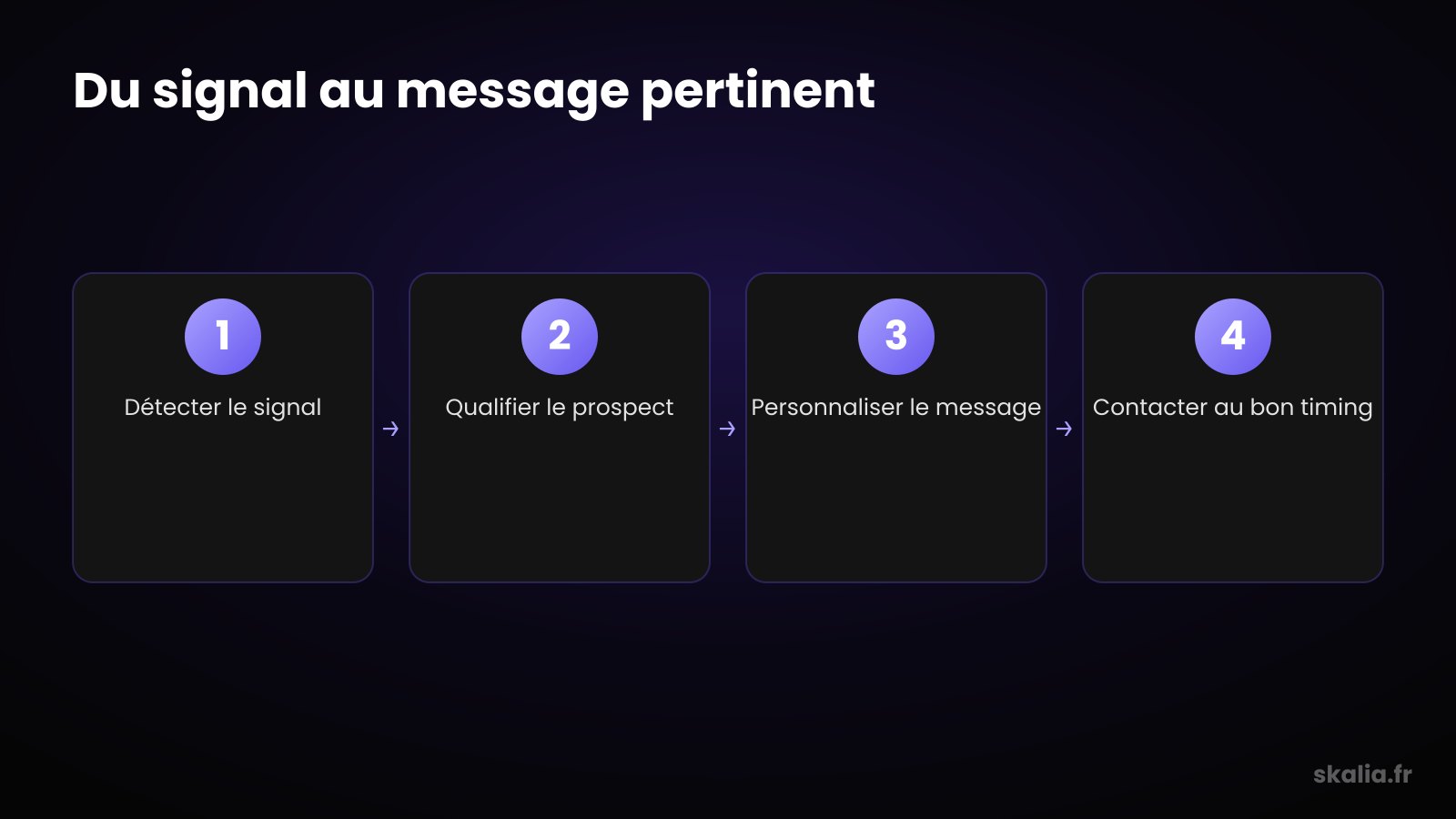
A good message opens with the signal, then pivots to the need it reveals, without ever turning the signal into a mere pretext. The structure that works: acknowledge the context (the signal), link it to a concrete challenge, ask an open question. In three sentences, you show you've done your homework.
The trap to avoid: fake personalization. "I saw your funding round, so let me offer you a demo of my software" sounds opportunistic. The signal should serve the prospect, not your pitch. Tie it to a problem they're living, not to what you're selling.
Good timing matters as much as the right words. A job change plays out in the first 30 to 60 days. A funding round, in the weeks following the announcement. A site visit, within 24 to 48 hours. Past that window, the signal cools off and your message becomes just another ordinary cold message. To go further on the overall mechanism, our guide to automated prospecting covers the rest of the chain.
What Tools Do You Need for Signal-Based Selling?
The toolset breaks down into three building blocks: signal detection, contact enrichment, and message orchestration. You don't need an overengineered setup to get started: LinkedIn and Sales Navigator already cover job changes, hiring, and engagement — among the richest signals in B2B.
To choose between LinkedIn plans, our comparison of LinkedIn Premium vs. Sales Navigator sorts through the options based on your volume. On the internal-signal side, your CRM and analytics tool are often enough: set up an alert for when a known prospect visits a key page.
For orchestration, keep it lean. 20 hyper-targeted messages a week beat 500 automated ones with no context. Most LinkedIn messages go unanswered because they're generic — and the signal is precisely what breaks that genericness.
What Are the Limits and Pitfalls to Avoid?
The main risk of signal-based selling is turning it into an excuse to spam faster. A signal gives you the timing and the opener, not the right to blast poorly targeted messages in bulk. If your volume explodes without quality keeping pace, you haven't done signal-based selling — you've just added a pretext.
Second limitation: not all signals are equal. A LinkedIn like is a weak signal; a funding round combined with a marketing hire is a strong one. Prioritize "hot" signals and cross-reference them when possible. A single isolated signal rarely justifies a full sequence.
Finally, volume remains inherently limited. Signal-based selling doesn't replace your entire prospecting effort — it complements it. Over a month, you'll generate fewer contacts than with a broad list, but with a better response rate. Our response rate benchmarks provide reference points to measure the gap. Also plan the expected number of leads from a LinkedIn campaign accordingly.
FAQ
Does Signal-Based Selling Replace Classic Prospecting?
No, it complements it. Signal-based selling maximizes response rate on a smaller volume of "right-moment" prospects. For volume, broader prospecting remains useful. The right approach combines both: hot signals as a priority, a targeted list as the campaign's foundation.
Do You Need Paid Tools to Get Started?
No. You can start with LinkedIn, job boards, trade press, and your analytics tool, all accessible for free or nearly so. Sales Navigator and detection tools mainly bring time savings and scale once the method is proven on 2 or 3 priority signals.
What's the Best Signal for a B2B SMB?
Hiring and job changes are often the most profitable. A hire reveals a budgeted priority; a job change opens a window where the new decision-maker is looking for solutions. Both are visible for free on LinkedIn and easy to turn into a natural opener.
How Long Does a Signal Stay Actionable?
It depends on the signal. A site visit plays out within 24 to 48 hours, a job change within 30 to 60 days, a funding round over a few weeks. Past that window, the signal cools off and your message loses its contextual relevance.
Adopting Signal-Based Selling With a Method
Signal-based selling doesn't require more tools — it requires more discipline: picking 2 or 3 signals that matter for your offer, detecting them early, and writing messages that serve the prospect. At Skalia, we build these targeted prospecting mechanisms for Toulouse-based SMBs, connecting signals, timing, and messaging. If you want to structure all of this, our LinkedIn prospecting method is a good place to start. Let's talk.