
 kevin@skalia.ca


AI Marketing for SMEs: Where to Start Without Messing It Up
AI in marketing isn't just ChatGPT, and you don't need a technical team to benefit from it. Here's a progressive roadmap for an SME: the use cases to tackle first, the ones to avoid, and how to measure a real gain from month one.
- Start with a single use case — the one costing you the most time each week.
- The 5 most profitable projects for an SME: content, email, prospecting, analysis, customer service.
- Start small, measure one real number (time saved, leads recovered), then expand.
- The real pitfalls are gimmicky tools and poorly prepared data, not a lack of technical skills.
What Does AI Marketing Actually Mean for an SME?
AI marketing for an SME isn't about generating one more piece of text in a chat window: it's about delegating repetitive tasks so you stop letting prospects slip away. According to the France Num 2024 Barometer, only 6% of French small and mid-sized businesses use AI, even though most say they lack time for daily tasks. That's where the real leverage lies.
When people talk about AI in marketing, the image that comes to mind is ChatGPT. That's missing the forest for the trees. The real value for a business is rarely about writing more. It's about saving time on repetitive work and never missing a request again.
Before choosing a tool, ask yourself one question: where am I losing time every week? The answer says more than any tool comparison. You don't need a PhD, or a large-company budget, to get started.
What Are the First Profitable AI Use Cases for an SME?
The five most profitable use cases for an SME are content writing, email marketing, prospecting, data analysis, and customer service. According to McKinsey (State of AI, 2024), marketing and sales are among the functions where generative AI creates the most measurable value. The good news: they're also the easiest to set up.
Each one solves a concrete pain point. AI-assisted writing cuts the time spent on a product sheet or a newsletter in half. Automatic qualification of inbound leads sorts what deserves a callback from what can wait. Customer service answers recurring questions without tying up a staff member.
The important thing is not to tackle everything at once. More on that just below.
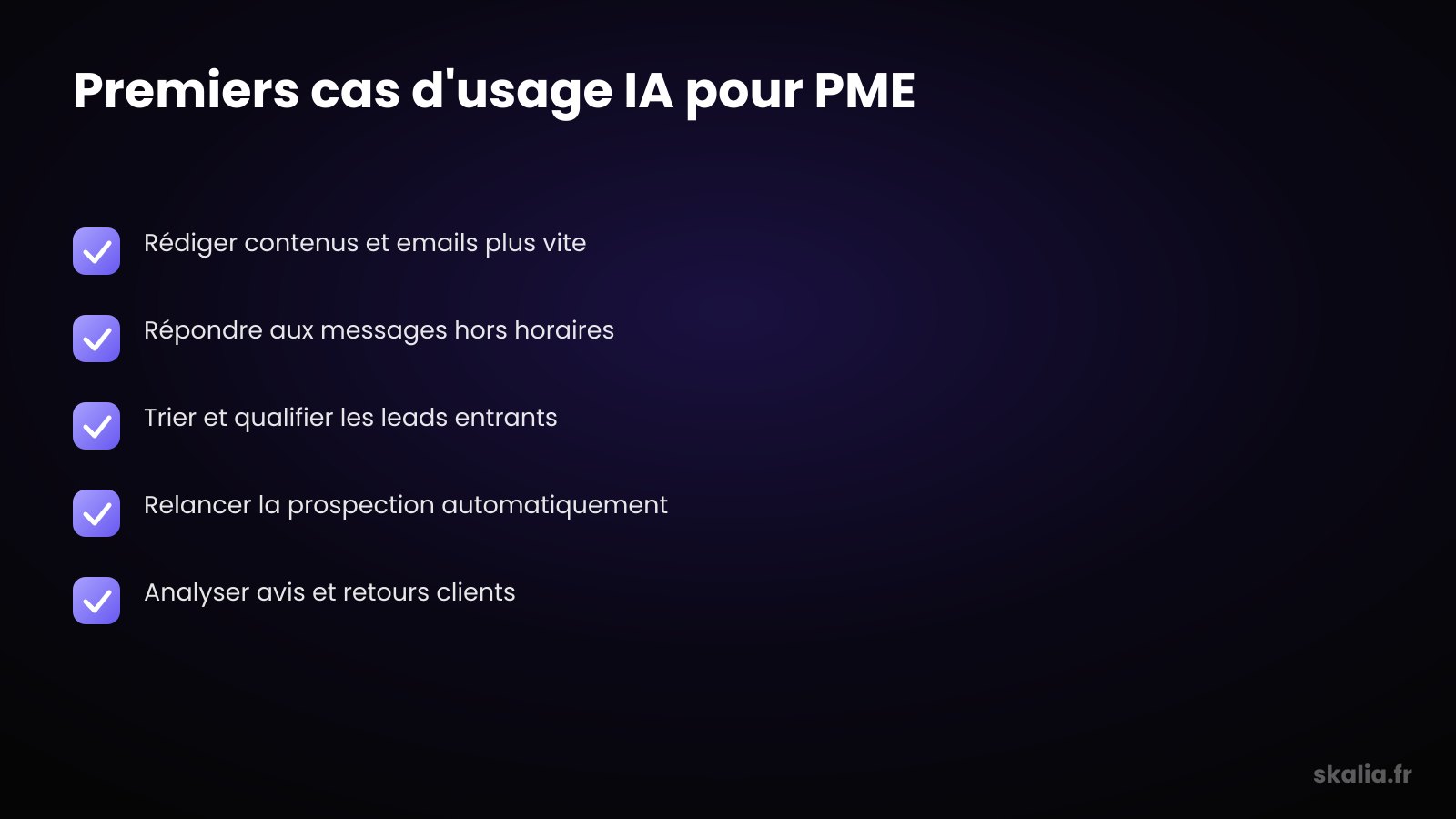
| Use case | Concrete benefit | Difficulty |
|---|---|---|
| Content writing | Product sheets, articles, and emails produced 2x faster | Low |
| Email and follow-ups | Personalized sequences at scale | Low |
| Assisted prospecting | Better targeting and messaging, less time spent | Medium |
| Data analysis | Review summaries, customer feedback, trends | Medium |
| Customer service | Answers to recurring questions 24/7 | Medium to high |
For more on what actually gets delegated, our guide to marketing tasks worth automating breaks down each project.
Why Should You Start With a Single Use Case?
You should start with a single use case because the costliest mistake is trying to automate everything at once. You end up with five subscriptions, zero process in place, and the feeling of having thrown money out the window. A 2024 Gartner study estimates that most AI projects never reach production for lack of proper initial scoping.
Pick one specific pain point. For example:
- Quote requests that come in on weekends and go unanswered until Monday.
- Google reviews nobody has time to reply to.
- The same customer questions coming up ten times a day.
Choose one. Just one. Fix it properly, measure the result, then move to the next. This discipline beats ten tools running in parallel.
At Skalia, we've seen tradespeople recover about ten requests a month simply by automatically answering messages received outside business hours. Nothing dramatic on paper. Except that ten requests, at their average deal size, changes how the year ends.
How Do You Measure Whether Your AI Is Actually Useful?
You measure an AI's usefulness with a concrete number: time saved, leads recovered, or extra meetings booked. An automation that "seems" to work well is worth nothing until you have that number in hand. According to HubSpot (State of Marketing, 2024), teams that track their AI metrics see significantly higher productivity gains.
Set a baseline before you start. How long does the task take today? How many requests are you missing each month? Once the tool is in place, compare. If the gap isn't clear after four weeks, adjust or drop that use case.
The right question isn't "can AI do this?" but "is it still worth doing this myself?"
One point often overlooked: AI writes and sorts fast, but it doesn't decide. You know your customers, your tone, your margins. Keep control of strategy and delegate repetitive execution. A good AI customer service agent remains a supervised executor, not a pilot.
What Pitfalls Should You Avoid When Starting With AI as an SME?
The two major pitfalls are gimmicky tools and unprepared data. A shiny tool with no real problem to solve costs money for nothing. And an AI fed incomplete data produces mediocre results: according to IBM (2024), data quality remains the top obstacle cited by companies adopting AI.
Three habits avoid most disappointments:
- Start from the problem, not the tool. If you don't know which number the AI is supposed to improve, don't buy it yet.
- Prepare your data. A clean contact database, up-to-date product sheets, a conversation history: that's the fuel.
- Keep a human in the loop on anything touching the end customer, especially early on.
These principles apply to sales just as much as marketing. AI-augmented prospecting with an AI SDR only works if your targeting and messaging are already solid. AI amplifies what's working — it doesn't fix what's broken.
What Roadmap Should You Follow to Progress Without Spreading Yourself Thin?
The roadmap comes down to four steps: spot the time-consuming task, test one use case, measure the gain, then expand. This step-by-step progression avoids scattering your efforts and builds real in-house skill, rather than piling up unused subscriptions.
In practice, list your three most time-consuming, least rewarding tasks. Whichever comes up most often is your first project. Once the gain is measured and the process stabilized, add a second use case. Then a third.
Over the months, these building blocks connect: content, email, and prospecting end up forming a coherent chain. That's exactly the logic behind an allbound approach that combines inbound and outbound, where each channel feeds the others. You're not building a sprawling system — you're adding one piece at a time.
FAQ
Do You Need Technical Skills to Use AI in Marketing?
No, not for the first use cases. Assisted writing, automatic replies, and email follow-ups are set up with mainstream, no-code tools. The useful skills aren't technical — they're clarity about your problem and rigor in measuring the result.
How Much Does It Cost an SME to Get Started With AI?
Often a few dozen to a few hundred euros a month to start with one or two use cases. Many tools offer plans accessible to small and mid-sized businesses. The real cost isn't the subscription — it's the time spent scoping and preparing your data upfront.
Which AI Use Case Should You Choose First?
Choose the one costing you the most time each week and whose result is easy to measure. Answering messages outside business hours or qualifying inbound leads are excellent starting points: fast impact, simple setup, a measurable gain from month one.
Will AI Replace Human Marketing?
No. AI is an excellent executor and a poor decision-maker. It writes, sorts, and follows up tirelessly, but you're the one who knows your customers, your tone, and your margins. Strategy stays human; repetitive execution gets delegated.
Want to Get Started Without Spreading Yourself Thin?
AI in marketing isn't reserved for large companies — it's actually more profitable for an SME, because saved time carries more weight there. Start small, measure, then expand. The first project is almost always the one that's already bugging you. If you want help mapping your roadmap and avoiding gimmicky tools, we can identify together the use case to tackle first and connect it to your acquisition strategy, as part of a genuine allbound approach. Let's talk.