
 kevin@skalia.ca


How to Optimize Your Google My Business Listing in 2026

A complete, active Google Business Profile climbs the local pack and captures customers nearby. Here are the concrete levers to activate, in order, and the mistakes that tank your visibility.
- A complete, accurate, active listing climbs the local pack (the top 3 on Google Maps).
- Prioritize precise categories, systematic review replies, and regular photos.
- Post one Google Post a week and keep your hours and special days up to date.
- The real lever is consistency: an active listing beats a perfect but frozen one.
How do you optimize your Google My Business listing in 2026?
To optimize your Google My Business listing (now Google Business Profile), you need to make it complete, accurate, and active. Google favors active listings in its local pack, that block of 3 results shown at the top of local searches. A 100%-filled-out listing, with reviews, photos, and recent posts, sends all the right relevance and proximity signals.
The local pack captures a huge share of clicks on a query like "Toulouse plumber" or "restaurant near me." Appearing there means showing up before the regular organic links. And unlike website SEO, results show up fast: a few weeks is often enough to see movement.
The most common mistake? Creating the listing, filling it in once, then forgetting about it. Google reads inactivity as a negative signal. To lay solid groundwork before optimizing, revisit our complete Google Business Profile guide.
Why do categories determine your visibility?
Categories are the single most decisive lever on your entire listing. They tell Google which searches you should appear for. A poorly chosen primary category makes you invisible, even with an otherwise perfect listing. It's the first setting to lock down.
Choose an ultra-precise primary category. "Italian restaurant" beats "Restaurant," "Locksmith" beats "Home service." Then add 2 to 5 relevant secondary categories that describe your actual services, without overdoing it. Each secondary category opens up new searches, but an off-topic category dilutes your relevance.
Check the category your best local competitors use — the ones already in the local pack. A listing inspector tool or a simple search reveals their primary category. Align with them when it makes sense for your business.
How do you handle your description, hours, and basic information?
This information forms the trust foundation of your listing, and Google penalizes the slightest inconsistency. Your NAP (name, address, phone) must be strictly identical everywhere on the web: website, directories, social media. An address that varies by a single comma muddies your proximity signals.
Write a description of up to 750 characters, customer-focused. Naturally weave in your services and service area, without keyword stuffing. Google doesn't index the description for ranking, but it reassures and converts the visitor.
Hours deserve special attention. Fill in your normal hours, but also special hours: public holidays, long weekends, exceptional closures. A listing showing "open" on a day you're actually closed generates frustration and negative reviews. This often-overlooked detail protects your reputation.
Photos, Google Posts, products: how do you keep your listing active?
Consistency beats perfection: a listing updated every week outperforms a rich but frozen one. Google values recent-activity signals. Add photos regularly (job sites, dishes, team, premises), ideally 2 to 4 a month, decent quality, taken on-site.
Google Posts are underused by most competitors, which makes them a real opportunity. Publish at least one Post a week: a new offering, a deal, news, a blog article. Every Post proves the business is active and takes up more visual space on the listing.
Then fill out the Products and Services sections. Detail your offerings with prices and descriptions where relevant. These sections enrich the listing and answer questions before the first contact even happens. To go deeper on the visual side, see our tips on photos for a Google Business listing.
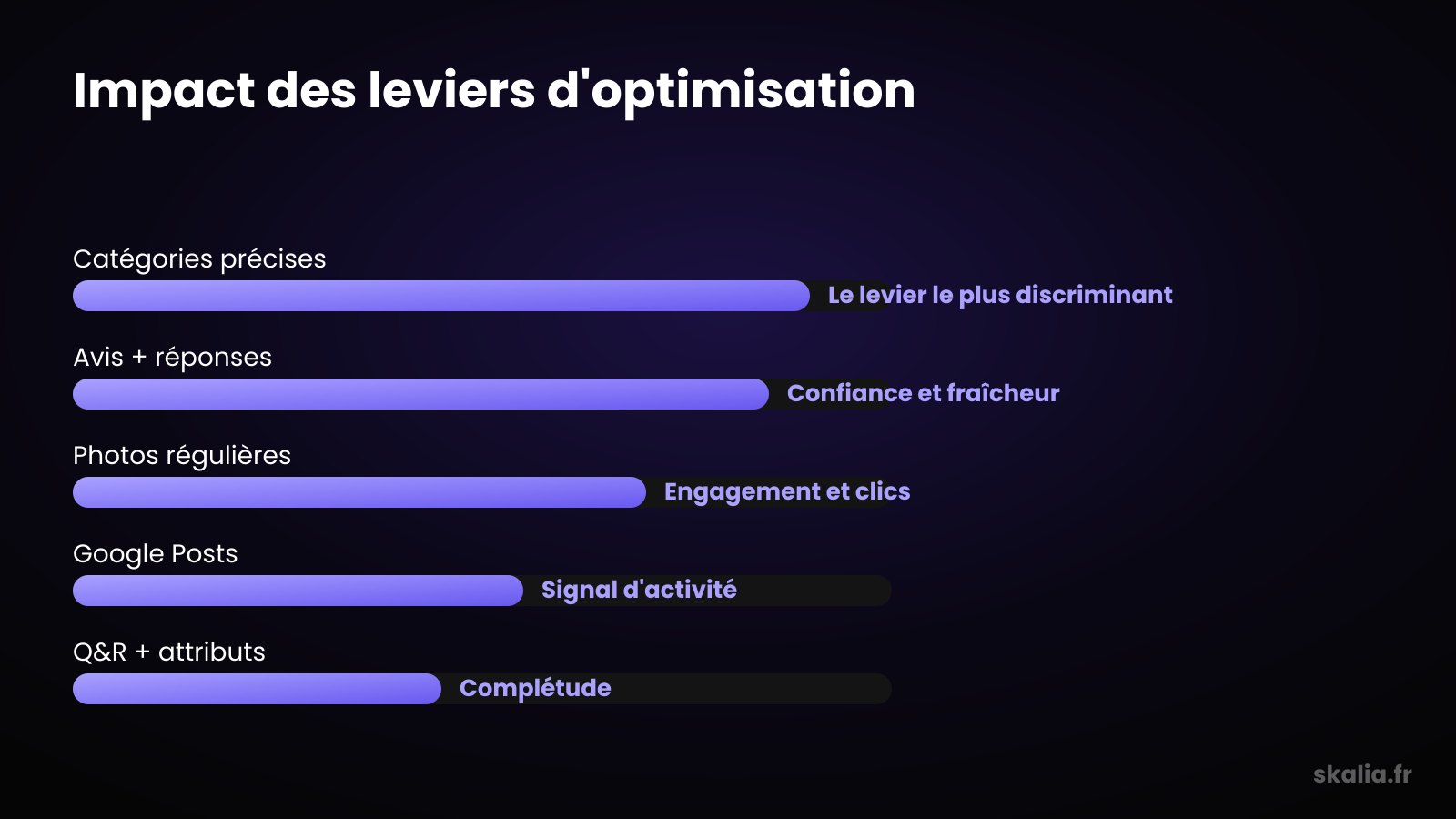
What are the optimization levers, and how often should you activate them?
Here are the main levers ranked by impact and recommended frequency. The table distinguishes what you set once from what needs regular upkeep — the real key to a high-performing listing in the local pack.
| Lever | Impact | Recommended frequency |
|---|---|---|
| Categories (primary + secondary) | Very high | Once, review twice a year |
| Reviews + systematic replies | Very high | Ongoing, within 48h |
| Exact, consistent NAP | High | Once, then verify |
| Quality photos | High | 2 to 4 per month |
| Google Posts | Medium to high | 1 per week |
| Hours + special days | Medium | With every change |
| Q&A (questions/answers) | Medium | Monthly |
| Products / Services | Medium | Quarterly |
| Attributes and messaging | Low to medium | Once, then activate |
How do you manage reviews and the Questions/Answers section?
Reviews carry serious weight in local ranking and in the purchase decision. Google combines rating, review count, freshness, and your replies. Reply systematically, to positive and negative reviews alike, within 48 hours. A polite reply to a critical review reassures more than a perfect rating with zero interaction.
Set up a routine to collect reviews continuously. A QR code, a short link by text or email after service, multiplies the responses you get. Consistency matters: ten reviews spread across the year beat twenty all at once followed by silence. Our article on how to get Google reviews breaks down the method.
The Q&A section is public and often left unattended. Get ahead of it: ask the frequent questions yourself (parking, payment, turnaround) and answer them. You control the information and stop a third party from answering in your place, sometimes incorrectly.
Which mistakes hold back your listing's ranking?
Some mistakes alone are enough to cap a listing — or even get it suspended. The worst one: stuffing the business name with keywords ("Toulouse Cheap Plumber Emergency Repair"). Google prohibits this and penalizes it. Only use your real, actual business name.
Here are the most frequent blockers to avoid:
- A business name padded with keywords or the city name
- A fake address or P.O. box for a business with no physical premises
- A duplicate listing (two listings for the same business)
- A primary category that's too broad or off-topic
- Bought reviews or fake reviews, detected and purged by Google
- A listing left inactive for months
Finally, keep an eye on your stats in the Business Profile interface: searches, calls, directions, clicks. This data shows what's working and where to focus your effort. Optimizing a listing is part of a bigger strategy: discover how the local pack and local SEO work.
FAQ
Do you need a physical storefront to optimize your listing?
No, but the rules differ. With a storefront, you display the address. Without one (tradesperson, home service), you declare a service area and hide the address. Never invent an address: Google verifies and suspends fraudulent listings.
How often should you update your Google Business Profile listing?
Ideally every week. Publish a weekly Google Post, add photos two to four times a month, and reply to reviews within 48 hours. This consistency sends an activity signal that Google rewards in the local pack, far more than one big occasional update.
How long does it take to see results in the local pack?
Generally a few weeks to three months. Categories and NAP act fast. Reviews and consistency pay off over time. A brand-new listing takes longer than an existing one you reactivate and complete.
Does the description influence ranking?
Not directly. Google doesn't use the description as a local ranking factor. It mainly serves to convert the visitor and clarify your offer. Focus your SEO effort on categories, reviews, and NAP consistency — far more decisive.
Optimize your listing, then keep it alive
Optimizing a Google My Business listing isn't a one-off action, it's a routine. First you lock down the foundations (categories, NAP, description, hours), then you maintain the listing week after week: reviews, photos, Posts, Q&A. It's that consistency that pushes a listing up — and keeps it — in the local pack.
The hard part is staying consistent over time, between two days of production work. If you'd like to hand off that upkeep or structure your local presence, let's talk: here's our local SEO & Google Business Profile service. We'll build an active listing that keeps capturing customers in your area, for the long run.