
 kevin@skalia.ca


B2B Email Prospecting: When and How to Use It in 2026?
Email prospecting isn't dead — it's grown up. In 2026, it's still the most scalable channel for reaching B2B decision-makers, provided you master targeting, deliverability, and relevance. Here's when to use it, when to avoid it, and how to weave it intelligently into a multichannel approach.
- Email remains the most scalable B2B prospecting channel for reaching decision-makers, provided targeting, deliverability, and relevance are handled with care.
- It excels when you need to reach many accounts at low cost.
- Pair it with LinkedIn and phone outreach rather than pitting them against each other.
- Five pillars make the difference: a clean list, deliverability, messaging, cadence, and compliance.
Is Email Prospecting Still Effective in 2026?
Yes — email prospecting remains the most scalable B2B channel for reaching decision-makers in 2026. It lets you contact hundreds of targeted accounts at near-zero cost, with none of the connection caps you'd hit on LinkedIn. The channel has matured: what's changed is the bar for targeting and relevance.
Email hasn't disappeared — it's cleaned itself up. Inboxes filter more aggressively, decision-makers are more heavily solicited, and generic mass sends no longer get through. In plain terms: raw quantity no longer works, precision does.
What email keeps is its unique asymmetry. A well-written message reaches a busy executive exactly when they choose to read it, without interrupting their day. It's an asynchronous channel that respects the prospect's time — and that's precisely what makes it so effective when done well.
For step-by-step implementation, our cold email guide covers the full method. This article takes a step back: when to choose email over another channel.
Email, LinkedIn, or Phone: Which Channel Should You Choose?
Email wins on scalability and cost, LinkedIn wins on context, and phone wins on immediacy. No channel is universally "best" — the right choice depends on your target, your volume, and how warm the account is. Here's how the three compare in practice.
Email targets volume and consistency. You reach many accounts at low cost with a message crafted once and reused. LinkedIn brings context and social proof but quickly hits a volume ceiling. Phone doesn't scale at all, but it remains unbeatable for converting an already-warm account.
| Channel | Scalability | Cost | Typical response rate | Ideal use case |
|---|---|---|---|---|
| Very high | Very low | 3 to 8% on a targeted list | Reaching many decision-makers cold | |
| Medium (quotas) | Medium (subscription) | 5 to 15% when warm | Context, social proof, lukewarm accounts | |
| Phone | Low | High (human time) | Variable, strong on warm accounts | Closing an already-engaged account |
These ranges vary by industry and list quality. For more precise benchmarks, check out our response rate benchmarks.
When Is Email the Right Channel?
Email is the right channel when you need to reach many targeted accounts quickly without blowing your budget. It shines with large target pools, decision-makers reachable via a professional email address, and sales cycles where you give the prospect time to respond. Conversely, it shows its limits with red-hot or hyper-strategic accounts.
Prioritize email in these situations:
- Your market has hundreds or thousands of relevant accounts to qualify.
- Your contacts are executives or managers with packed calendars.
- You have a clear, specific message addressing a precise problem.
- You're looking for consistency: a steady flow of inbound conversations.
Avoid making it your only lever when targeting a handful of large, strategic accounts. There, an ultra-personalized approach — often multichannel and human — pays off more. Email is still useful as support, not as the sole pillar.
How Do You Integrate Email Into a Multichannel Approach?
Email fits better into a sequence than into a silo: it opens the contact, LinkedIn builds context, and the phone closes it. A well-orchestrated multichannel sequence noticeably boosts response rates compared with a single channel, because each touchpoint reinforces the last without repeating it.
The principle is simple: don't duplicate the same message across three channels. Make them complement each other. An email asks a precise question, a LinkedIn visit makes your name familiar, a second email follows up from a different angle, and a call comes in once the account shows a signal of interest.
Order matters less than coherence. What counts is that the prospect experiences a logical conversation, not three outreach attempts tripping over each other. Our article on multichannel LinkedIn and email sequences breaks down concrete flows you can copy.
Finally, automation is what makes this sustainable over time. Without it, cadence collapses within two weeks. Our guide to automated prospecting explains how to scale up without losing relevance.
What Are the Five Pillars of Email Prospecting That Works?
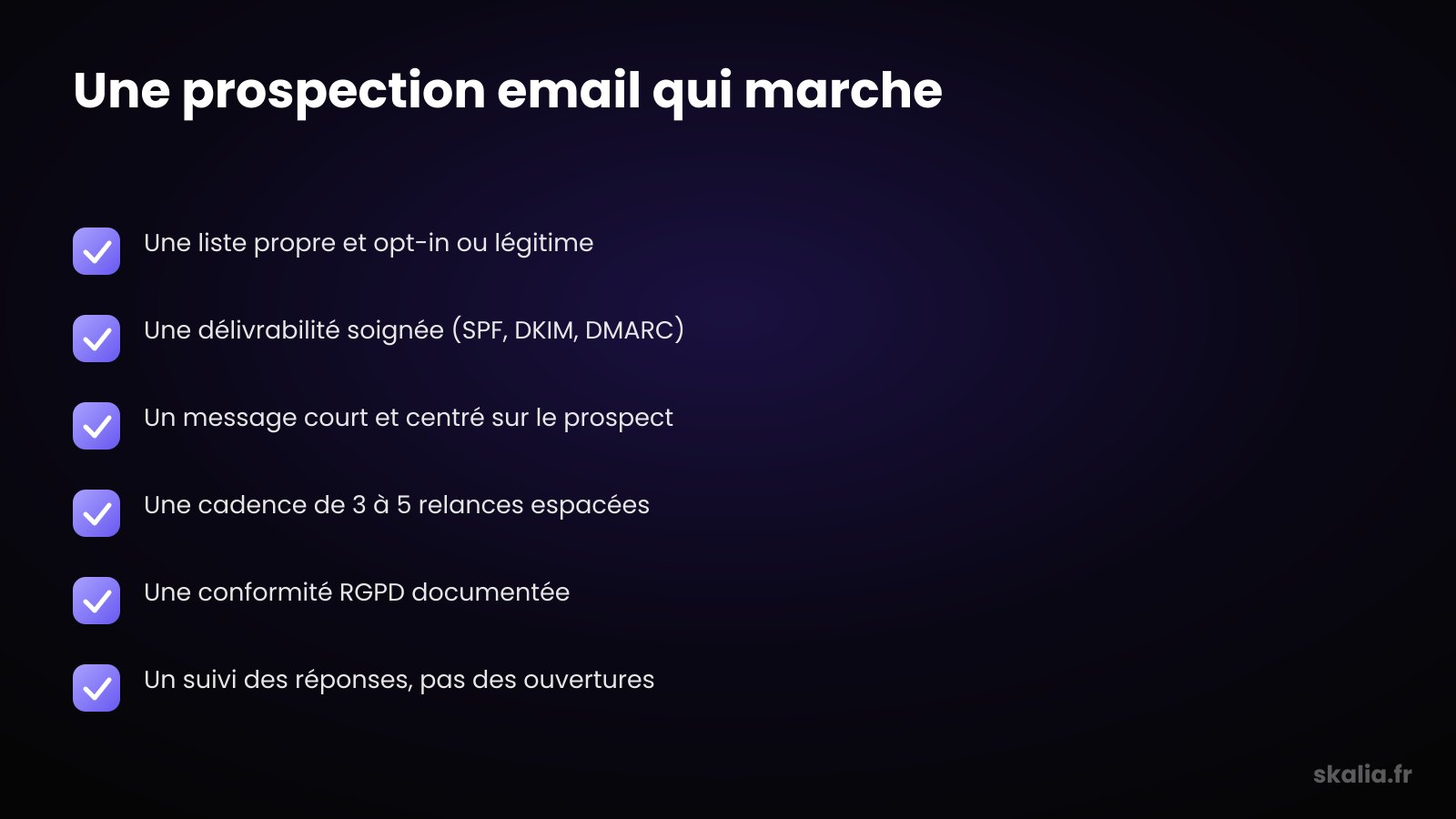
High-performing email prospecting rests on five pillars: a clean list, solid deliverability, a relevant message, a controlled cadence, and GDPR compliance. Neglecting even one drags down results, often before the prospect has even read your message. Here's why each one matters.
A Clean, Targeted List
Everything starts with the list. A poorly targeted database, or one full of invalid addresses, wrecks both deliverability and response rate. Favor quality over volume: 300 relevant contacts beat 3,000 sloppy ones. Before buying a list, read our analysis on buying email lists and its legality.
Deliverability Comes Before the Message
A perfect email that lands in spam is worthless. Set up SPF, DKIM, and DMARC, warm up your sending domain gradually, and monitor your bounce rate. Deliverability is an invisible technical foundation — but a decisive one.
A Short Message, Centered on the Prospect
The best message talks about the prospect's problem, not about you. Short, specific, with a single clear ask. Ban the self-promotional wall of text: the decision-maker decides in five seconds whether to reply or archive.
A Controlled Follow-Up Cadence
Most replies come after the initial email, from follow-ups. Plan for 3 to 5 spaced-out follow-ups, each bringing a new angle — never a simple "just following up" — without becoming pushy.
GDPR Compliance
In B2B, email prospecting is regulated, not banned. You need a legitimate interest basis, a clear opt-out, and you must honor deletion requests. Our article on cold email and GDPR covers the concrete rules in full.
FAQ
Is Email Prospecting Legal for B2B in France?
Yes, as long as you comply with GDPR. In B2B, prospecting emails are allowed on the basis of legitimate interest, provided the message relates to the recipient's professional role. You must clearly state your identity and offer a simple opt-out with every send.
What Response Rate Should You Aim For in Email Prospecting?
On a well-targeted list, a response rate of 3 to 8% is realistic in 2026. Below that, something's off with your targeting or your message. Above it, you're in great shape. This figure depends on your industry, list quality, and how relevant your offer is.
Is Email or LinkedIn the Better Choice?
Both, together. Email scales and reaches many accounts at low cost, while LinkedIn adds context and social proof but caps out in volume. A combined sequence almost always outperforms a single channel. The choice depends on your target and your volume.
Should You Automate Your Email Prospecting?
Yes, as soon as your volume exceeds a few dozen sends per week. Automation maintains follow-up cadence and frees up time for personalization. Just be careful to keep your targeting precise and your message relevant — automating a bad message only amplifies the failure.
Where Should You Start With Email Prospecting?
Start with targeting and deliverability, not the message: these are the two pillars that sink 80% of campaigns before a single email is even read. Once these foundations are in place, email becomes a regular, predictable, low-cost acquisition channel — especially when paired with LinkedIn and phone.
At Skalia, we build multichannel prospecting systems where email plays its part: reaching the right decision-maker, at the right time, with the right message. If you're torn between handling this in-house or outsourcing it, our comparison of in-house SDR vs. prospecting agency sheds light on the decision. Let's talk.