
 kevin@skalia.ca


Waterfall Enrichment: Maximizing Your Contact Data
A single data source never finds all your prospects. Waterfall enrichment queries multiple providers in a cascade, until it finds the information, driving up your match rate. Here's how it works, which tools to use, and at what cost.
- Waterfall enrichment queries multiple data providers in a cascade until it finds the email or phone number.
- You only pay for data that's actually found, source after source.
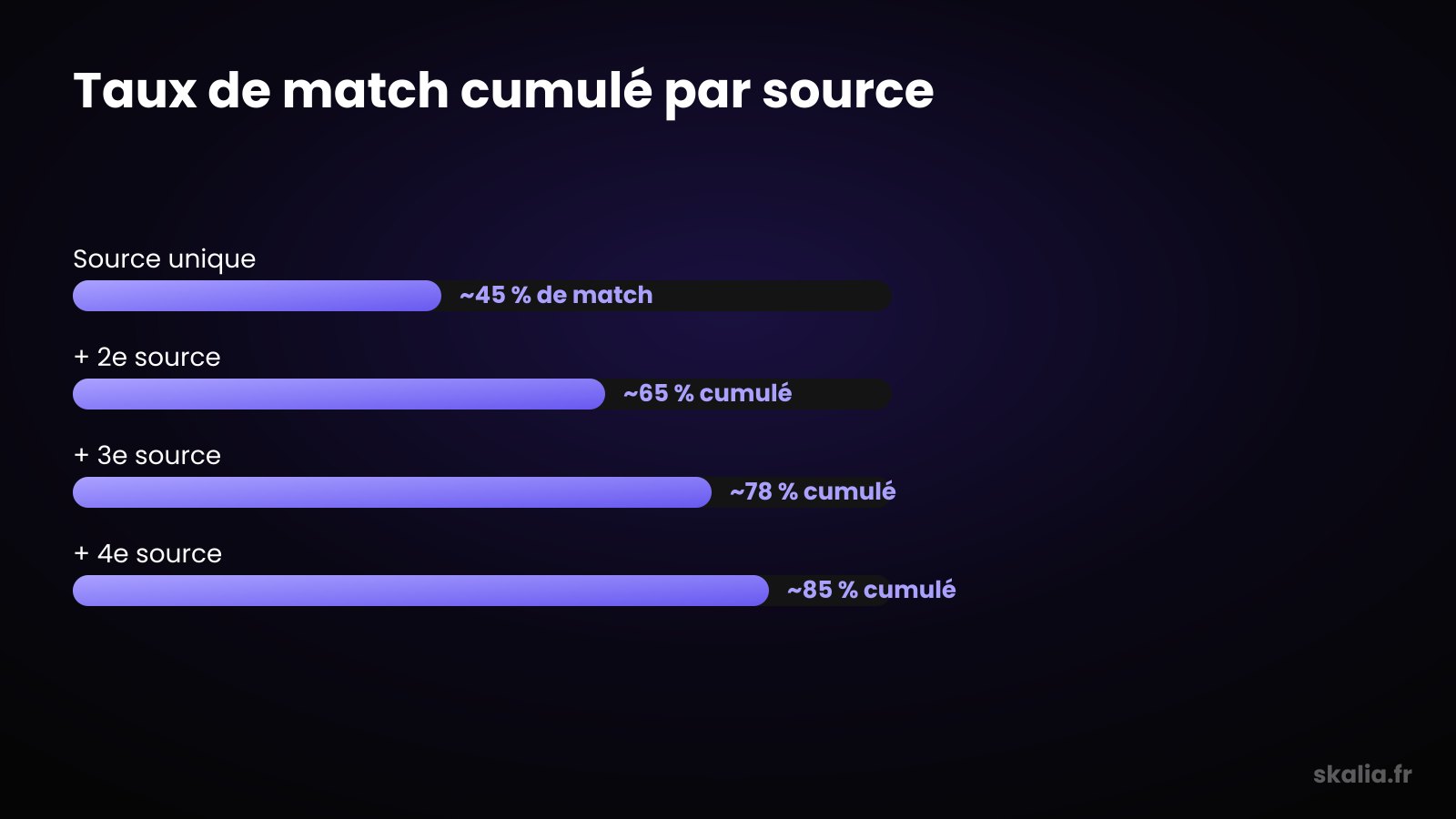
- Match rate climbs from 40-50% (single source) to 80%+ (cascade).
- The go-to tool is Clay, but data quality and GDPR compliance remain your guardrails.
What is waterfall enrichment?
Waterfall enrichment means querying multiple data providers in a cascade, one after another, until you find the contact information you're looking for. As soon as one source delivers the email or phone number, the search stops. Otherwise, it automatically moves on to the next provider, and so on.
The name comes from the image of a waterfall: the query falls from one level to the next as long as it hasn't retrieved anything. Each provider has its own databases, with different coverage areas. By chaining them together, you cover far more prospects than with a single one.
In practice, you start from a list of contacts (name, company, LinkedIn profile) and try to retrieve a verified professional email or a mobile number. The cascade orchestrates the calls to the different APIs for you, without you having to test each tool by hand.
Why isn't a single source enough?
A single contact data source often caps out around 40 to 60% match rate, because no provider covers the entire market. Every database has gaps: one tool is strong on French mobile numbers, another on US tech emails, a third on industrial SMBs. Nobody has it all.
The result: if you rely on a single tool, you mechanically leave 40 to 60% of your prospects on the table. These are contacts you've identified, targeted, and qualified, but will never be able to reach for lack of contact details. For a sales team, that's half the pipeline evaporating before the first message is even sent.
Quality also varies by region. A provider can be excellent on enterprise accounts and mediocre on small businesses. In France, mobile number coverage is particularly uneven from one tool to another. Waterfall solves this problem by combining each provider's strengths.
How does an enrichment waterfall work?
An enrichment waterfall follows a defined order of providers and only bills for data that's actually found, at each level of the cascade. You rank your sources from best value to most expensive. The query cascades down until a provider responds, then stops immediately.
The order of providers
Order is the heart of the method. You put the cheapest and most reliable sources for your target audience first. Expensive or specialized providers come last, as a safety net for hard-to-find contacts. Set up well, this order minimizes the average cost per contact found.
For the French market, it's common to lead with a tool that's strong on European B2B emails, then a mobile-number specialist, then a pricier premium source as a last resort. Comparing providers upfront helps define this order: our analysis of Apollo, Lusha, and Kaspr breaks down their respective strengths.
Cost per data point found
The pricing model changes everything. You don't pay a subscription per provider, you pay a credit for each piece of data actually retrieved. If the first tool finds the email, the next ones are never called, so never billed. You optimize spend contact by contact this way.
Single source or waterfall: which should you choose?
Waterfall wins as soon as volume and contact quality matter, at the cost of higher setup complexity. A single source stays simpler and is enough for light testing. But to build a serious pipeline, the cascade changes the scale of your results.
| Criterion | Single source | Waterfall enrichment |
|---|---|---|
| Match rate | 40 to 60% | 75 to 90% |
| Cost | Fixed subscription, wasted credits | Paid per data point found |
| Complexity | Low, one tool to manage | High, multi-source orchestration |
| Best for | Testing, small volumes | Structured pipeline, large volumes |
The table shows the real trade-off: waterfall requires more setup upfront, but it makes every identified contact pay off. If you're already automating your prospecting, the cascade fits naturally into the flow. Our guide to automated prospecting puts this building block back into the full machine.
What tools can you use for waterfall enrichment?
Clay is the go-to tool for orchestrating waterfall enrichment, since it connects dozens of providers into a single configurable cascade. You define the order of sources, the conditions for moving to the next level, and email verification, all without writing code.
Clay works like an enriched spreadsheet: each row is a contact, each column an enrichment. You plug in your providers (email finders, mobile, firmographic data) and Clay chains the calls according to your rules. Our guide to prospecting with Clay walks through getting started step by step.
Other platforms offer cascade-style logic, but Clay remains the most flexible on number of sources and conditions. To choose your full stack, start by comparing the building blocks available: our selection of the best automated prospecting tools helps you avoid stacking up unnecessary subscriptions.
Is waterfall enrichment profitable?
Yes, waterfall enrichment pays off as soon as you reach contacts you'd otherwise have lost, since every activated prospect can become a meeting. Going from 45% to 85% match rate is nearly double the reachable contacts from the same targeted list.
The logic fits in one sentence: you pay a bit more per contact, but you turn "dead" prospects (no contact info) into reachable ones. On a sales pipeline, doubling the number of people you can reach outweighs the enrichment surcharge by far, often just a few cents per data point found.
That said, these extra contacts still need to be good quality and well used. Enriching wider only makes sense if your messaging follows through. Combining enrichment with buying signals sharpens your targeting: our article on B2B intent data shows how to prioritize your hottest contacts.
What are the limits of waterfall enrichment?
The two major limits are variable data quality and GDPR compliance on B2B contacts. A high match rate doesn't guarantee valid emails or up-to-date numbers. And enriching personal data at scale imposes a strict legal framework in France.
On the quality side, always verify emails before sending. A poorly tuned cascade can favor volume over reliability, which inflates your bounce rate and damages deliverability. Better to have 80% clean contacts than 90% littered with dead addresses.
On the GDPR side, enriching professional data remains regulated: legal basis, informing individuals, right to object. Waterfall doesn't exempt you from any obligation. Make sure your providers are compliant and document your approach before launching your campaigns.
FAQ
Is waterfall enrichment legal in France?
Yes, under certain conditions. B2B data enrichment is possible on the basis of legitimate interest, provided you inform individuals and respect their right to object. Check each provider's compliance and document your legal basis before any prospecting campaign.
How many providers should a cascade include?
Three to five providers are enough in most cases. Beyond that, the match-rate gain becomes marginal and complicates orchestration. Start with two or three well-chosen sources for your target audience, measure the match rate, then add a premium provider as a last resort if needed.
Waterfall enrichment vs. intent data: what's the difference?
Enrichment finds the contact details for a prospect you've already targeted. Intent data identifies which accounts are showing buying signals at a given moment. The two combine well: you first detect hot prospects, then enrich them in cascade to reach them at the right time.
Is Clay essential for waterfall enrichment?
No, but it makes setup enormously easier. Clay connects many providers and manages the cascade logic without code. You could orchestrate a waterfall through scripts and APIs, at the cost of much heavier technical work that's harder to maintain over time.
Waterfall enrichment: where should you start with Skalia?
Waterfall enrichment only has value plugged into a coherent prospecting machine: targeting, sequences, follow-up. At Skalia, we build these flows for small and mid-sized businesses in Toulouse, from cascade enrichment all the way to qualified meetings. The idea isn't to stack up tools, but to reach more of the right prospects, cleanly.
If you're wondering how to fold enrichment into a complete setup, start with our guide to automated prospecting, then let's talk about adapting it to your market.