
 kevin@skalia.ca


Warm Outbound: Why It Outperforms Cold Outreach in 2026
Warm outbound means reaching out to prospects who've already had some interaction with you or your content, rather than total strangers. The result: response rates far higher than classic cold outreach. Here's how to build that 'warmth,' prioritize your targets, and scale the method without diluting it.
- Warm outbound targets prospects who already know you, not strangers.
- Its response rates run around 10 to 30%, compared with 1 to 5% for cold outreach.
- You build "warmth" through content, LinkedIn engagement, site visitors, and events.
- You scale it with signals, not blind volume.
What Is Warm Outbound in 2026?
Warm outbound means reaching out to prospects who've already had some interaction with you or your content, as opposed to pure cold outreach where you're writing to a total stranger. The "warmth" comes from a prior signal: a visit to your website, a like on a post, a webinar sign-up.
The idea is simple. A prospect who's already come across your name lowers their guard. They no longer wonder "who is this person?" but rather "why are they reaching out now?" That nuance changes everything about the first message.
Warm outbound isn't inbound. You're still the one initiating contact. But you're doing it with an audience that's already been warmed up, which brings modern B2B closer to active nurturing than to cold canvassing.
How Does Warm Differ From Cold Outbound?
The difference lies in the starting point: cold targets strangers, warm targets prospects already exposed to your brand. 2026 benchmarks put cold email response rates between 1 and 5%, while a well-targeted warm approach often exceeds 10 to 30%.
Beyond the numbers, it's the nature of the effort that changes. With cold, you compensate for the low rate with volume: more contacts, more sequences, more tools. With warm, you invest upfront to create the signal, then contact fewer people — but far more effectively.
The sales cycle follows the same logic. A prospect who already knows you moves faster through their decision. Less mistrust, fewer back-and-forths, a meeting booked sooner. To understand why so many messages go unanswered, see our analysis of LinkedIn messages that get no reply.
| Criterion | Cold outbound | Warm outbound |
|---|---|---|
| Response rate | 1 to 5% | 10 to 30% |
| Nature of the effort | Volume of contacts | Creating the signal |
| Sales cycle | Longer | Shortened |
| Sources | Purchased lists, scraping | Content, website, events |
| Risk of rejection | High | Low to moderate |
Why Does Warm Outbound Outperform Cold?
Warm outbound outperforms cold because it removes the main friction point in prospecting: the unknown. When a prospect recognizes your name, the odds they open and reply climb sharply, whereas cold email caps out at 1 to 5% response rates according to current response rate benchmarks.
There's a well-documented familiarity effect at play. Seeing us multiple times creates a trust bias, even without any direct exchange. A prospect who's read two of your posts already perceives you as a reference point, not a spammer.
Warm also protects your sender reputation. Fewer ignored messages, fewer reports, preserved deliverability. At a time when spam filters keep getting stricter, reaching out to people who are somewhat expecting you beats blasting everyone.
How Do You Build "Warmth" Before Reaching Out?
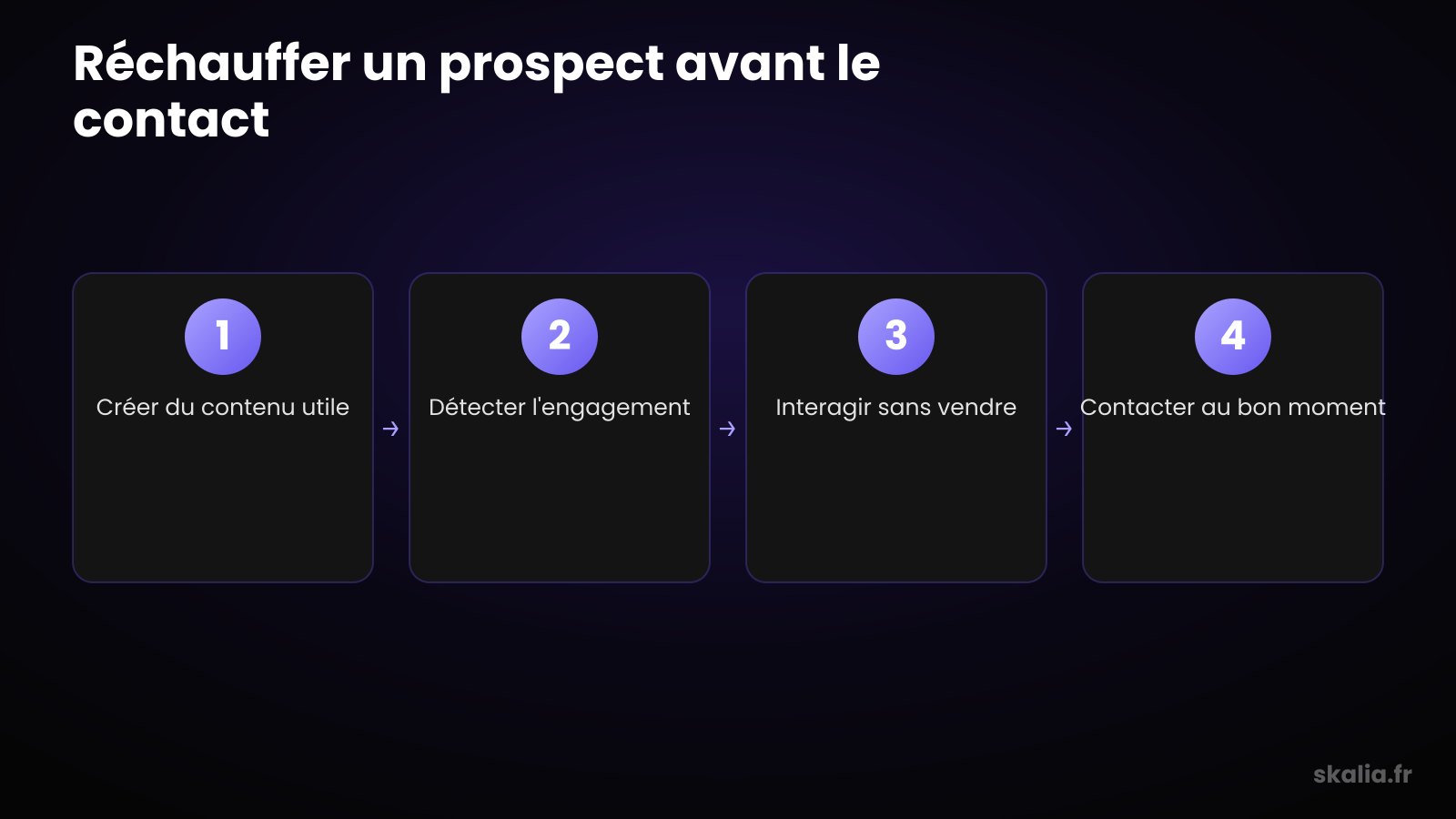
You build "warmth" by generating touchpoints before the direct approach: useful content, LinkedIn engagement, site visitors, events, and communities. Each interaction leaves a usable trace that turns a stranger into a lukewarm prospect.
Content and LinkedIn Engagement
Posting regularly on LinkedIn remains the most accessible lever. Every post that gathers likes and comments builds you a list of prospects already exposed to your expertise. You can then contact those who engaged, with a hook tied to their reaction. Our LinkedIn prospecting method details how to chain engagement into a message.
Website Visitors and Events
Visitors to your website are already actively searching. A B2B visitor-identification tool or a simple gated-content form captures these signals. Webinars, trade shows, and Slack or Discord communities work the same way: participation becomes the legitimate reason for the first message.
How Do You Prioritize Your Warm Prospects?
You prioritize based on the intensity and freshness of the signal: the stronger and more recent the interaction, the higher the prospect moves up the list. A detailed comment this week beats a like from three months ago.
Rank your signals by warmth level. At the top, those who requested a demo or downloaded content. In the middle, active commenters and repeat site visitors. At the bottom, simple likes or profile views. This hierarchy directs your energy toward the most ready prospects.
The time window matters as much as the intensity. A prospect who just interacted is warm right now, not in a month. In practice, we've found that reaching out within 48 hours of a strong signal nearly doubles the odds of a reply. Good timing often beats a perfect message.
How Do You Scale Warm Outbound Without Losing What Makes It Work?
You scale it by automating signal detection, never the human side of the message. Tools identify who's engaging, but personalizing the first contact stays manual or heavily guided — otherwise you fall right back into cold outreach in disguise.
Automate what's mechanical: collecting engagements, enriching contacts, visit alerts. Our guide to automated prospecting shows how to wire up these flows properly. But keep control over the message's angle and the reference to the specific signal.
The classic trap is trying to scale everything at once. A generic "warm" message rings just as false as a cold email. The rule to follow: every message should contain an element you couldn't have written without the signal. If it doesn't, you're doing cold outreach with a coat of varnish. To frame your written sequences, lean on our cold email guide and adapt it to the warm context.
FAQ
Is Warm Outbound Legal Under GDPR?
Yes, within the B2B and legitimate-interest framework, as long as you inform the individual and allow them to object. The fact that the prospect has interacted with you strengthens the relevance of the contact, but it doesn't exempt you from mandatory disclosures. Treat warm outbound with the same rigor as cold email.
How Long Does It Take to Generate Warm Prospects?
Expect several weeks for content and engagement to produce a steady flow of signals. Early results come faster if you're starting from an existing LinkedIn audience. Warm outbound is a gradual investment, not a switch you flip overnight.
Can You Do Warm Outbound Without a LinkedIn Audience?
Yes. Website visitors, newsletter subscribers, webinar attendees, or community members are all sources of warmth too. LinkedIn speeds up the process, but any traceable touchpoint can serve as the foundation for a warm approach.
Does Warm Outbound Completely Replace Cold Outreach?
Not always. Warm covers prospects already in your orbit, a volume that's inherently limited. Cold remains useful for opening new segments where you have no presence at all. The two approaches work together: warm first, with cold as a targeted complement.
Switch to Warm Outbound With Skalia
Warm outbound isn't a trend — it's the logical next step in a B2B world where strangers convert less and less. By betting on signal rather than volume, you get more replies with fewer messages, while protecting your reputation. At Skalia, we help Toulouse-based SMBs turn their content and presence into a warm-lead machine, then reach out at the right moment. To build the mechanism end to end, check out our guide to automated prospecting. Let's talk.